
 AUS
AUS
 NZ
NZ
 UK
UK
 CA
CA
 USA
USA
 IND
IND








Summary
- NZ entered the deepest recession, as its economy plunged by a record 12.2% in the June quarter after the country imposed strict measures to battle COVID-19 pandemic.
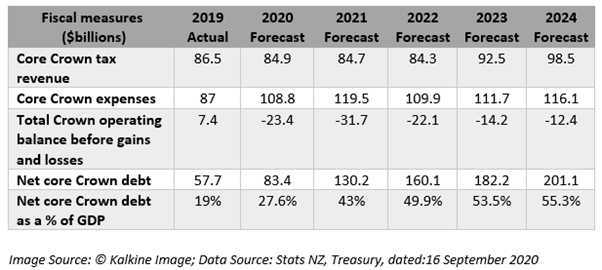
- Core crown expenses rose significantly in 2020 and could reach $119.5 billion next year, since the Government launched many schemes to soften the blow of COVID-19.
- The net core Crown debt is projected to peak at 55.3% of the GDP in 2024, marginally higher than the forecast at the budget.
- NZ dollar could face headwinds ahead of RBNZ policy decision due on 11 November and swings in investor confidence.
New Zealand is currently facing the worst recession, it has ever seen in the last few decades after the country imposed strict measures to control the spread of coronavirus. On 18 September, Stats NZ disclosed that NZ economy shrank by 12.2% in the June quarter of 2020, a record fall since 1987 when the current system of measurements began.
At the beginning of the June quarter in April, NZ was already placed under Alert Level 4 until it fell to Level 3 on 27 April. Since then, the country continued to ease the alert levels to a point where it reported 0 cases on 8 June.
The country gained international accolades for its proactive elimination strategy to fight the virus. However, the country was hit by another community transmission in its biggest city, Auckland by 11 August, which again pushed it into high alert levels.
As per Stats NZ, industries like retail, accommodation, restaurants, and transport witnessed substantial fall in production for the June quarter, as they were the most affected ones by the international travel ban and strict lockdown in the country.
INTERESTING READ: Has lockdown been a turning point for the Retail Sector?
Ministry of Health, NZ has recorded 1,848 cases with 25 deaths and 1,770 recoveries, as on 1 October, 9:00 am.
COVID-19 effect on government debt
NZ economy has managed to emerge from COVID-19 crisis in healthier shape than anticipated. However, it is still staring at long road to recovery as coronavirus effects are likely to be more continuous and take a more significant toll, worldwide.
The Treasury, in its Pre-Election Economic and Fiscal Update, in mid-September revealed that the Government incurred an OBEGAL (operating balance before gains and losses) deficit of $23.4 billion for the financial year ended in June.
Net core Crown debt of $83.4 billion for 2019-20, rose by $25.7 billion from $57.7 billion in 2018-19, due to a rise in cash shortfall, which witnessed an increase of $23 billion, rising to $23.7 billion from the earlier $0.7 billion. The debt is estimated to grow to 55.3% by 2024 from 27.6% in 2020.
ALSO READ: How did the economy get affected by the pandemic?
Core Crown expenses rose substantially to $108.8 billion in nominal terms, in the year of 2020, as Government unveiled several schemes to mitigate the coronavirus blow. The costs are likely to rise to $119.5 billion in 2021 and stay at elevated levels for few years before falling, as per Treasury.
Caralee McLeish, New Zealand’s Treasury Secretary, stated that the effect of lockdown has been less acute than originally expected due to early raising of alert level restrictions in the quarter ending June 2020. The moderately shorter lockdown and a solid recovery in activity have supported Government finances with the tax take relatively lower compared to a year ago.
The update also predicted the economy of New Zealand falling into slump during the quarter ended in June. Treasury also forecasted that the unemployment rate would peak to 7.7% in 2021, as a result of border restrictions that weighs upon activity and ending of fiscal support.
ALSO READ: Unemployment, Financial and Economic Crunch: 3 Things that Kiwi landers May Consider to Sail Though
However, the unemployment rates are likely to gradually drop over the next 4 years, falling to 5.3% in 2024.
Treasury has predicted that border restrictions will be relaxed after 2022, with all international travel permitted from thereon. However, NZ Finance Minister, Grant Robertson stated that the year 2022 is the presumption shared by NZ Treasury and the Government was intending to start opening the borders as promptly as it is enabled to do so.
Hence, the net core Crown debt is projected to peak at 55.3% of GDP in 2024 or $201.1 billion in nominal terms, marginally higher than predicted. The OBEGAL deficit is forecasted to peak at $31.7 billion in 2021, before reducing to $12.4 billion in 2024.
The unaudited report derived through financial measures for the current year is as follows:
The Treasury has projected a marginal reduction in the magnitude of the Government's COVID-19 response, reducing from $62.1 billion to $58.1 billion, as the acceptance of the likes of wage subsidy, Small Business Cashflow Loan Scheme and the Business Finance Guarantee Scheme were much smaller than anticipated. Though, the $14.1 billion out of the $58.1 billion is yet to be allocated.
Mr Robertson stated that he would spend that money only if there is an absolute need for it. He laid stress on the need for taking a cautious approach in managing the books.
NZ Dollar could face headwinds ahead
NZD edged higher against USD on 30 September, reaching a week-high of 66.13 US cents. Nonetheless, US dollar began to gain strength amid risk-averse sentiment and forced the pair to reverse the course.
On 30 September 2020, NZD/USD was trading at 65.97 US cents at the time of writing, up by 0.17%. The currency dropped below the level of 66 US cents ahead of Q2 GDP data for the US.
On 1 October, NZD/USD was trading at USD 0.6653, during the time of writing the report, up by 64%.
GOOD READ: With interest rate at an all-time low, how are Businesses managing their debt funding?
Generally, higher government debt levels can have implications for the potency of the currency. A massive debt prompts more inflation, and if inflation rises, the debt will have to be paid off with cheaper dollars in future. Further, the debt rating of the country can also influence the NZD.
However, NZ has a strong credit rating as the Auckland Council's credit rating has been kept unchanged at AA stable by S&P Ratings.
Changes in investor confidence may influence NZD/USD as major central banks rely on unconventional tools to support the economy. Kiwi dollar may also have to cope with headwinds prior to the policy rate decision, set to be disclosed on 11 November, as RBNZ plans to reveal a range of new tools and drive monetary policy into uncharted waters.
(NOTE: Currency is reported in New Zealand Dollar unless stated otherwise)
