
 AUS
AUS
 NZ
NZ
 UK
UK
 CA
CA
 USA
USA
 IND
IND







Summary
- Retailer experiences during coronavirus restrictions have continued to alter significantly with Auckland at Alert level 2 and the rest of NZ at Alert Level 1.
- Retail Card spending fell $530 million in August 2020 as Auckland entered Alert level 3, with the hospitality sector spending experiencing the biggest drop of 18%.
- Retailers might witness a cashflow crunch in coming months as they try to stock up their stores for Christmas.
- The major problem faced by retailers at present and in the months ahead is of the international shipping ports as fewer ships are loaded up, presently, but more time is being taken for products to pass through the foreign ports.
In the recent times, coronavirus has been the biggest challenge faced by businesses around the world, along with the retailers. Supermarket sales have been up (both in-stores and online) when the country was at Alert Level 4 as buyers stocked up on goods.
However, retailers with limited online stock or with dependency on international visitors are facing a mixed retail environment.
ALSO READ: Online Boom – Kiwi businesses that have benefitted
New Zealand had got rid of the virus in early June by imposing strict lockdown measures in late March and April. However, the country reported its first locally transmitted coronavirus outbreak after more than 3 months on 11 August in a community in Auckland. This led NZ’s PM Jacinda Ardern to put strict lockdown measures in the biggest city of NZ, Auckland.
Did You Miss Reading; Deja Vu -Shortage of Essentials as Customers Rush to Stock Up
However, the restrictions are easing now, and the number of infection cases have been reducing since then.
As per the Ministry of Health, New Zealand detected only one coronavirus case, as on 30 September, but Kiwis have been cautioned to not take the virus leniently as travel increases across the country during school holidays.
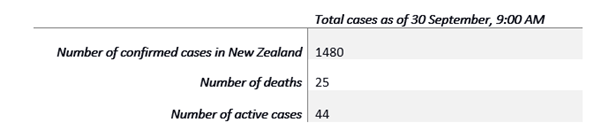
Data Source: Ministry of Health, NZ
At present, Auckland has been placed under (Alert) Level 2 while the remaining portion of NZ is placed under (Alert) Level 1.
Card spending and retail confidence fell in August
The resurgence of virus in Auckland led to a drop in retail card spending for August.
As per Stats NZ, retail card expenditure for August dropped by $530 million relative to July as Auckland went into Alert level 3. Retail spending using electronic cards fell by 0.8% compared to pcp to $5.4 billion in August 2020, in actual terms.
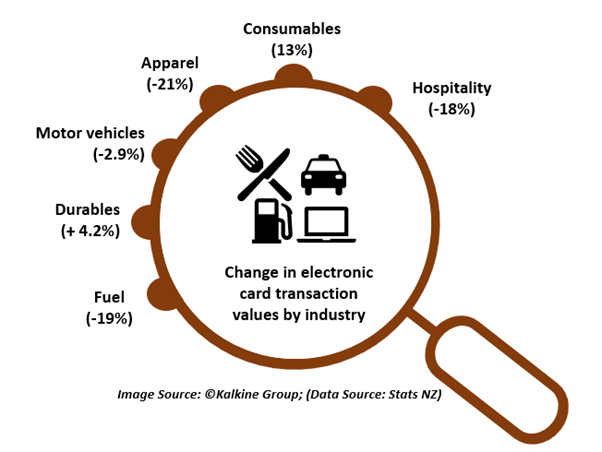
Kathy Hicks, Retail Statistics Manager, stated that the drop in retail spending was not alarming amid a high level of restrictions imposed to lower down the impact of the second wave of coronavirus.
She also added that Auckland was the sole region to be under Alert level 3, which resulted in lowering the card spending at the national level since 33% of the population that resides in the city could spend on only limited services.
ALSO READ: Retail Card Spending Picks-Up After Lockdown | NZ Market Update
Hospitality sector was the hardest hit with spending on eating out, hotels, motels and other accommodation experiencing the most significant drop in August 2020, down by 18% from the previous year.
Further, the retail confidence also took a beating in August. The August survey by Retail NZ showed that 90% of the retailers with stores in Auckland registered a decline in revenue. The shutdown imposed on the megacity Auckland had impacted businesses across NZ, with sales dropping by 53% in stores located outside Auckland.
DO READ: Retail Confidence Crashes in August amid Level 3 restrictions
Retail spending to rise in September
Retail foot traffic has been gradually improving, as restrictions are easing in the country. Head of Retail NZ, Mr Greg Harford stated that he had witnessed a massive rise in terms of individuals utilising the COVID-19 (tracer) application since Auckland moved to alert level 2.5. He noted that this had helped consumers in gaining confidence about moving out of their houses.
Satish Ranchhod, Westpac Senior Economist, expects that spending levels will rise in September. He stated that weekly indicators of retail spending have recovered and are now back at the level witnessed at the start of August, due to easing restrictions in Auckland.
ALSO READ: Shopping trends in a Post-Pandemic Environment: Any takers on NZX
However, the recent lockdown has put many retailers with bigger cracks in their earnings in 2020, especially in the hospitality sector. Persistent Alert level 2 restrictions have resulted in spending changes by households.
Kiwis are paying less on outings and leisure front as compared to food and essential goods. The expenditure effect is evident in the service industry, which is by now witnessing a huge number of employment cuts.
Shops are facing a supply crisis
A cash flow crisis is on the horizon for retailers who are trying to stock up their shelves for Christmas. The value of imports dropped 16% in August, compared to the previous year.
The movement in imports has been ruined in many areas recently, indicating empty shop shelves and prolonged delays for customers, particularly those looking for whiteware and electronics.
Mr Harford stated that the time taken to get freight into NZ had been delayed by several weeks, which implied stores had to buy the goods sooner to ensure a smooth flow of the stock.
He asserted that the major issue was with international shipping ports as fewer ships were being loaded, while longer time was being taken for products to get through foreign ports.
As a consequence, the retailers are dealing with a problem like placing their orders in advance, which is mostly difficult as retailers have to pay a fraction or all the costs of those items at the time of placing an order.
(NOTE: Currency is reported in New Zealand Dollar unless stated otherwise)
