
 AUS
AUS
 NZ
NZ
 UK
UK
 CA
CA
 USA
USA
 IND
IND








Summary
- Currency traders have reacted to the favourable outcomes with respect to the Australian economy.
- A global economic recovery, stronger domestic economy and greater chances of Australia keeping its AAA sovereign rating are adding tailwinds to AUD.
Australian Dollar has been on a scintillating run this year, specifically after March 2020. On 8 December 2020, the FX rate on AUD/USD contracts clocked around US74 cents, which was recorded in August 2018.

Image Source: Shutterstock
On Tuesday, the currency traders saw favourable news flows with respect to the Australian economy.
NAB Business Survey reported that business confidence and conditions were at an above-average level in the November 2020 survey.
ANZ-Roy Morgan Weekly Consumer Sentiment survey also inflicted optimism as Australians are gearing up for festive season with intentions to spend big.

Image Source: © Kalkine Group 2020
After the second lockdown in Victoria, the economic activity in the country is also rebounding as state borders are reopened and restrictions are eased.
The Australian Consumer is strong going into the festive season. The latest reading on the Westpac-Melbourne Institute Index of Consumer Sentiment underscores this belief.
On Wednesday, the index clocked 112 for December, which is an increase of 4.1% from November. It has reached at the highest level since October 2010, recording a 10-year high.

Image Source: © Kalkine Group 2020
Commodity prices, specifically iron ore, are also supporting the rise in Australia Dollar. China’s demand for iron ore is also increasing, which bods well for the Australian iron ore miners and the economy.
A stronger domestic economy and prospects of current account surplus means that Australia’s AAA rating on the sovereign credit is here to stay.
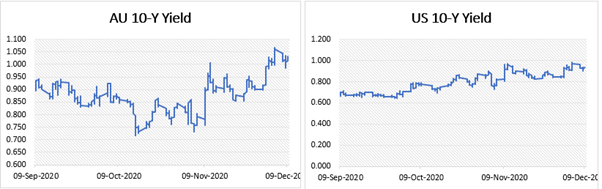
Source: Refintiv, Thomson Reuters
Australian sovereign credit is yielding the highest in its AAA category. This means that investors are finding relatively better yield on Australian Government bonds compared to other AAA peers.
As a result, the demand for Australian bonds from overseas investors aids the currency flows, therefore also leading to a higher Australian Dollar.
Australian 10-Year Government Bond presently yields above 1% while its counterpart in the US is yielding below 1%. Moreover, Australian bond is relatively attractive compared to the US bond.
Reserve Bank of Australia is tackling the very same problem of higher yields on Australian debt through quantitative easing.
At the same time, it is also being argued that the US Dollar is yet to reflect its true value. The upcoming regime change could pose many surprises to the market as President-elect Joe Biden takes office in January 2021.
