
 AUS
AUS
 NZ
NZ
 UK
UK
 CA
CA
 USA
USA
 IND
IND








Summary
- Australia employed around 90,000 people in November, driven by substantial gains in Victoria.
- Labour force participation rate also increased to a historic high of 66.1%.
- Currency traders are buoyed by the ongoing strength in the Aussie economy.
Australian Dollar is on an upside run against the US Dollar today. Currency traders are speculating relatively better economic conditions compared to the United States.
Interest rate differentials on the sovereign yields of two countries are already inducing flows into the Australian Dollar denominated papers.
At the time of writing, the rate on AUD/USD pair was seen at 0.7582, meaning around US 0.76 cents for $1.
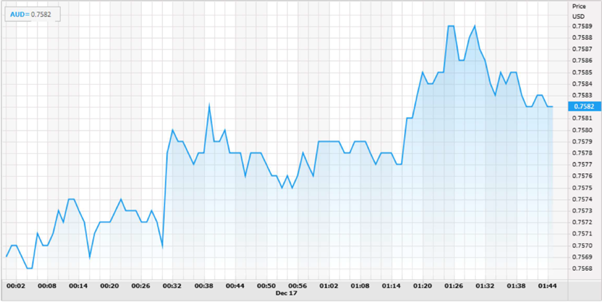
Source: Thomson Reuters Eikon
The latest strength in the Aussie currency can be attributed to the better than expected November job data.
On 17 December 2020, Australian Bureau of Statistics (ABS) reported job data for November 2020. On a seasonally adjusted basis, the Australian unemployment rate fell to 6.8% from 7% in October, showing an improvement of 0.2pts.
Despite an increase of 0.3pts in the participation rate to 66.1%, the unemployment rate was down compared to the previous month.
The latest improvement in the employment numbers underscores the continued recovery in the Australian economy.
90,000 Australians were employed in November, while monthly hours worked increased by 43 million to 1,752 million.
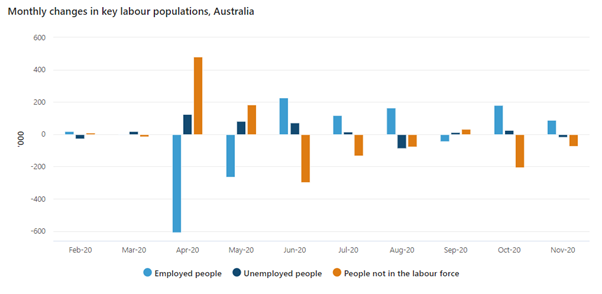
Source: ABS Media Release, 17 December 2020
Head of Labour Statistics Bjorn Jarvis said a robust recovery was witnessed in Victoria as 74,000 people were employed in November. Victoria is now closing the gap with the rest of the country.
At 66.1%, the participation rate has now returned to historic highs previously recorded in January 2020. Australian youths are also returning to the workforce with youth participation rate at 69.7%, which is the highest since March 2009.
Reserve Bank of Australia (RBA) is presently expecting the unemployment rate to increase on the back of rising participation and business restructure due to the pandemic.
According to RBA, unemployment would be around 6% by the end of 2022. A new set of economic forecast would be released in February 2021 by the RBA.
Given the ongoing strength in the economy, currency traders must be speculating less intensive quantitative easing by the bank, which would eventually push the yields on Australian paper to higher levels.
