
 AUS
AUS
 NZ
NZ
 UK
UK
 CA
CA
 USA
USA
 IND
IND







Summary
- Altering interest rates can have a significant impact on the capital market and on financial products.
- Interest rates and the prices of various fixed income securities are inversely proportional.
- COVID-19 pandemic has been very tough for the survival of some firms as cashflow dried up for many of them, increasing their need for capital.
- Governments have announced a wave of targeted measures and assistance programs to support businesses in sailing through the coronavirus headwind.
- Many companies have got aid from their local government’s emergency support programs, which delayed or eliminated their plans for taking a debt.
Businesses are facing the ravaging impact of COVID-19, regardless of how huge or successful they had been in the past. Most of the companies across the world have got hit by the coronavirus induced economic downturn and nationwide lockdown. They have been forced to look back at their operational plans, along with re-evaluation of their business strategies.
Start-ups and small businesses have been impacted more due to low revenues and an uncertain environment all around the world. Hence, several firms require capital for their survival. Also, debt financing is one of the options.
ALSO READ: Capital Raising Spree Gaining Ground in COVID-19 Storm; Know Why!
Debt financing refers to money borrowed at a fixed rate of interest and predetermined maturity date to run the business by selling debt instruments to individuals or institutional investors. Debt can occur in the form of a loan, sale of bonds, bills, or notes.
However, the economic environment plays a significant role in determining a business to be healthy or prosperous, no matter how well the business functions. Interest rate changes affect the desirability of every debt instrument ranging from bonds to loans.
The central bank of a country raises or lowers the interest rate to control inflation in an economy.
DO READ: Banks raise an alarm as RBNZ Governor prepares for Negative Interest Rate
If the interest rate is high, the cost of borrowing will go up showing that businesses would be unable to borrow money to fund their expansion plans and thus hampering their growth. If the interest rate is low, the cost of borrowing falls and permits businesses to get money for investment or funding due to swift inflow of cash in the economy, which may prove profitable for the company.
Debt instruments and dependency on interest rates
The prices of fixed income securities are controlled by interest rates prevalent in the market. Interest rates and the prices of fixed income securities are inversely proportional.
If the interest rates rise from the current level, prices fall while prices rise in the case of falling interest rates.
INTERESTING READ: NZX Turns Saviour in COVID-19 Crisis, Marks a Phenomenal Half-Year of Capital Raisings
Bonds are the most common form of debt instruments issued by corporates, government, and municipal bodies to generate funds. When investors buy a bond, they get a fixed repayment and interest payments on their investment at a predetermined rate and schedule. The annual interest rate paid on the money borrowed is known as the coupon rate.
Changes in interest rates set by the central bank impact the bond interest rates. When there is a rise in interest rates, the value of bonds issued previously with lower coupon rates falls while when interest rates go down, the value of previously issued bonds having higher coupon rate rises.
Businesses in need of capital amid COVID-19
As coronavirus continues to spread across various countries, the adverse impact has left several businesses and economies reeling under its pressure. For certain firms, the pandemic has been tougher to deal with, as cashflow for many firms dried up. Funding has been crucial for several companies to stay alive.
ALSO READ: Business Confidence Still Negative, More Job Losses In The Pipeline
However, it remains highly important to distinguish the appropriateness of funding (equity vs debt) needed for the business, depending on the type of company and the kind of environment it is operating in.
This is because excess equity can be substandard for a company without destroying it, but excess debt can actually shoot down the company.
Businesses got significant backing from government support schemes
Many businesses have got assistance from government support programs which delayed or eliminated their plans for taking any debt.
New Zealand government announced various financial support schemes to cushion businesses against the impact of COVID-19 and is helping in rebuilding the economy.
Some of the COVID-19 support schemes announced by the NZ government are as mentioned in the figure below.
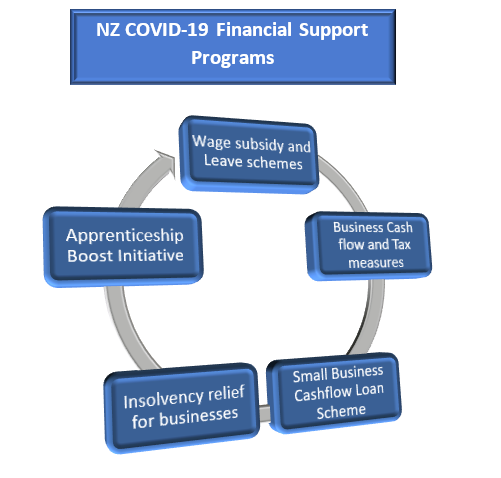
Kalkine image, Data source: covid-19.govt.nz
Governments have initiated quantitative easing programs all around the world to support the debt markets and have unleashed a wave of targeted assistance programs to help sustain employers through the crisis period.
ALSO READ: Plan of Action on Track to Restore Credit Scenario; 5 Cs of Loan Lending
Direct lending, Grants, credit guarantees, funding for lending programmes and many alterations in tax policy have been done to support businesses in investing so that they can restart their businesses while lowering their incremental capital requirements.
One example is Australia. Australia is providing SMEs with temporary cash flows based on their size and level of activity through JobKeeper and JobSeeker schemes, which have saved millions from falling into the poverty net.
TO KNOW MORE, DO READ: All you need to know about JobKeeper Payment scheme
The US government has announced support for SMEs in the form of grants, recovery fund, commercial paper funding facility, COVID Relief bill and loans.
DO READ: Government Opens Up Kickstart Scheme For Small Companies
New Zealand also announced wage subsidies for employers based on their revenue and efforts to retain employees. The country also announced COVID-19 Leave Support Scheme for employers who cannot pay their employees, and also support measures for specific sectors like construction and schools.
