
 AUS
AUS
 NZ
NZ
 UK
UK
 CA
CA
 USA
USA
 IND
IND




_07_03_2026_03_50_21_133108.jpg)

Summary
- Lloyds Bank’s business barometer rose from -22 to -14 per cent in August 2020
- South east of Britain was the only region across the nation showing a positive value of the barometer for the survey period
- Firms surveyed are expected to lay-off staff once the furlough scheme expires
- Retail sales were 27 per cent less as compared to the pre-pandemic levels for the month of August 2020 – CBI survey
- Regional income inequalities to rise as a result of job losses – Labour party
The business barometer index by the Lloyds Bank, that measures the economic optimism and business prospects across the UK, displayed an improvement of 8 points but continued to remain in the negative territory (-14) per cent for the period of 3 to 17 August 2020. This figure is much below the long-term historic average for the barometer, quoted the bank.
The survey recorded that the business trading prospects rose by 9 points, to reach a value of (-14) per cent for the survey period, which was the largest reported monthly rise since the past three years.
In terms of the regional break-up, all the regions were showing negative value for the business barometer, except South East, where the business confidence shot up to a positive value of 1 per cent for the period. Its corresponding value in the month of July 2020 was (-31) per cent.
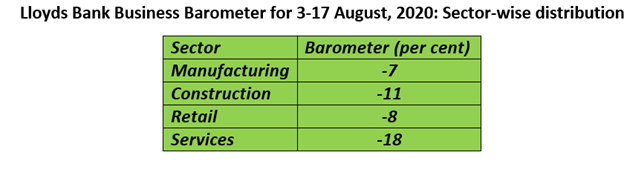
62 per cent of the total firms surveyed by the bank reported that the demand for their products/services has been negatively impacted as a result of the coronavirus pandemic.
The findings also revealed that only 18 per cent of firms using the furlough scheme are expected to retain their entire staff once the scheme expires by the end of October 2020. This implies that more job cuts are in the pipeline.
Retail employment also expected to shrink
In a separate survey released by the CBI (Confederation of British Industry), it was revealed that the retail firms across Britain laid off employees during the period of June to August 2020. The survey was titled ‘Distributive Trades Survey’ and was released on 25 August 2020. It was conducted on 128 firms which found out that retail sales were 27 per cent less as compared to the pre-pandemic levels for the month of August 2020.
Respondents also informed that they had no plans to make any business investments in the near future, given the surrounding uncertainties prevailing in the economy’s revival.
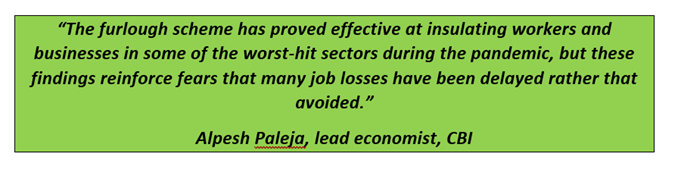
Alpesh Paleja, lead economist, CBI said that in case the consumer demand continues to be low, prolonged government support might be required to avoid further business and job losses. Probably, if the existing business relief rates are continued, it would help the British retail sector, explained Paleja.
Jobs in the British retail sector shrunk by (-45) per cent in August 2020 as compared to the previous month of July 2020, according to the CBI survey findings. It was recorded as the steepest monthly fall since February 2009. An even sharper fall is expected in job losses during the next few weeks across the country’s retail sector, added the survey findings.
Another reason for falling employment in the retail sector is a shift in consumer preferences towards buying through online platforms. Sales via web platforms have rise by almost 50 per cent from February to July 2020, according to the latest UK government statistics.
Rich-poor divide to rise with uneven distribution of job losses
The Labour party has requested the government to come up with a plan to save jobs. It has pointed out that apart from playing a havoc on the social and economic fabric of the British community, ending the furlough scheme will raise the rich-poor divide across the nation, which is undesirable.
A recent study conducted by the Labour party mentioned that around 10 per cent of the total workforce in north-west England is employed across the retail sector, while 13 per cent of the employed people in the east Midlands area currently work for the manufacturing sector. Therefore, any important redundancy decisions by these sectors will impact the fortunes of a sizeable proportion of the affected region’s population. So, such decisions should be carefully deliberated.
As a stark variation to the east Midlands region, only 2.2 per cent people of the total city workforce are employed by the manufacturing sector in London.
Recent job loss announcements
BMW – On 26 August 2020, BMW announced that it will lay off 400 employees at its mini car factory in Oxford, since the consumer demand has been severely hit as a result of the pandemic. The plant will be going in for two instead of three shifts beginning 15 October 2020. The lay-off decisions shall be conveyed to the respective employees by middle of September, according to company sources.
Pret a Manger- The sandwich seller chain is slashing 2900 jobs across the UK since the food outlets have seen plummeting sales, as a result of the coronavirus pandemic. Sales in August 2020 have dropped by 60 per cent as compared to the same period a year back in 2019.
Gatwick Airport- The airport is planning to slash close to 600 jobs as the total number of passengers to the airport have dropped by 80 per cent. This number is around 25 per cent of the airport’s total staff strength. Almost two-thirds of the airport’s total workforce was put on the government’s furlough scheme. The airport’s trade union is still trying to negotiate with the management to minimise the total number of redundancies, as much as possible.
To sum up, even though the Lloyds Bank’s business barometer rose for August 2020 as compared to the previous month of July, but the worrying part is that it is still negative. Consumer demand continues to be much lower than desired levels, and companies across sectors are being forced to close outlets, reduce operations, and lay off staff. Labour party has urged the government to reconsider its decision of not extending the furlough scheme, which could bring devastating consequences for the British society at large. Apart from cutting-off the regular income stream of the affected people, redundancies across the most impacted sectors could also increase the income-inequality across the UK.
