
 AUS
AUS
 NZ
NZ
 UK
UK
 CA
CA
 USA
USA
 IND
IND








Summary
- Initially the kickstart scheme came handier for larger sized businesses, because it came with the rider that only businesses making 30 or more placements would be able to directly apply under it.
- Later, government clarified that intermediaries are being allowed so that smaller businesses can easily apply together to access the scheme.
- 500 plus trade and institutional organisations have agreed to act as intermediaries.
- First placements under the kickstart scheme are expected to be available by November 2020.
- The kickstart scheme provides a six-month job placement to youngsters in the age bracket of 16-24 years by financing their employers.
- Youngsters witnessed the largest fall in employment for the three months to July 2020 period as compared to other age groups.
The UK government was facing criticism over the fact that its kickstart scheme worth two billion pounds would be effectively excluding small-sized companies. To remove this anomaly, the government has now expanded the scheme to intermediaries who are allowed to act on behalf of smaller firms.
The scheme funds businesses to generate jobs for youngsters in the age bracket of 16 to 24 years of age. This age group had been seen to be particularly vulnerable to job losses during the pandemic period and this support will go a long way in providing income-generation opportunities for them.
In fact, the latest ONS (Office for National Statistics) data revealed that young people witnessed the largest fall in employment for the May to July 2020 quarter as compared to other age groups. To be specific, there were 0.16 million lesser youngsters (16-24 years age bracket) in jobs in the three months to July 2020 as compared to the earlier quarter, according to government estimates.
Rishi Sunak, Chancellor, UK Treasury aims to use the kickstart scheme for providing jobs for as many as 0.25 million youngsters who are currently surviving on the universal credit.
SMEs’ access was difficult initially
The scheme was announced during July 2020 and was officially launched on 2 September 2020. The Sunak’s July announcement of the kickstart scheme had categorically mentioned that all the employers, big or small, were urged to hire as many kick-starters as possible, which implied that there was no cap on the number of placements.
However, the scheme details that came out on 2nd September mentioned that only businesses making 30 or more placements would be able to directly apply to the government under the scheme. Others should partner together to make up for the minimum required number before applying to the government. This left the British SMEs (small and medium enterprises) heartbroken.
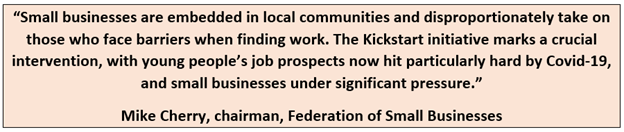
Nevertheless, on 20 September 2020, the Federation of Small Businesses (FSB) clarified that it had discussed with the government and resolved the issue so that smaller businesses can also avail the benefits of the scheme. As a solution, government suggested that the FSB could act as an intermediary to facilitate those SMEs who wish to make fewer than 30 placement and avail a grant under the scheme.
First placements in November
In fact, Therese Coffey, work and pensions secretary told later that 500 plus organisations including industry associations and local authorities had agreed to act as an intermediary under the kickstart scheme.
Employers had begun to apply for the scheme from its first day itself, which talks of a successful start. First placements under the kickstart scheme are expected to be available by November 2020.
Government would be providing funds for 25 hours per week equal to the minimum wages for people hired under the scheme. Contributions towards enrolment and national insurance would also be given from the government’s side.
Later, extra funds would be provided for these young kick-starters so that they can move up the sustained employment chain.
The kickstart scheme
The UK government’s kickstart scheme is aimed at providing a job placement for young people (age bracket: 16-24 years) by financing their employers. The eligibility conditions are that these youngsters should be living on universal credit and be at a risk of a long-term unemployment.
Once these people complete their 6 months of employment under the scheme, extra finance would be provided to help them take up a sustainable job for the longer-term.
Government clarification
Therese Coffey clarified that the scheme was indeed designed for all types of employers, big or small. Coffey was delighted that FSB had agreed to become a country-wide gateway for small businesses and support them access the kickstart scheme in an un-interrupted manner.
The government is encouraged with the overwhelming response of hundreds of businesses trying to help build the nation back and provide gainful employment to the young Britons, she added.
The Federation of Small Businesses represents the interest of 165000 small businesses across the UK.
The government wants more and more businesses to join the scheme going forward, according to Coffey. She told that the growing list of gateways will help smaller businesses in finding the much-needed support to avail the kickstart scheme.
To sum up, the kickstart scheme began from 2 September 2020 across Britain to provide a six-month job placement to youngsters in the age bracket of 16-24 years by financing their employers. It came with a rider that a minimum of 30 placements are to be promised by the employer if he has to directly apply to the government for the scheme. This disappointed the smaller sized businesses as they had to collaborate together in groups to come up with the minimum number. Later, FSB came to the rescue and offered itself to become an intermediary who was allowed by the government to directly apply for the scheme. Later, more such trade organisations and institutions also signed up as an intermediary. Finally, it remains to be seen if the scheme is able to generate employment opportunities for youngsters who are particularly impacted by the coronavirus led pandemic.
