
 AUS
AUS
 NZ
NZ
 UK
UK
 CA
CA
 USA
USA
 IND
IND






Summary
- Australian GDP fell 7 per cent in the June 2020 quarter, the largest quarterly fall on record, according to latest ABS results.
- The combined effects of the global coronavirus pandemic and associated containment policies are the key drivers of the latest GDP fall.
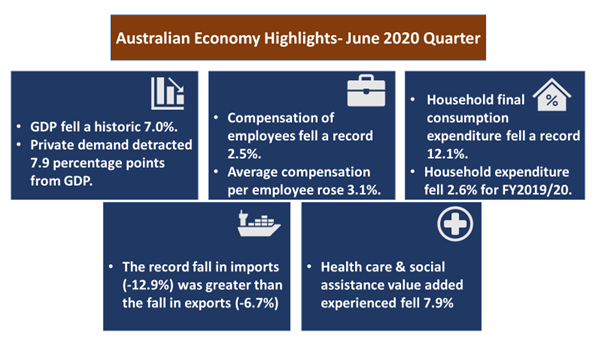
- Household consumption collapsed, gross fixed capital formation shrank, inventories fell, exports declined, and imports fell faster. Meanwhile, the government spending grew.
- Currently, Australia's second most-populous state of Victoria remains in lockdown while international borders remain shut.
- Governor Philip Lowe recently acknowledged that the Australian economy is going through a tough period.
- As difficult as this is, the downturn is not as severe as earlier expected and a recovery is now under way in most of Australia, opines Philip Lowe.
Australia suffered its worst economic downturn on record last quarter. Latest figures on National Income, Expenditure and Product were released by the ABS on 2 September 2020. The Bureau reports that Australia’s GDP fell 7.0 per cent in the June 2020 quarter, the largest quarterly fall by a wide margin since records began in 1959. GDP dropped by 6.3 per cent relative to last year.
MUST READ: RBA retains cash rate at 0.25% yet again; Majority of ASX indices ended in red
June Quarter Economic Charter
The COVID-19 pandemic and corresponding movement restrictions continued to impact the nation’s economic activity. The June 2020 quarter release records the first annual estimate of GDP for 2019/20, which fell 0.2 per cent. The report ends Australia's longest streak of continuous growth of 28 years.
In the first quarter of 2020 (March Quarter), real GDP contracted by 0.3 per cent from the previous quarter. Back then, high-frequency indicators pointed to a steeper contraction in the second quarter, followed by an incipient recovery in the third quarter.
Head of National Accounts at the Bureau, Michael Smedes opines that the global pandemic and associated containment policies led to the GDP fall for the June 2020 quarter. He further emphasised that the quarter saw a significant contraction in household spending on services, as households altered their behaviour. Besides, restrictions mandated to contain the spread of the coronavirus may have further propelled this behaviour.
Other excerpts from the ABS release are underscored below-
- Net Trade added 1.0 percentage points to total GDP.
- Imports of goods tumbled 2.4 per cent.
- Imports of services dropped 50.5 per cent, while exports of services dropped 18.4 per cent.
- Public demand added 0.6 percentage points to total GDP.
- Household saving to income ratio climbed to 19.8 per cent.
- Hours worked fell 9.8 per cent. This outperformed the record 2.5 per cent decline in wages which were supported by JobKeeper
- Social assistance benefits in cash rose a record 41.6 per cent.
- General government net saving fell to -$82.6 billion.
- A record-high subsidy payment of $55.5 billion and reduced tax income was received.
Is Australia Moving Towards Recession?
The unprecedented fall of 7 per cent sure seems to be a major setback for the Australian economy, that continues to be engulfed with second wave fears of COVID-19. Fresh virus outbreaks have been threatening to tip over the already bumpy road to recovery. Besides, they exert mounting pressure on the Government to keep fiscal options open.
Few economists suggest that the path back from the COVID-19 recession will be protracted. It is likely that growth in the September quarter will be weighed down by the lockdown in Victoria that has continued amid rising virus cases.
Subsequently, continued health concerns, ongoing restrictions and the reduction of income support may collectively weigh on the economy.
GOOD READ: Victoria’s second wave of COVID-19 is pulling down jobs and consumer spending
Where is the Silver Lining?
Globally, an uneven economic recovery remains under way post an extremely severe contraction in the first half of 2020. Undoubtedly, containment of the virus remains key to this path.
In his latest statement made towards the monetary policy decision, Reserve Bank of Australia (RBA) governor stated that Australia is going through a very difficult period, experiencing the biggest contraction since the 1930s. However, the downturn is not as severe as earlier expected. He even believes that a recovery is under way, in most parts of the country.
On the positive side, employment increased in June and July even when unemployment and underemployment remained high. Besides, the economy is being supported by the substantial, coordinated, and unprecedented policy easing over the past six months. Public sector balance sheets seem to be in good shape, Mr Lowe stated.
Additional support for economic recovery is being provided by financial institutions, which have strong balance sheets and access to high levels of liquidity.
The RBA has kept cash rate and the yield on 3-year Australian Government bonds at 25 basis points. It has also opted to increase the size of the Term Funding Facility and make the facility available for longer.
GOOD WATCH: Federal Bank Provides Monetary Policy Review | ASX Market Update
Way Forward
The Central Bank forecasts that the unemployment rate may rise to ~ 10 per cent later in 2020 before declining gradually to ~ 7 per cent in two years' time. Wage and prices pressures remain subdued and would remain so for some time. Inflation is projected to average between 1 and 1½ per cent over the next couple of years.
