
 AUS
AUS
 NZ
NZ
 UK
UK
 CA
CA
 USA
USA
 IND
IND








Highlights
- Decentralised applications, popularly known as DApps, are innovative open-source, P2P network, allowing developers to create online tools, which are of the interest to businesses.
- These new-age software ecosystems are both secure, transparent as well as resilient.
- Chainlink, NEO, XEM, Brave, etc., are some of the most popular DApp platforms.
With the advent of technology, many new business automation software have been developed. One such invention is dApp, which harnesses the power of thousands of computers globally.
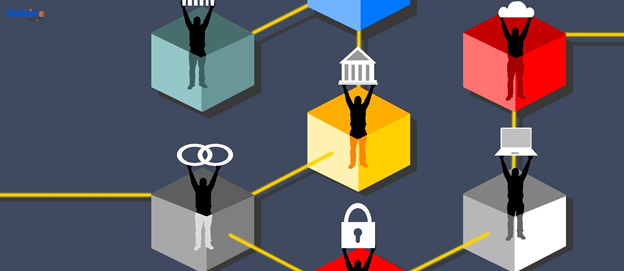
Decentralised applications, commonly referred to as DApps are digital programs and applications that run on blockchain or on a peer-to-peer network.
Instead of making use of a single computer, these applications run on a distributed network.
They are not hosted on a centralised server, instead are run in a public, open-source, decentralised environment and hence are outside the control and interference of a single authority.
Related Read: What are the top 10 advantages of blockchain technology for businesses?
Source: Copyright © 2021 Kalkine Media
Who popularised DApps?
The concept of a decentralised application has been popularised by DLT, i.e., distributed ledger technologies. The first one to use this was Ethereum blockchain, where DApps are generally known as smart contracts.
Which are popular DApps for blockchain?
Currently, there are about 4,000 DApps running across the globe, which range from gaming to gambling, to health, insurance, and many others.
There are many popular DApps, which boast having millions of active users and are innovative and feature-rich.
Some of them are NEO, XEM, Chainlink, Brave, MakerDAO, EOS Dynasty, Circulor, Chainyard, KYC-Chain, Cipher, and heaps more.
Interesting Read: Why to get acquainted with 10 blockchain platforms in 2021?
What are the advantages of DApps?
These decentralised applications are equipped with numerous advantages. Some of them are:
- DApps are usually designed to connect various organisations or trading businesses. Because of their decentralised structure, they allow each user to run the app without depending on the other party, thereby giving more control to the users.
- Being open-source, these dApps are transparent and can be viewed by anyone who wants to verify developers' claim on what the app is meant for.
- Being more robust and flexible than a centralised application, DApps ensure minimum interruption and less downtime, thus ensuring business resilience.
- Since these apps are not hosted on a specific IP address, external authorities may find it difficult to block a DApp.
- It must be noted that once any information is fed into a blockchain, it is stored forever, hence data is never lost on DApps.
- Offering high transaction speed, these DApps greatly help in reducing costs on blockchain.
Are DApps safe to use?
As mentioned earlier, since these decentralised applications are not restricted to a single system, instead are run on a distributed network, all the information is stored on a shared database, which is easily assessable across all other nodes.
Hence, any ransomware attack or the hijacking of a system or a single node has no effect on other systems or the stored information.
Related Read: Failed attack on Ethereum blockchain affects 0.8% nodes
Even if one node is active, data can be retrieved and is functional.
Also Read: Don’t get blocked out: Investing in blockchain technology
Bottom Line
DApps are the future of businesses, ensuring that it is both safe and resilient for its customers.
