
 AUS
AUS
 NZ
NZ
 UK
UK
 CA
CA
 USA
USA
 IND
IND


.jpg)





Summary
- The global pandemic has accelerated the rapid digitisation and globalisation to change the future of work.
- Amid COVID-19 pandemic, while many sectors took a big hit, IT sector performed well and generated job opportunities for Australian citizen.
- A Report published by AIIA stated that the sector experienced less turbulence due to COVID-19. While many companies from different sector announced salary cut, there was a growth in the wages of people from the technology sector.
- Around 85% of the technology companies did not reduce their headcount. The sector needs more skilled labours to flourish.
Amid the COVID-19 pandemic, where many sectors like hospitality and advertising are taking a huge hit, experts believe that the technology sector has been performing well and will continue to grow strong.
From many sectors, there were updates related to job losses due to the pandemic and the related economic decline. However, it was the technology sector which generated job opportunities for Australian citizens.
As per the recent report published by the Australian Information Industry Association (AIIA), there has been a growth in the wages in the technology sector. The sector experienced minimal or no turbulence from COVID-19. AIIA is Australia’s apex representative body and advocacy group for those in the digital environment.
According to AIIA Remuneration Report for the Information, Technology and Telecommunications Industries, the criticality of the technology sector was highlighted concerning the rebuilding of the economy. It was evident via improved nominal basic salary in the present economic situation.
The tech sector, even in the pandemic era, continues to showcase unmatched resilience. The report shows that 85% of the technology companies have not reduced their headcount. Further, the industry needs more technology and digital skillsets to flourish.
In a recent white paper shared by AIIA, there were a set of practical suggestions to state and federal government which were framed to guide policy development and focus areas in the current scenario and the following decade involving digital investment priorities, skills and jobs of the future.
DO READ: Technology Space in the face of COVID-19; Investment Tips for Tech Stocks
People with Tech Skills During COVID-19
As highlighted above, the tech sector has flourished during the pandemic and having talent in this field is still a premium. At a global level, technology jobs continue to surge, and there is a massive demand for skilled labours from this sector.
In this sector, instead of a salary cut, the existing employees have reduced working hours.
In Australia, there is a considerable demand for people with experience in Artificial Intelligence, Machine Learning and Data Science. Once Australia comes out of this economic turmoil, there would be a requirement for more skillsets plus the technology needs.
A Brief Idea About Salary Offered to Employees with Technical Expertise
In Australia, based on market estimates, a person working in the Information Technology sector earns approximately ~A$7,500 per month. The salary of an IT professional in the country ranges from A$3,900 to A$12,500.
In addition to the skillsets, the salary also depends on the number of years of experience. More the experience higher is the wage. On average, employees with 2 to 5 years of experience generally earn over 30% of what a fresher earns across all industries.
In Australia, salary also varies according to gender. It has been observed that men working in the IT industry earn more than what women make in the same field. The increments are impressive as well, considering the overall scenario, with employees getting a % hike in the late single digits every 15 months.
Australian Tech Sector Contribution to the Economy
As per the AIIA report, in Australia, there are nearly 723,300 people who are employed in the technology sector. The sector accounts for ~5.7% of the total Australian labour force. The industry comprises of people from tech-based occupations in other sectors.
Technology sector contributes A$122 billion and 6.6% of the Gross Domestic Product.
A Peek into the Labour Force Statistics of Australia
As per seasonally adjusted estimates for August 2020 published by the Australian Bureau of Statistics, there was a fall in the unemployment rate to 6.8%. The participation rate has increased to 64.8%. There is also a growth seen in the employment by 111,000 to 12,583,400.
There was considerable improvement in employment to population ratio at 60.3%. Underemployment rate stood at 11.2%. Monthly hours worked also improved by 1.6 million hours.
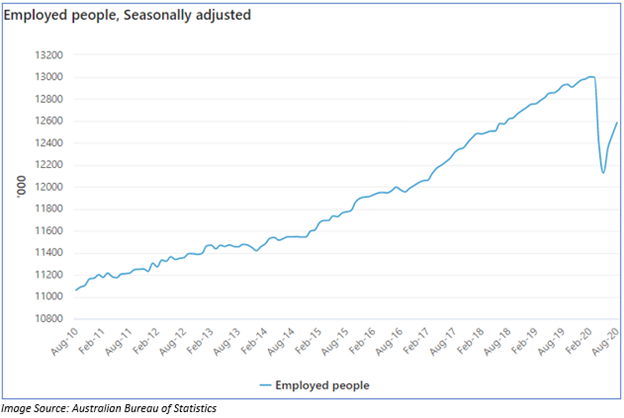
From the table above, we see that in Australia, there was a massive growth in the number of employed people from August 2010 till February 2020. Post that, there was a steep fall in the number of employed people. By May 2020, the number of employed people reached nearly 12.125 million. From June 2020, there was a rise in the number of employed people which continues to surge in the upward direction.
INTERESTING READ: Unemployment rate slips to 6.8% in August, Beacon of Hope on Economic Charter?
Full-Time and Part-Time Job during August 2020:
In seasonally terms, there was an increase in full-time employment by 36,200 to ~8.585 million people and part-time employment by 74,800 to nearly 4 million individuals. For the 12 months ended August 2020, full-time employment shrunk by 234,200 while part-time employment slipped by 104,100.
Duration of Working Hours:
In seasonally adjusted terms, the monthly working hours in all jobs improved by 1.6 million hours to 1,683 million hours, while decreased by over 5% in 12 months.
ALSO READ: All you need to know about JobKeeper Payment scheme
