
 AUS
AUS
 NZ
NZ
 UK
UK
 CA
CA
 USA
USA
 IND
IND




Highlights
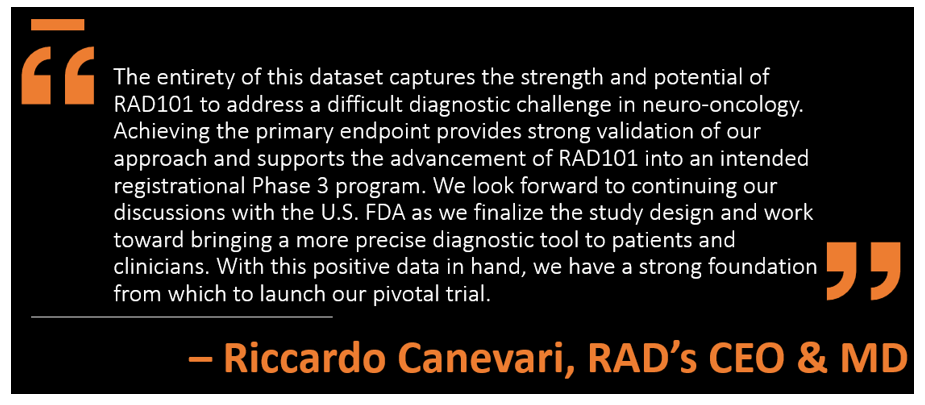
- Radiopharm's RAD101 met the primary endpoint in its Phase 2b trial, achieving 93% concordance between PET imaging and MRI across all evaluable lesions.
- Preliminary data showed RAD101 achieved 86% sensitivity in 14 evaluable patients, with specificity results expected in Q4 2026.
- The company plans to commence a global Phase 3 pivotal trial of RAD101 in the United States in Q4 2026, supported by its FDA Fast Track Designation.
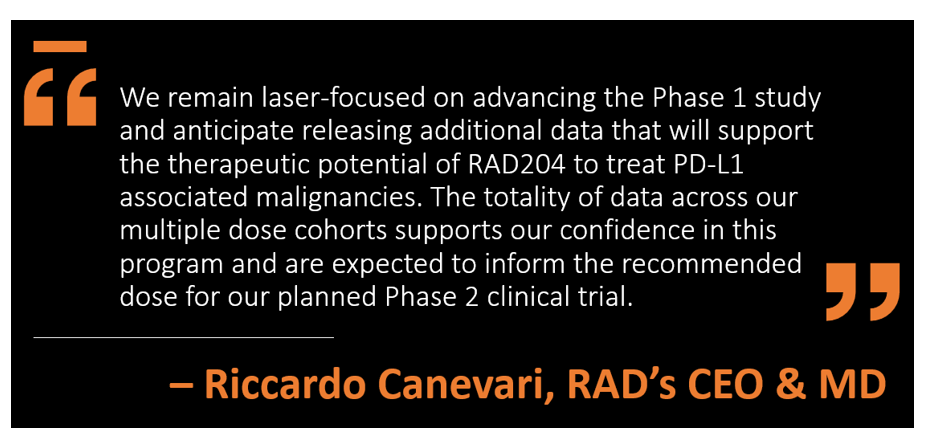
- RAD204 delivered a RECIST-confirmed partial response in a Phase 1 trial, with one patient remaining progression-free for more than seven months.
- RAD204 has reported no dose-limiting toxicities across all evaluated dose levels, supporting continued dose escalation in the ongoing Phase 1 study.
Radiopharm Theranostics Limited (ASX:RAD) has announced positive clinical updates across two of its oncology programs. The company reported that its RAD101 imaging agent met the primary endpoint in a Phase 2b trial for recurrent brain metastases, while RAD204 demonstrated a RECIST-confirmed partial response in an ongoing Phase 1 trialinvolving patients with advanced solid tumors following immunotherapy.
RAD101 Phase 2b Trial Meets Primary Endpoint
RAD101 demonstrated 93% concordance between PET imaging and MRI across all evaluable lesions in its Phase 2b clinical trial involving 30 patients with suspected recurrence of brain metastases following radiotherapy. The imaging results showed selective tumour uptake, and images confirmed metabolic activity in PET, compared to equivocal MRI findings.
The imaging agent, radiolabelled with Fluorine-18, targets fatty acid synthase (FASN), a protein associated with cerebral metastases originating from various solid tumours.
The clinical data will support the initiation of a global, multicentre Phase 3 imaging trial in the United States, which is scheduled to begin in Q4 2026.
Secondary Endpoint Data and Market Opportunity
Among 14 patients with available six-month follow-up and biopsy data, RAD101 recorded preliminary sensitivity of 86%. Specificity data is expected in the fourth quarter of 2026.
Radiopharm noted that more than 300,000 patients are diagnosed annually with cerebral metastases in the United States, while the market for imaging brain metastases is estimated at over USD 600 million, with no approved PET imaging product currently available for this indication.
The company also highlighted that RAD101 has received Fast Track Designation from the U.S. Food and Drug Administration (FDA) for differentiating recurrent disease and treatment-related effects in patients with brain metastases. Earlier this year, Radiopharm entered into a partnership with Siemens Healthineers to manufacture and distribute 18F-labelled RAD101 doses for the upcoming Phase 3 study.
RAD204 Delivers Early Clinical Response in Phase 1 Trial
Radiopharm also released updated results from the Phase 1 clinical trial of RAD204, its PD-L1-targeted lutetium-177 nanobody radiotherapeutic, being evaluated in patients with advanced solid tumours after progression following immunotherapy.
The company reported that the first patient in Cohort 3 (90 mCi) achieved a RECIST-confirmed partial response after the second treatment cycle.
Clinical observations showed:
- 19% reduction in target lesions after the first dose.
- 43% reduction following the second dose, meeting RECIST criteria for a partial response.
- 43% reduction maintained after the third treatment cycle.
- 35% reduction after the fourth cycle, while continuing to satisfy RECIST criteria.
The patient has remained progression-free for more than seven months during follow-up.
Meanwhile, the second patient remained on treatment and progression-free after demonstrating an early 7% reduction in target lesions following the initial treatment cycle.
Safety Profile Supports Ongoing Dose Escalation
RAD204 has demonstrated favourable tolerability and safety profile across all three dose levels evaluated to date.
The company reported no dose-limiting toxicities in any dosing cohort, while kidney radiation exposure remained within levels that do not prevent progression to the next planned dose level.
RAD shares traded at AUD 0.019 per share on 21 July 2026.
