
 AUS
AUS
 NZ
NZ
 UK
UK
 CA
CA
 USA
USA
 IND
IND







Summary
- Trade account surplus has fallen by a value of 1,998 million in August 2020 and currently stands at 2,643 million, Australia’s lowest recorded trade surplus level since October 2018.
- Imports increased by 2% while exports fell by 4% in August 2020.
- As the export-import window narrows, there are impending risks associated with unemployment increasing, foreign exchange reserves falling and availability of funding for home operations.
- If the exchange rate depreciates due to the revised monetary policy being adopted, Australian exports might gain pace by becoming cheaper.
The Australian Bureau of Statistics (ABS) recently published the Trade Accounts statistics for August 2020. The trade account surplus has fallen over the course of one month from 4,652 million in July 2020 to 2,643 million in August 2020. These statistics were a long way off from the expected surplus projection of over 5,000 million.
Trade Balance Trend
The national account balance on goods and services started showing a decline post March 2020, although it remained positive throughout.
A spike was observed in March 2020, when the surplus in trade accounts was recorded at 10,527 million, a record high since October 2018. Trade balance continued to deteriorate afterwards and gained momentum in June 2020 when it reached 7,551 million (in seasonally adjusted terms).
Australia has not recorded a trade deficit since 2018; however, the pandemic might change things for the country as numbers continue to fall.
Trade Scenario Under The Microscope
The spike in trade accounts was observed in March 2020, which coincides with the timeline when lockdown started in Australia. As the situation under lockdown progressed, the exports fell due to closed international borders. Imports have also decreased owing to the post-pandemic demand shock.
Australia reported major exports of iron ore and coal, which increased by 30% in March. Most of these exports were to China. Tourism industry took the fall. However, outbound travel also decreased, leaving behind a somewhat neutral scenario.
A sector-wise breakdown of exported goods shows that exports of rural goods increased by a substantial amount of 12%. The exports of non-monetary gold, which refers to the gold held as a physical asset rather than monetary, fell by 62%.
Narrowing Export-Import Window
The anomaly was recorded both in exports as well as imports. The exports fell short of expected projections whereas imports exceeded expectations. Exports decreased by 4% and imports increased by 2% in August 2020. The service sector is pulling down on national trade exports. The 2% increase in imports noted might be a consequence of the easing of lockdown restrictions and hence an improvement in demand.
Australia Exports vs Imports
Exports of services show a sharp decline post December 2019 and have not yet recovered. Exports of goods, on the other hand, maintained a stable path with intermittent recoveries post December 2019.
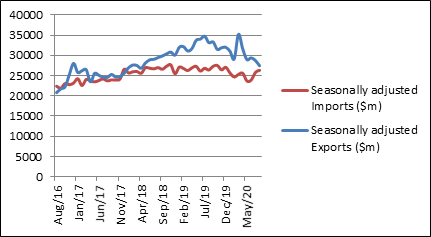
Image: © Kalkine Group, Source: ABS
The narrowing trade surplus is of concern, especially since the Australian economy is currently witnessing high unemployment rate of 6.8% coupled with a low-interest rate of 0.25%.
Is An Impending Trade Deficit On The Way?
Australia has not seen a deficit for about 5 years, but the current scenario might lead the economy towards one.
A trade surplus can be enjoyed while it lasts; it might also eventually get absorbed into the economy to maintain a balance. A country maintains a surplus only for it to get utilised at a time like this.
There is no doubt that economies worldwide are currently suffering because of the pandemic, and a blow to the trade balance is just one of the many repercussions of the same.
A sudden depletion of trade surplus might cause a disruption in funding for the home country. Most of the surplus is accounted for and has a place to fill in the home balance sheet. With a sudden full stop on net payments from abroad, the operations at home might get hampered. This could, in turn, result in job loss and could result in slowing down of the economy.
Another implication would be on the foreign exchange reserves. Trade partners provide foreign currency in exchange for the goods and services imported from the home country. As exports fall, these foreign exchange reserves are at risk of depletion.
The RBA has been maintaining an interest rate of 0.25%, which might lead to a depreciation of the domestic currency. This could mean that Australian exports could become cheaper as compared to the rest of the world. The move to reduce the interest rate to a modest 0.25% was taken in March. Any consequences of the same might take some time to be visible.
The Australian economy might see some improvements in the long run, however sluggish it may be. Given then Australia has mostly controlled community transmission besides a resurgence in Victoria, recovery can be expected in the months to come.
DON’T MISS: Federal Budget 2020-21
