
 AUS
AUS
 NZ
NZ
 UK
UK
 CA
CA
 USA
USA
 IND
IND


_02_06_2025_07_05_23_538703.jpg)

_07_03_2026_03_50_21_133108.jpg)

Highlights
- Dual-ion batteries, emerging as one of the promising technologies for sustainable energy storage, have low costs and lack toxic materials.
- DIBs have the potential for large-scale stationary storage of electricity.
- The research work is in the initial phase, and various combinations of electrodes and electrolytes are being used to increase the voltage output of the battery.
The world is undergoing a rapid transition to electric mobility and batteries will play an important role in facilitating the shift. The growing popularity of electric vehicles could be attributed to various factors including advancements in battery technology. Now, electric vehicles can cover more ground in a single charge and generate enough power for a smooth and quick run.
Research work is underway to develop more efficient battery technologies with different electrolyte and electrode combinations. On this front, one of the emerging and highly interesting research fields is dual-ion battery.
Related read: Novonix partners with Phillips 66 for lithium-ion battery tech development
Dual-ion battery – A high-voltage energy storage system
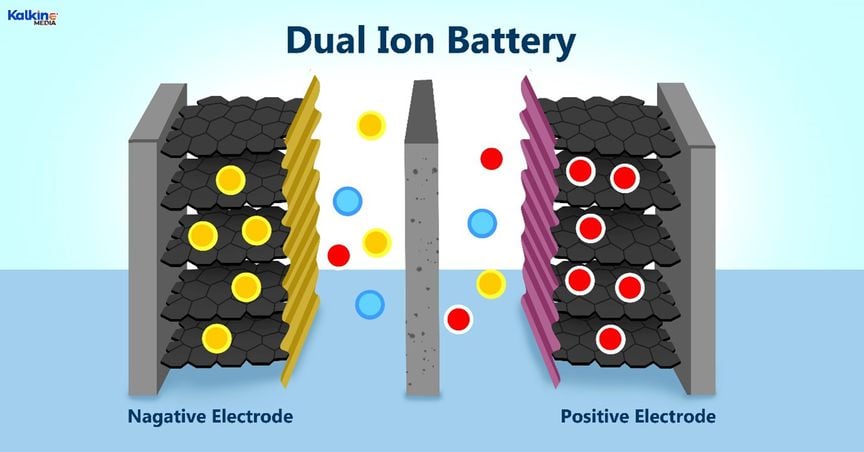
A dual-ion battery or DIB functions on a mechanism that has cations (positively charged ions) and anions (negatively charged ions) stored separately in the anode and cathode during the charging/discharging process. The cations and anions in dual-ion batteries are active and move in parallel from the electrolyte to anode and cathode, respectively.
DIBs hold the potential for large-scale stationary storage of electricity.
In general, a battery has three parts: a positive electrode called cathode, a negative electrode called anode and an electrolyte. The positive charged ions or cations (Li-ions in case of lithium batteries) from the cathode flow towards anode. When this action happens in a loop, electricity is generated due to the motion of the charge.
Related read: Tesla strikes battery-metal deal with Rio JV to ensure supply
This is the basic difference between normal/lithium-ion and dual ion batteries. In DIBs, both the charges move parallel to each other, towards their respective electrodes. As both the ions in the electrolyte are active, further optimisation of the battery is achieved.
DIBs operate on a combination of chemistries. In DIBs, graphite is used as both electrodes and different combinations of organic salts and lithium salts are used as electrolytes. Researchers around the world are experimenting with different combinations of electrolytes and electrodes to develop a battery free of lithium and other chemical elements.
What are dual ion batteries? How do they work?
DIB research work
The research on DIBs is still in its initial stage. The prime objective of the research work is to develop a stationary storage facility that is low in cost and does not involve metals like lithium, nickel, and cobalt.
Related read: Is nickel ready to be the next hot battery metal?
Lithium reserves are unevenly distributed, making it a scarce commodity to several nations. The extraction of cobalt and nickel has its own environmental issues. A battery with more naturally occurring material like graphite will be more cost-effective and sustainable.
Currently, performance-wise, DIBs have only one-third capacity compared to Li-ion batteries. Li-ion batteries possess one of the highest energy densities. This is why lithium batteries can provide significant energy, and still their sizes can remain smaller.
The mechanism used in DIBs makes them suitable for high-power applications using moderately high energy. This makes them suitable for grid energy storage applications. The size of the battery may not fit in mobile or other gadgets but could be put to use in a local utility system.
The International Union of Pure and Applied Chemistry (IUPAC) listed DIBs under its top ten emerging technologies in chemistry of 2020.
Related read: What's panning out in Australian battery recycling space?
Limitations of DIBs
- Practical applications of DIBs are hindered by limited capacity and cyclic stability.
- Large quantities of electrolyte solutions as reservoirs of all ions are required for complete charge and discharge of electrodes.
- DIBs currently perform at about a third of the capacity of Li-ion batteries.
Advantages of DIBs
- DIBs could make stationary storage batteries free from lithium, nickel, and cobalt.
- A battery using DIB technology is expected to be more economical and sustainable.
- They could be used to support grids for storing a large amount of energy and supply them at higher output.
