
 AUS
AUS
 NZ
NZ
 UK
UK
 CA
CA
 USA
USA
 IND
IND







Highlights
- Stocks indicate that the holder owns some part of that company.
- In the stock market, public listed companies exchange their shares.
- A startup company can raise capital from the public by issuing shares through an initial public offering (IPO).
Generally, investors purchase a company’s stock to get some returns on their investment or get a share of the company’s success. But before expecting some profit from a company or investing in stocks, they need to understand how stocks work. So, in this article, we will explore the same.
What is a stock?
A stock is an investment giving ownership of some part of the company to investors. A stock is known as a company's equity provided to investors for raising capital for the business. For example, if a company has two million outstanding shares and an investor owns 200,000 shares, then it means he will have 10 per cent ownership in that company.
Also read: How does a stock market work?
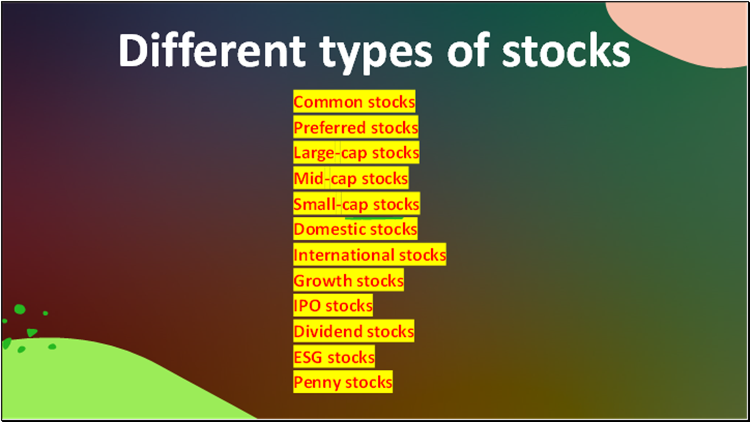
Image credit: © 2022 Kalkine Media®
Different types of stocks are following
- Common stocks
- Preferred stocks
- Large-cap stocks
- Mid-cap stocks
- Small-cap stocks
- Domestic stocks
- International stocks
- Growth stocks
- IPO stocks
- Dividend stocks
- ESG stocks
- Penny stocks
Also read: What are the different types of stocks in Canada?
Five key points to know of how stocks work
Raising money
A startup company can raise money by issuing stocks or taking loans. But raising money through debt financing (loans) can become a hurdle for a new company as it needs to pay interest on loans.
So, debt financing would be a burden for the startup company if it fails to generate revenue in the initial days. In comparison, equity financing for a startup is considered the most preferable way for generating capital as a startup can get money from its savings, family, and friends.
How do startups work?
When a startup company wants to expand its business, it requires a large amount of money. For this, the company can raise capital from the public by issuing shares through completing an initial public offering (IPO). After completing an IPO, when the company is registered on a stock exchange, then that company’s stocks can be purchased and sold. The raised money can be used for various purposes, including paying off debt, launching new products, and expanding business.
In the stock market, public listed companies exchange their shares, and the buying and selling of stocks generally happen between institutional investors, companies, and individual investors.
Two stock markets
The stock market works on two market systems, the primary market, and the secondary market. In the primary market, a company issues its stock for the first time to the public. After issuing its securities on the primary market, the company trades on the secondary market. The primary market is known as the new issue market and secondary market as the after issue market.
Benefits
A company gets liquidity in exchange for the shares. An exchange listing empowers the company to generate more funds by selling more shares.
As a stock investor, one can make money through capital gains and dividends. When you issue your stock at a higher price than the original purchased price, it is known as a capital gain. A dividend is a profit that the company provides to shareholders.
Stockbrokers
Stock exchanges provide a platform for buyers and sellers to trade their securities and to access the exchange market, an investor needs a stockbroker. So, investors generally buy stock through the help of brokers to whom they share details of what stocks they want to buy and sell. Then, the broker passes stock orders to exchanges and the investors get shares at the present market price through a market maker. After receiving the shares, it is delivered to the investors' account.
Also read: Stocks that can benefit from COVID restrictions easing in Canada
Bottom line
Before investing in the stock market, one needs to know what stocks are and how the stock market works. The above article provides the basics of how investing in stocks works.
