
 AUS
AUS
 NZ
NZ
 UK
UK
 CA
CA
 USA
USA
 IND
IND






In the era of sustainable development, focus has shifted from mere companiesâ financial growth to environmental, social and governance (ESG) responsibility by the institutional investors. Sustainable business, corporate responsibility and increasing social expectations are a crucial part of the business strategy of companies as well as to its allied stakeholder. Interestingly, the companies which follow ESG adherence is more operational efficient due to improved cost by lowering the risk associated with mining, processing, refining and transportation as well as by thriving better community with all amenities reduces the health risk and improves the economy.
The concept of Sustainable Development is not new, the first Enduring Value â Australian minerals industry framework for sustainable development was launched by International Council on Mining and Metals (ICMM) in 2003. The Enduring Value had 10 Principles for Sustainable Development which didnât involve any stakeholder towards the common goal of clean development. This issue was later resolved in 2015 by the launch Sustainable Development Goals, i.e. SDGs, adopted by all United Nations Member States. It has 17 goals, which is in line with Enduring Value, including involvement of stakeholder of whole value chains to end poverty, protect the planet and ensure that all people enjoy peace and prosperity by 2030.
The launch of the above framework is essential for Mining Industry to develop common goals and among all the players in the sector for the welfare of the community and to the company itself by improving its credit rating. Spotting higher rank in Risk Atlas is a testimony to the nature of work of the mining sector involving both Environment and Social Risk significantly: -
- Environment Concern: Mining activities increases GHG emission throughout its life cycle from construction to processing and closure. It can contaminate air, water and soil during its operations. Mining involves crushing and grinding stage and consumes around ~60% of total electricity polluting both directly and indirectly the air quality.
Similarly, leaching or electrowinning activity involves used of cyanide or Sulfuric acid, which not properly stored can impact the quality of water and soil through seepage. Even the tailing after the processing if not stored accurately, can pose a great threat to the community. The example which we can see is Brazil Samarco Dam failure incident happen in 25th November 2015 which has reduced the share of both BHP Group Limited (ASX:BHP) and Vale gradually by 9% and 12% by 31st December 2015. And again in 2019, Brumadinho dam disaster happened in 25th January 2019 which has led to 18% fall in share price in two days.
It is quite palpable that the big companies still need to do a lot of inspection of infrastructure to maintain the quick check for safety concern. Also, bigger the company more lies the responsibility due to the scale of operations.
- Social Concern: Mining always involves society as the mines are generally located in remote areas where we need to engage local community for the prosperity of mining operations. If activities or operations are not carried out under proper safety guidelines or without apt safety equipment, it can lead to a hazardous impact on health and threat to the life of miners. Therefore, it is always wise to do proper planning and to educate the workforce to reduce the mis happening.
Also, companies should track âLost time injury frequency rate (LTIFR)â to see their progress and to devise the plan accordingly. Not maintaining sufficient social cohesion with the company can lead to a huge impact on the performance of operations, and so does the valuation of the company. Even poor history of companies can revolve themselves in trouble as it is mandatory to have social to license to operate and the consent of the local community â examples such as the strike in Codelco and Sterlite Smelter protest, to mention a few.
- Governance Concern: Mining Governance risk is mainly due to the complexity of operations, region of business, synergy between various stakeholders. Itâs been noticed that the company with poor financials generally poses a greater risk or poor governance due to the motive of short terms goal.
However, this has not been the case of always even big companies do fall into the arena of mismanagement or allegation leading to liquidation or snatching of mining rights by the state government. This happens in cases where the mining companies are acquiring or running mines in a different location or risky region without proper policy and administration. Such an example can be seen in dispute between Vedanta and Zambia Government over breach of a term of its license, Tanzanian Government allegation to Barrick and banning the export of concentrate due to unpaid taxes and interest accumulated over the export of an accountant metal content in concentrate over the years.
In milieu of which it is quintessential that the major companies should start working toward the improvement of ESGs through various policy initiative or framework. To improve the company valuation as well as building trust not to the investors or creditors but to the community and country as a whole. Proper laying of administration and infrastructure is vital for sustainable development.
The investment by Australian company in relation to framework is given in the figure 1 given below.
Figure 1: Framework comparisons and Mining Companies initiative
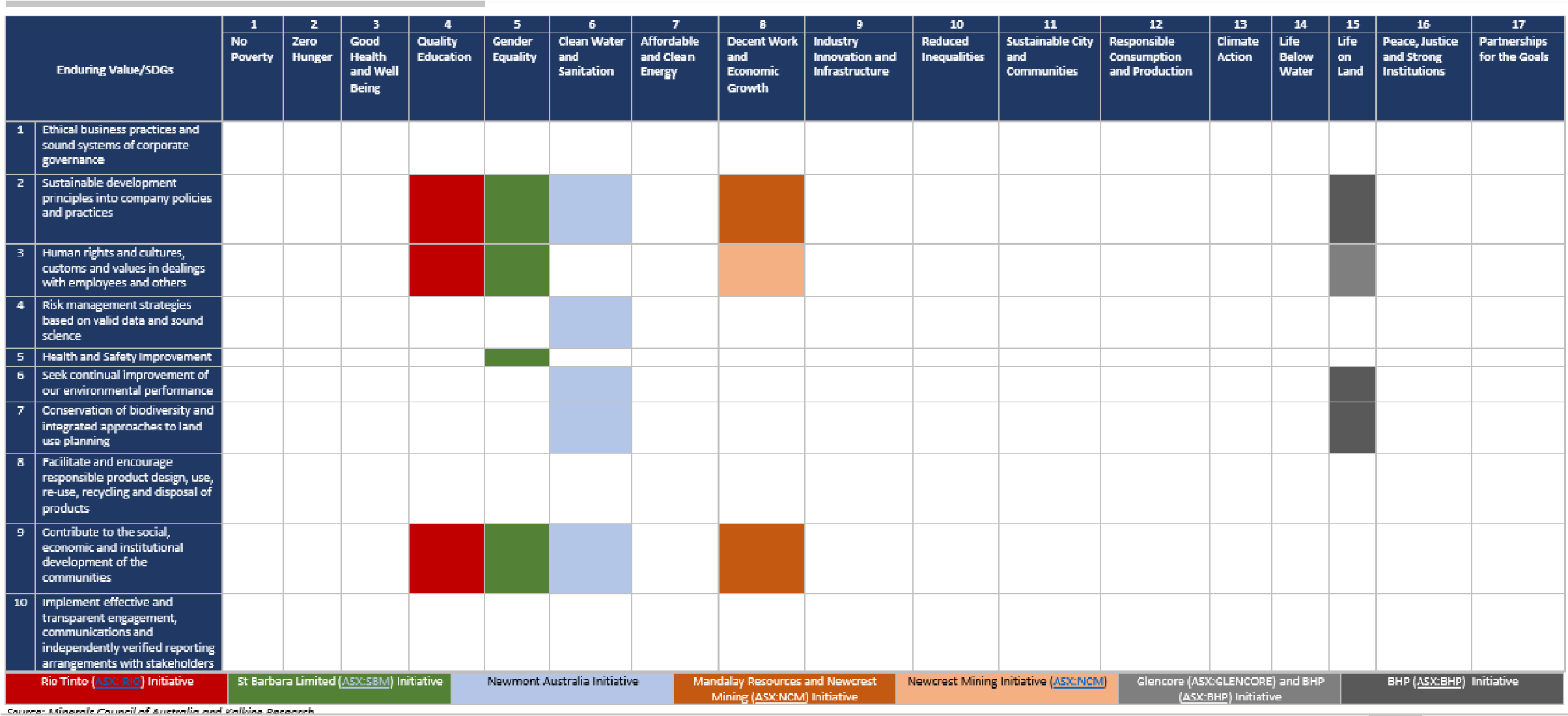
Source: Minerals Council of Australia and Kalkine Research
Disclaimer
This website is a service of Kalkine Media Pty. Ltd. A.C.N. 629 651 672. The website has been prepared for informational purposes only and is not intended to be used as a complete source of information on any particular company. Kalkine Media does not in any way endorse or recommend individuals, products or services that may be discussed on this site. Our publications are NOT a solicitation or recommendation to buy, sell or hold. We are neither licensed nor qualified to provide investment advice.
