
 AUS
AUS
 NZ
NZ
 UK
UK
 CA
CA
 USA
USA
 IND
IND






Highlights
- Australia's military fortunes are expected to shine brighter following the signing of a significant defence treaty between Australia and Japan.
- According to Tokyo's top diplomat in Canberra, both Australia and Japan are ready to send a strong message of deterrence to a more assertive China with this historic agreement.
- The new RAA pact between Australia and Japan will be inked to bolster military forces to combat China's growth in the Indo-Pacific region.
Australia's military fortunes will shine brighter following the signing of a significant defence treaty between Australia and Japan.
Despite Japanese Prime Minister Fumio Kishida cancelling a trip to Sydney and a meeting with Scott Morrison owing to COVID-19 fears, the long-awaited Reciprocal Access Agreement (RAA) between Japan and Australia is set to be inked on Thursday. Both leaders are slated to attend a virtual meeting to sign the accord.
Recent Article: AUKUS: Australia, UK, US join forces to stave off Chinese threat
This move involving Australia and Japan working together may send a strong message to China, with whom relations have deteriorated after Australia asked for an enquiry on the origin of coronavirus in China in 2020. China is Australia’s biggest trading partner.
China’s ties with Japan have also turned sour over growing concerns on Hong Kong and the Taiwan Strait.
How will the RAA deal benefit Australia and Japan?
Military relations between Australia and Japan are currently more robust than ever. The RAA is Japan's only second significant defence deal with another country, the first being with the United States.
Australian Prime Minister Scott Morrison has lauded the decision as a "watershed moment" in Australian-Japanese ties.
Let's look at how both countries will gain from this agreement.
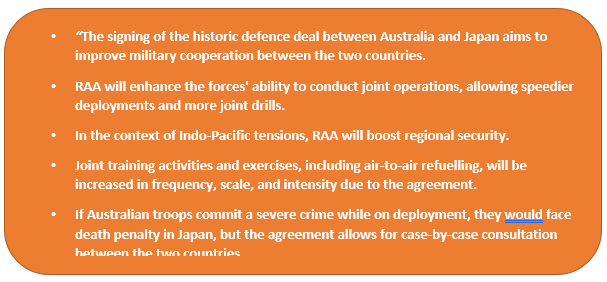
Image ©2022 Kalkine Media®
Recent Article: Can economies really cut Trade ties with China?
What are Indo-Pacific tensions, and why will the RAA deal exacerbate it for China?
The Indian and Pacific oceans meet in Southeast Asia, forming the “Indo-Pacific region.”
Many analysts believe that the transition from Asia-Pacific to Indo-Pacific is due to India, Japan, and China's exponential economic boom. One of the reasons for the term's prevalence is recognising that the Indian and the Pacific oceans are linked strategic theatres.
As a result, Asia is now the centre of gravity. This is because the Pacific and Indian oceans provide sea lanes and provide routes to the majority of the world's trade.
Furthermore, various studies show that the Indo-Pacific area will share at least half of the world’s GDP.
The United States, India, Japan, and Australia have collaborated to strengthen their position in the Indo-Pacific area in which China holds a strong economic hold.
The following reasons are further prompting US allies including Australia and Japan to gain a strong position in the region.
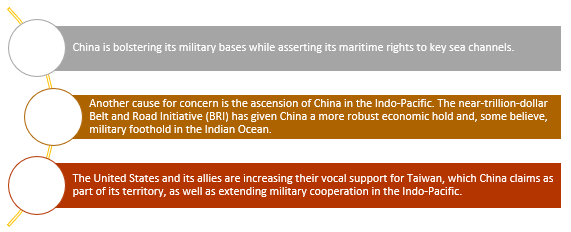
Image ©2022 Kalkine Media®
A few months ago, Australia, the United Kingdom, and the United States launched the AUKUS alliance due to China's expanding influence in the region.
The new RAA pact between Australia and Japan will be inked to bolster military forces to combat China's growth in the Indo-Pacific region.
Recent Article: China-Australia: The present and future
Final Thoughts
Other countries are concerned about China's growing military dominance in the Indo-Pacific region, as the majority of trade must pass through India's pacific oceans.
As a result, the RAA agreement will allow Australia and Japan's militaries to increase the number of collaborative training sessions and host each other's soldiers. The move will send a strong message to China, demonstrating how world leaders work together to combat China's influence in the Indo-Pacific area.
Recent Article: 2022: A major year for Australia with elections around the corner
