
 AUS
AUS
 NZ
NZ
 UK
UK
 CA
CA
 USA
USA
 IND
IND







Summary
- Global ride services giant Uber’s core business is in loss. Uber Eats revenue however grew 125% year-over-year.
- Uber also stated that its customers have turned out to be price-sensitive amid coronavirus pandemic.
- CEO Dara Khosrowshahi remains confident of bringing profits back to Uber by end of 2021.
Global e-hail company Uber Technologies Inc released a statement on Thursday stating that the demand for its food-delivery service Uber Eats rose exponentially in the latest quarter ending on 30 September 2020. However, it's signature global rides business is underperforming in the United States, which is its most important market.
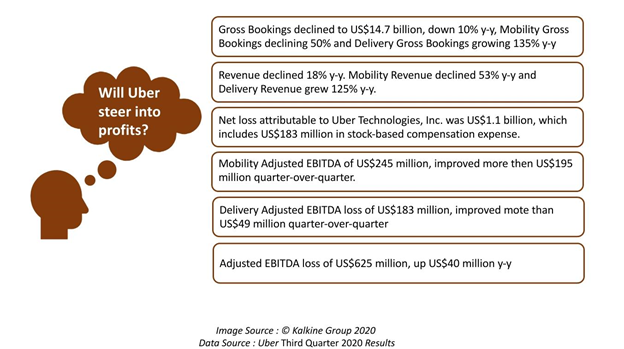
As soon as the company reported an adjusted third-quarter EBITDA loss of US$625 million, Uber (NYSE:UBER) shares dropped 2 per cent in after-hours trading.
The trend shows a drastic change in consumer behaviour. Uber also showcased how the company adapted to these changes since the pandemic struck.
The San Francisco-based Uber ride bookings dropped low primarily due to the slow pace of recovery in the West Coast area of the country. Meanwhile, its booking numbers improved steadily in Europe and the Middle East regions.
Also read: Uber Remains Available in London, Licence Granted for 18 Months
Quarterly earnings of 2020:
Uber suffered a loss on a GAAP basis in the third quarter as a resurgence in virus infections made many customers choose to stay away from shared vehicles. Ride-hailing customers who are venturing out, have turned out to be price-sensitive.
It is impacting Ubers margins as it was once Uber's largest and most influential segment. The customers who considered price factor while booking the rides had different options to choose from such as rival Lyft.
Now Uber may find it challenging to position the company in the affordable pricing segment; the company directly depends on cost reductions. Uber nevertheless maintained its aim to turn into a profitable business before the end of next year on an adjusted basis.
Uber delivery unit, which includes Uber Eats generated about US$1.45 billion in revenue, which grew 125 per cent year-over-year. The company explained the reason for such surge is because in the pandemic times people food desire relied on Uber to deliver orders and people preferring to order at home instead of visiting restaurants.
Its non-adjusted EPS were reported at a loss of 62 cents. Revenue reported was US$3.1 billion, down 18 per cent from the same time last year. Uber's mobility business unit, which consists of ride-hailing, scooters and bikes reported US$1.37 billion in revenue during the quarter, down by 53% form the same period last year.
Good read: Uber Reports Dismal Results; Mobility Losses Offset By Delivery Business Gains
Uber confident of turning the wheel around:
Dara Khosrowshahi, CEO of Uber Technologies, said that despite such fluctuating pandemic situations and larger economic uncertain times, the Company delivered steady improvising results. Khosrowshahi appreciated the company's global reach and the team's tireless execution. He continued saying that total company gross bookings are down only 6 per cent year-on-year in September.
Mobility gross bookings have declined by 50 per cent. The company believes that the delivery services rose to 135 per cent year-on-year growth because of the rate innovating is expanding. The company launched a new product into its delivery segment, added groceries and prescriptions to it. It also launched Uber Green to more than 50 cities which allows the customers to ride Electric Vehicles and hybrid vehicles. The Company also started to offer Uber Pass and Eats Pass membership plans to customers.
CFO, Nelson Chai commented that once the consolidated growth returns, Uber will again be a profitable foundation. Uber Mobility segment generated US$245 million adjusted EBITDA, which is more than US$195 million quarter-over-quarter.
Chai said that once the company puts forward a strong execution and focuses on cost disciplines, it will achieve quarterly adjusted EBITDA profitability before the end of 2021, Uber is confident of it.
Also read: Why Are Investors Eying Tesla and Uber?
Ballot campaign to keep gig economy alive:
The quarterly figures were reported a day after Uber achieved a significant victory in its California home market. Voters passed a company-sponsored Proposition 22 ballot measure. Uber, Lyft, Doordash, and others are now granted with an exception to a law which made the companies classify their drivers as employees.
Fifty-eight per cent majority of California voters gave preference to the app-based food-delivery and ride-hail drivers to be listed as independent contractors. These contractors, unlike employees, are not eligible for benefits such as unemployment pay and health insurance. California drivers will continue to receive minimum pay wages, healthcare subsidies along with accidental insurance.
This gig economy model business was built upon Ubers's backing. Uber along with its small rivals Lyft, DoorDash, Instacart and Postmates jointly initiated the ballot campaign spending more than US$200 million. The analyst, however, thought the decision had the ability to hammer Uber's business in California.
