
 AUS
AUS
 NZ
NZ
 UK
UK
 CA
CA
 USA
USA
 IND
IND





Summary
- The investment prospects demonstrate that foreign investors are confident about Australia.
- Foreign investments are primarily focusing on sectors such as mining, real estate, finance and insurance, trade, manufacturing.
- Country's resource sector, which has always been attractive to foreign investors, the industry is now receiving heightened attention and gaining continued investment.
Foreign investment is essential to any country's economic prosperity. Even in Australia, the investment has helped build the country's economy. The investment provides a platform to improve the wellbeing of its citizens' financial growth as well.
Globally, with the coronavirus health crisis disrupting the businesses, the global foreign direct investment fell substantially by 49 per cent in the first half of the year from the same period last year.
To worsen the situation more, the United Nations recently said that the FDI is on the path is plunged by 40 per cent for the year. The fears of a deep recession are very alarming.
On a positive note, according to the World Investment Report 2020 published by UNCTAD, FDI inflows lowered substantially by 47 per cent and reached US$36 billion, well above the US$68 billions of 2018. According to the report, Australia also climbed the ladder one place from the previous year and was the world's 7th top economy in terms of FDI inflows in 2019.
TOP Australian sectors grabbing FDI Attention (A$ billion)
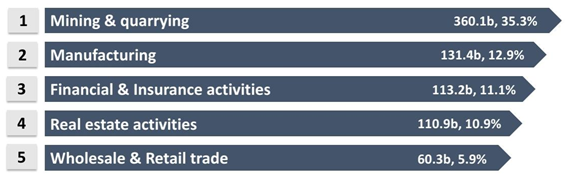
Image Source: © Kalkine Group 2020, Data Source: Australia Government Department of Foreign Affairs and Trade
Good Read: China’s Net-Zero Emission Goal Calls of USD 5 Trillion Investment – Wood Mackenzie
Let us explore the top five countries which are investing heavily in Australia and in sectors that continue to receive investor interest.
The United States of America
Believe it or not, about 25.6 per cent of foreign investment in Australia is from the US. In 2019, the US invested AU$983.7 billion, demonstrating a 3.6% year-on-year increase. In 2017-18, the US bought 5.9 per cent of Australian exports which is AU$21.4 billion.
Trade with countries like the US has given Australia the necessary capital to develop Australia's largest export industry which is minerals and resources. The US is top third on Australia's top 10 two-way trading partners list of 2017-18 with total trading valued worth AU$70.2 billion.
Foreign investment coming from the US in 2017 is around AU$912.9 billion and AU$949.2 billion in 2018. The US has been Australia's largest foreign investor; around AU$896.9 billion were invested in the country by the end of 2017. The two-way investment stock reached AU$1.6 trillion in 2017.
Did You Watch: US Government to invest US$50 Million in Australia | ASX Market Update
The United Kingdom
The UK is on the second number in 2019 when it comes to foreign investment in Australia. In 2019, investment from the UK valued at AU$686.1 billion. The country is expanding its footprint outside the EU. The UK government's vision to put Britain on the global map includes increasing trade and investment with Australia.
In 2018, it was at AU$584.0 billion, and in 2017 it was AU$498.4 billion. At the end of 2017, a total of AU$3.3 trillion were invested in Australia through foreign investment. The FDI is, in a way, also creating an employment opportunity.
Foreign investment drives Australia's leading minerals and energy sector since long. Australia aims to attract foreign direct investment in the education sector as well.
Also Read: All you need to know about Australia- Britain Trade deal
Belgium
In 2019 foreign investment from Belgium was at AU$348.1 billion. Belgium's total investment in Australia was AU$315.5 billion in 2018 and AU$305.1 billion in 2017. Total goods and services traded between Australia and Belgium in 2018 were AU$3.4 billion.
Traditionally both countries cherish a robust and long-standing investment relationship. Belgium invests in Australia primarily in the sectors such as infrastructure, agribusiness, construction, financial services, mining and resources etc.
Good Read: K2fly Onboards Belgium Based Sibelco for RCubed Solution; Managing well Amidst COVID-19 Situation
Japan
Be it in Australia or any other country; foreign investment is mostly linked to the political and diplomatic ties between the state. Japanese investment in Australia surged in the last 1980s, mainly in the real estate and tourism businesses. Slowly the Japanese investment increased in minerals and agricultural land as well.
Being in number four position, investment from Japan was totalled at AU$241.1 billion in 2019. In 2018 investment from Japan stood at AU$233.9 billion and AU$226.5 billion in 2017. Japan's primary import from Australia includes in the field of mineral fuels, machinery, pharmaceuticals and chemicals. Its policy towards Australis has been stable, supporting economic activities while highly depending on strengthening trade and investment ties. Japan is also closely working with Australia on COVID-19 response and recovery.
Good Read: Japanese Exports face the Steepest Plunge as Economy sinks into Recession
Hong Kong (SAR of China)
In 2019, Hong Kong stood at the fifth position in terms of top economies investing in Australia. The foreign investment from Hong Kong stood at AU$140.7 billion in 2019, AU$122.9 billion in 2018 and AU$108.7 billion in 2017.
Hong Kong's overall economic growth has been driven through open trade and foreign investment. Both Australia and Hong Kong have built extensive trade and investment connections over many years. The region invests in Australia in sectors such as utilities, telecommunications, infrastructure, resources and transport.
The investment is also increasing rapidly in agri-food, major infrastructure and health services. Australia is a safe, reliable and thriving investment hotspot for Hong Kong businesses.
Read Blog: Global Economic Pulse, Trade Deal Scenario, Hong Kong Issues and ASX Uptick
