
 AUS
AUS
 NZ
NZ
 UK
UK
 CA
CA
 USA
USA
 IND
IND


_02_06_2025_07_05_23_538703.jpg)



Summary
- Day trading has taken a leap in the wake of the pandemic, as retail investors have found making money easy and fast. At the heightened market volatility in March, there had been an addition of a large number of new traders.
- The stock market frenzy led by retail investors has caused never seen moves, especially in companies with bankruptcy protection and stressed share prices. The discount broking services offered by brokers have introduced many first-time investors to markets.
- There is a dedicate website that tracks activity on the popular day trading application, Robinhood. It has perhaps become imperative for some smart money managers to monitor the activity in the retail e-broking world.
Just like online shopping and remote consulting have been gaining traction in the wake of the pandemic, stock brokerages in many countries have seen dormant accounts coming back online or an increase in account openings.
With US brokers already plying with no commission syndrome, the delivery of service is extremely cheap, insightful, and perhaps value driven. The emergence of trading applications has enabled various classes of investors to participate in price discovery.
Robinhood is one of the e-broking apps, which is extremely popular in the United States. Market participants have been trying to analyse activity at the platform and its effects on markets. Robinhooders were also believed to be the reason behind wild moves in the shares of bankrupt Hertz.
Related: Shocking! Car Rental Company, Hertz to sell $1 billion worth of Stock After Going Belly Up
The hype in the e-broking market is also reflected by Morgan Stanley’s bid to acquire E*Trade Financial Corp., another large player in the market. It is being emphasised that last time retail investors were on a frenzy back in the 1990s, the dotcom bubble burst.
But the information flow has been far more superior than last century. Social media platforms are popular place for discussions and opinions. Since March, the activity in markets has increased evidently, and even the Australian Security & Investment Commission (ASIC) banned index betting offering by betting providers.
Eastman Kodak Bounces after Government Loan
Shares of Eastman Kodak closed at a high of $33.2 on 29 July after closing at $2.1 on 24 July. This move was credited to a US Government loan secured by the company to produce pharmaceutical ingredients.
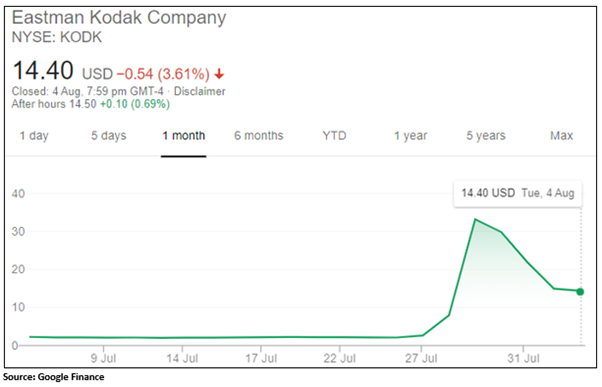
Under the Defense Production Act (DPA), the company secured $765 million in Government loan. Such loans had been granted by the incumbent US Government to expedite COVID 19 related supplies like PPE and ventilators.
Eastman Kodak was once among top players in the digital camera space, but now the company has come to produce generic pharmaceuticals ingredients to limit the reliance on foreign sources. Kodak is obliged to repay the loan in 25 years.
Reports suggest that news regarding the Government loan broke one day earlier before the company announcement; however, it was deleted by the authors. Kodak shares started trending on Robinhood, and volumes increased over options trading.
Related: Global Equity Markets: High-Level Punting by Retail Investors, Watch Out the Trends
Day Trading and Discount Brokerages
At the peak of lockdown, there had been a large number of new account openings in the stockbroking industry, as investors cheered the heightened volatility in markets. Day trading among individual investors has become very popular since gaming avenues were forced to close.
With the help of collaboration among investors and information flow, the markets are witnessing some of the never seen moves in low priced stocks, which are accessible for the investor class with low capital.
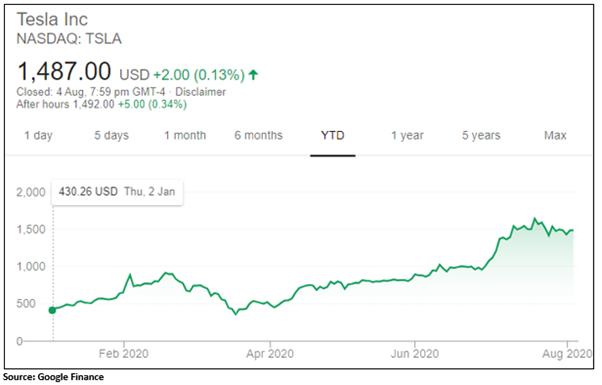
Intentions of investing into stocks are being largely driven by the profit-making potential in markets, as there is no limit on how high price of a stock can go. Tesla is believed to be one of the beneficiaries of this shift in retail investor participation.
The ecosystem is well supported by a number of companies providing broking services on their respective applications. As far as Robinhood is concerned, it also offers investors to park their funds in a fractional share, if they can’t buy a whole share.
There has been a large influx of traders in markets that may have driven price for many individual names, as popular stocks continue to march higher, outstripping returns of conventional picks of smart money managers.
As a result, it has become imperative to closely monitor the activity in e-broking markets. It seems that players like Robinhood have also forced high street brokerages to move to the zero-commission model in the US markets.
Related: Australian Retail Investors And The Market Turmoil
Thriving through Tracking Day Trading
At the backdrop of leaps in day trading, market participants have also started tracking compatible e-broking platforms. There is a dedicated website that tracks activity on the Robinhood platform. Moreover, there are more e-brokers where retail investors have accounts.
Popular stocks and love for such stocks are reminiscing the environment during the late 1990s when the dotcom bubble was growing stronger. The environment was similar as people were running for stocks to not miss out on the expected high growth in dotcom companies.
This time most people have opened trading accounts to get out of the boredom caused by lockdowns. For many, daily punting on stocks and other asset classes could be full-time work, especially the ones who lost jobs in the wake of the pandemic.
As per reports, a US-based hedge fund has outperformed its peers by following the trends of the popular day trading app, Robinhood. Sender Company & Partners is the volatility hedge fund that has gained 30% this year.
