
 AUS
AUS
 NZ
NZ
 UK
UK
 CA
CA
 USA
USA
 IND
IND







Summary
- Retail investors seem to be piling into beaten-down stocks of fundamentally sound companies amid anticipation of a faster than expected recovery from coronavirus crisis.
- Investors appear to be optimistic on prospects of swift economic revival following receipt of favorable economic data in China.
- nabtrade recently revealed a considerable rise in trading volumes in March, April and May 2020, with fresh applications soaring up by 360 per cent.
- On revival hopes, mum-and-dad investors seem to be crowding into undervalued stocks of companies offering huge growth potential, especially in telecom, healthcare, and financial sectors in India.
- Robinhood platform also experienced a historic opening of 3 million new accounts in Q1 2020, with many traders considering coronavirus downturn as an opportunity to enter the world of investing.
While COVID-19 driven volatility continues to persist in the global equity markets, a surge in retail investor participation has been observed in stock markets lately. Investors seem to be piling into beaten-down stocks of fundamentally sound companies amid anticipation of a faster than expected recovery from coronavirus crisis.
With retail investors flooding into the market, speculations are rife that this could initiate the next bull run following months-long bear ride triggered by coronavirus-induced shutdowns. Notably, most of the global equity markets have considerably recovered from the March 2020 bear market bottom, shrugging off fears of escalating coronavirus cases.
For instance, the S&P 500 and S&P ASX 200 indices have so far delivered substantial returns of over 40 and 30 per cent, respectively since March 2020 crash. Growing optimism over economic revitalization from virus crisis seems to be stimulating stock market recovery, with retail investors rushing to tap “buy the dip” opportunity.
Let us quickly scroll through some key trends exhibiting high-level punting by retail investors in global equity markets:
Chinese Stocks Walk into Bull Market
Retail investors lifted China’s Shanghai Composite Index for the seventh consecutive trading session on 8th July 2020, with the index closing 1.7 per cent higher at 3403.44. Chinese stock market rallied post a nation-owned media house urged a need for a ‘healthy bull market’ to strengthen the nation’s diplomatic hand and fund rapidly developing digital economy.
In addition, investors seem to be optimistic on prospects of swift economic revival following receipt of favorable economic data.
The nation’s Caixin Services Purchasing Manager’s Index (PMI) reached its 10-year high level in June 2020, rising to 58.4 from 55 in May. Besides, China’s Markit/Caixin manufacturing PMI increased to 51.2 in June, arriving at its highest level since December 2019. Signaling expansion, both manufacturing and services PMIs are offering glimmers of hope towards country’s economic recovery from coronavirus downturn.
Besides these factors, continued reforms in capital markets and anticipation of limited impact from the second wave of COVID-19 infections appear to be shoring up retail investors’ confidence in Chinese stocks.
Record Levels of Engagement on Australian Trading Platform
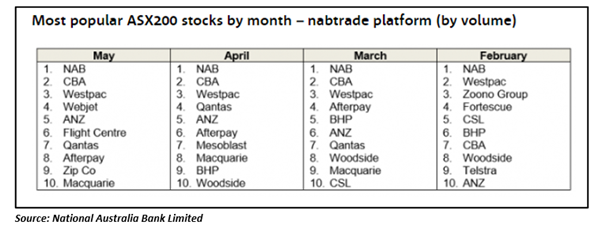
An identical trend has been noticed in Australia, with retail investors flocking into the stock market amid an escalation of online share trading during the lockdown. National Australia Bank Limited’s (ASX:NAB) trading platform, nabtrade, recently revealed a considerable rise in trading volumes in March, April and May 2020, with fresh applications soaring up by 360 per cent.
National Australia Bank notified that Buy Now Pay Later space garnered considerable attention of retail investors during these months, with work from home becoming a new normal. Besides, increased investors’ interest was noted in travel and airline space in expectation of lifting of border restrictions.
nabtrade data demonstrated a willingness of investors to act contrarian, making considerable investments in Afterpay Limited (ASX:APT) and Qantas Airways Limited (ASX:QAN), at the time when these stocks were trading at multi-level lows.
Additionally, the data uncovered that while blue-chip stocks in healthcare, telecommunications and resources remained in heavy demand during February and March, the preference of retail investors fell in favor of airline and travel players from mid-May 2020.
Mum-and-Dad Investors Pile into Indian Equities
Akin to Australia, a robust revival in retail investor participation has been noted in the Indian equity market since the initiation of lockdown, with a surge in opening of online trading accounts. Since March 2020, around 1.8 million new trading accounts have opened in India on expectations of faster than anticipated economic recovery with the nation’s shift to Unlock 2.0.
On revival hopes, mum-and-dad investors seem to be crowding into undervalued stocks of companies offering huge growth potential, especially in telecom, healthcare, and financial sectors. Another interesting trend to note is that homebound investors in India are lapping up shares of mid-cap and small-cap companies, that appear to be outperforming large-cap shares in India.
Flood of New Clients in US’ Robinhood Trading Platform
The phenomenon is not only unique to the Asian and Australian markets! The US’ trading platform Robinhood also experienced a historic opening of 3 million new accounts in Q1 2020, with many traders considering coronavirus downturn as an opportunity to enter the world of investing.
Robinhood noted investors’ flooding into stocks beaten down by coronavirus-triggered economic downturn, such as casinos, airlines and hotels. Besides, the trading platform observed a decent amount of buying in stocks of companies engaged in streaming services, videoconferencing and biopharmaceutical spaces.
In a nutshell, the boon in new trading accounts appears to be driven by investors’ rush to make money from market bloodbath while capitalizing on cash savings and lockdown time at home. The lower level of interest rates is further giving a leg up to investors to look beyond savings account, encouraging them to harness the benefit of buying opportunities in virus crisis.
