
 AUS
AUS
 NZ
NZ
 UK
UK
 CA
CA
 USA
USA
 IND
IND








Summary
- Banks are under an increased regulatory pressure to manage financial risks arising from climate change.
- NZ proposed a new policy in September where companies and financial institutions, with more than $1 billion in assets will be required to disclose their climate risks.
- Banks would need to consider transition, physical and liability risk, while lending and offering insurance, and would also have to scale up their abilities to estimate flooding risk.
Banks are under regulatory and economic pressure to safeguard themselves from the effects of climate change. In the months ahead, banking authorities around the world are now reinforcing new climate risk management guidelines and are preparing to introduce taxing stress tests.
As per a report released by Ceres (non-profit organisation), the U.S. banking sector is much more vulnerable to the systemic and financial threats of climate change than earlier recognised by investors or revealed by banks.
The report also divulged that the exposure to the banking sector is so substantial that it could cause a financial crisis, with more than half of all large US banks' syndicated loans subjected to severe climate danger, which could result in losses of more than US$100 billion.
ALSO READ: World Economic Forum: Climate crisis takes centre stage at Davos 2020
All 6 of the largest banks in the US namely JPMorgan Chase, Bank of America, Morgan Stanley, Citi, Wells Fargo, and Goldman Sachs are susceptible to above-average loan risk related to climate change.
Some of the banks have made a start, but many still have to devise strategies, develop their capabilities, and establish risk management structure.
Mandatory disclosure requirements of climate risk under new policy in NZ
Most of the businesses in NZ provided limited or no information on climate change.
In September, New Zealand proposed a policy to introduce mandatory reporting of climate risks for companies and financial institutions, becoming the first country in the world to do the same. The new system will come into action in 2023.
ALSO READ: How is climate change impacting the way NZ businesses operate?
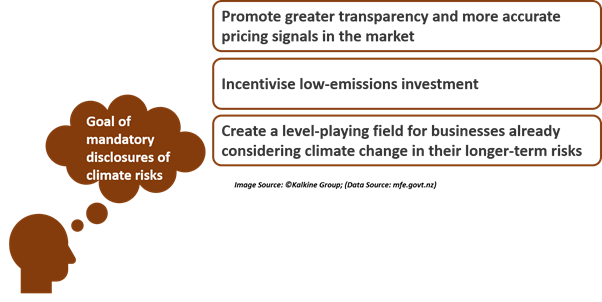
The policy requires all banks, wealth managers and insurance firms, with more than NZ$1 billion in reserves to report their climate risks, in accordance with the developing international standard from TCFD (Task Force on Climate-related Financial Disclosures).
Steps that can be considered by NZ Banks
Banks are the primary source of finance for companies in NZ. Here is a look at the things banks need to consider after the new mandatory disclosure policy.
- Banks would need to consider transition, physical and liability risk while lending and offering insurance to households as well as SMEs
- Banks would need to step up their ability to estimate the likelihood of floods in suburban housing from heavy rain, hurricanes, and rising sea levels.
- Banks would need to assess whether potential loan applications for dairy escalation are following the Paris Agreement as the emission profile of NZ is dominated by agricultural emissions.
Banks must measure climate risk at both firm and portfolio levels across all asset classes and business lines so that banks, its investors, regulators, and customers can understand the exposure of the sector to climate change.
(NOTE: Currency is reported in NZ Dollar unless stated otherwise)
