
 AUS
AUS
 NZ
NZ
 UK
UK
 CA
CA
 USA
USA
 IND
IND







Summary
- Australia’s unemployment rate grew 0.1% pnts to 6.9% in the month of September.
- Unemployment rate showed recovery from 7.5% to 6.8% in August, but it was short lived.
- ABS estimated that 29,500 people lost their jobs in the month of September alone.
- Underemployment rate has increased, and participation rate has fallen.
- RBA has been prioritising private sector-led job creation, although situation at ground level still seems bleak.
- Soaring joblessness has impacted people’s mental health as much as it has affected their spending capacities.
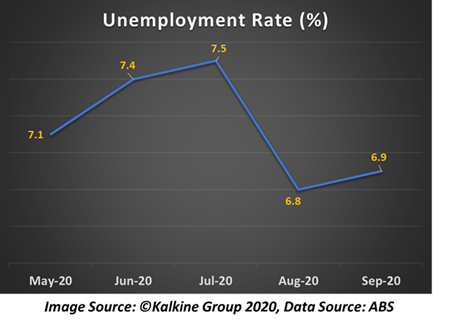
Economic analysts are pondering over the headline estimates of unemployment released by the Australian Bureau of Statistics. Australia’s unemployment rate grew 0.1% pnts to 6.9% in the month of September. According to ABS, 29,500 people have become unemployed over the month of September 2020. Number of employed people reflected a dip of 0.2% on M-o-M basis.
There was a surprise dip in unemployment in August when the unemployment rate fell from 7.5% to 6.8%. However, this recovery was short lived as the rate rose back to 6.9% in September 2020.
While, this is still better than the unemployment rates recorded prior to August.
ALSO READ: Key Takeaways from Phillip Lowe’s stance on rate cuts and stimulus
Key Statistics
According to the ABS data, the participation rate has fallen by 0.1 pts to 64.8%. For men, the labour market participation has decreased to 69.6% (- 0.1 pts). While for women the participation has dipped to 60.1% (- 0.1 pts).
The underemployment rate has also increased by 0.1 pts to 11.4%, while the underutilisation rate has shown an uptick of 0.2 pts.
In the month of September, the hours worked have increased by 0.5% to 1,688 million hours.
The fall in full time employment was much greater than part time. While full time employment dipped by 20,100 people, the part time employment saw a decline of 9,400 people.
The employment to population ratio, which is a measure of employment relative to the size of the population, decreased by 0.2 pts.
Labour Market Scenario Under the Scanner
In a recent speech, RBA governor Phillip Lowe expressed concern regarding the anticipated increase in unemployment in near term. He said that unemployment rates are expected to increase by December and fiscal aids may become more targeted.
The impact of soaring joblessness on reduced consumption level is also a national policy concern. Moreover, the distressed house sales and lower property demand is expected to have a crippling impact on the property market.
Besides, banks’ asset quality and housing loan arrears is also a matter of grave concern for the policymakers.
There is also a rising concern that reported unemployment figures are underestimated. Besides, many people are still struggling to find a job, which has also had an effect on people’s mental health.
Many economists fear that JobSeeker aid offered by the government would not be enough to cover expenses, especially in the long run. The only long-term solution to managing finances is to be employed.
RBA stands tall on the needed labour market fix
RBA has prioritised job creation and has given a push to private sector jobs. The JobMaker policy was also given focus in the Federal Budget of October 2020. These policies should bring about a positive change.
RBA has time and again showed its commitment to progress towards full employment. The monetary policy easing is expected to stay in action until labour market conditions are consistent with 2-3% inflation target range.
While the RBA promises resilient policy measures, public confidence seems to be dwindling with time as the economic position of Australia is under the scanner. Situation has been better for a few capital cities; however, there are still concerns of uneven and partial recoveries all through Australia.
