
 AUS
AUS
 NZ
NZ
 UK
UK
 CA
CA
 USA
USA
 IND
IND








Summary
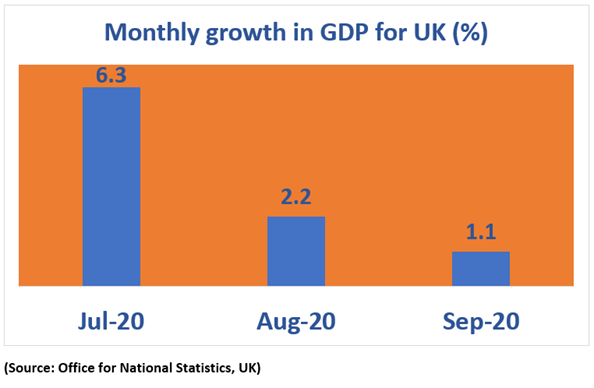
- Monthly economic growth slowed down in September to 1.1 per cent, as per the ONS figures
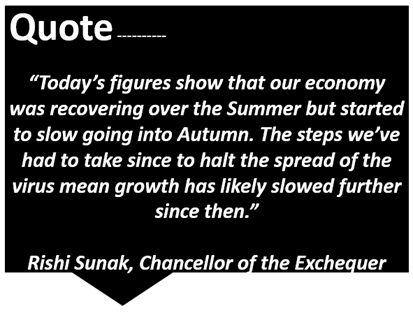
- Sunak warned of hard times ahead as England is going through partial lockdown till at least 2 December
The gross domestic product (GDP) for Britain grew at a record pace of 15.5 per cent for July to September 2020 quarter, reflecting a strong recovery after a record contraction of close to 20 per cent in the previous quarter of the year. In fact, it was the sharpest quarterly growth since the records started in the year 1955.
However, the overall size of the nation’s economic output remained around 10 per cent smaller than in December 2019.
United Kingdom experienced the biggest drop in its national income for the nine months ending September 2020 as compared to France, Germany, Spain, Italy, and the US.
With tighter restrictions in place during October and November, the economic outlook does not look very promising for the Q4 2020.
The growth of 15.5 per cent for Q3 was quite close to economists’ predictions of 15.8 per cent.
Rishi Sunak, Chancellor, UK Treasury pointed out that the nation is faced with hard times ahead with the growth probably started to have slowed down since September 2020. The monthly GDP estimate for September was 1.1 per cent, according to the ONS data.
Market analysts estimated that the economic damage in the Q4 is expected to eat into the record recovery observed in the Q3.
At the same time, these numbers do hold importance as they would mitigate some of the economic losses that are likely to take place in the near future, with tighter restrictions and lockdown in place.
The GDP
The estimate for gross domestic product is released by the Office for National Statistics (ONS) in the UK. It calculates the total value of goods and services produced in the nation.
GDP is a measure of the economic activity of any country.
Key highlights
Some of the main highlights of the GDP numbers released by the ONS for the quarter ending September 2020 are as follows:
- Economic output expanded by 6.3 per cent in July, then grew at a slower pace of 2.2 per cent in August, and then dragged at an even lower value of 1.1 per cent in September 2020.
- The construction output expanded at the fastest pace in Q3 2020 at 41.7 per cent. Production grew by 14.3 per cent while the services output rose by a similar number of 14.2 per cent for the period.
- The monthly growth of September was positive but relatively lower for all the three – services (1 per cent), construction (2.9 per cent), and production (0.5 per cent).
- The ONS report mentioned that the manufacture of pharmaceuticals dropped sharply by 9.8 per cent for September, pulling down the overall growth of manufacturing sector to 0.2 per cent for the month.
- New private housing was the biggest contributor to the third quarter’s growth. New orders rose at their fastest pace in the quarter with higher demand from buyers.
- Production of electricity, gas, steam, and air grew by 8.1 per cent in Q3 2020 as their demand increased with the opening up of offices and factories.
- Car production was down by 5 per cent in September as compared to the same month in 2019, driven by a fall in exports to primary markets like EU, China, and the US.
- More than 50 per cent of the GDP growth in July and August came from the food and accommodation sectors that benefited from the government’s Eat Out to Help Out scheme and easing of lockdown restrictions.
- Scientific, professional, and technical services had the maximum contribution to the monthly growth of GDP in September. Education sector also contributed positively with the opening up of schools and colleges.
- Household consumption rose by more than 18 per cent in Q3, driven by higher expenditure on transport, restaurants, and hotels.
- However, the demand for conferences, business travel, and corporate entertainment remained particularly weak during the quarter.
- Government consumption rose by close to 8 per cent for the July to September period, with higher activity in healthcare and education.
Jobs losses on cards
Sunak emphasised that despite the hard times ahead, the government was committed to support jobs and livelihoods. This was the precise reason why he had extended the furlough scheme until March 2021, he added.
The ongoing kickstart scheme had created roughly 20,000 new roles for young people in the country.
Despite all these support measures, the UK unemployment rate had shot up to touch almost 5 per cent for the quarter ending September 2020. The latest government data also revealed that the redundancies rose to a record high level of 314,000 for Q3 2020.
Analysts suggested that the real litmus test was for the economy to bounce back to its pre-corona levels fast, as unemployment and insolvencies were expected to rise further over the tough winter season.
Additionally, failed Brexit talks could shake up the economy further and pull its growth in the downwards direction, they exclaimed.
