
 AUS
AUS
 NZ
NZ
 UK
UK
 CA
CA
 USA
USA
 IND
IND








Summary
- The extension could cost more than £6 billion per month, according to expert estimates
- Millions of workers to get salary support, the final uptake would depend on the length and severity of coronavirus restrictions
The extension of the popular furlough scheme till end of March 2021 has been described as a lifeline for the businesses and workers struggling to survive a harsh pandemic led winter in the UK. Rishi Sunak, Chancellor, UK Treasury extended the scheme recently which was launched after the first lockdown was imposed throughout the nation.
The scheme was due to expire on 31 October, when it was extended for one more month as the second lockdown was imposed in England beginning 5 November. Earlier a new scheme called the jobs support scheme was due to begin on 1 November to replace the furlough. It has been postponed now with the furlough’s extension. On similar lines, the job retention bonus scheme has also been suspended.
Furlough or the coronavirus job retention scheme (CJRS) would enable employers to claim up to 80 per cent of their staff wages with a monthly cap of 2500 pounds on individual salaries.
Employers need not contribute any amount to their staff salaries till the time they are furloughed. Government would foot the entire bill within the caps set. Employers would merely have to pay for their National Insurance and pension contribution.
As per the UK Treasury, this amount averages out to be £70 per worker on a monthly basis.
Government would be reviewing the policy in January 2021 to see if the employers needed to contribute anything more.
Who can claim?
Any employer can claim money under the furlough scheme, even if they have not used the scheme previously.
Businesses across the United Kingdom can claim, whether their workplaces are closed or open.
Some publicly funded organisations would also be eligible to claim benefits in case their revenues are hit. Complete details of the employers eligible for the scheme would be published on 10 November 2020 by the UK Treasury.
Claims can be made beginning 11 November 2020.
What will it cost?
According to the latest available government statistics, the CJRS scheme has costed the exchequer a hefty sum of £41.4 billion till 18 October 2020. Close to 9.6 million people were furloughed under the scheme.
The cost of the extension of the furlough scheme would be dependent upon its uptake. This in turn would be impacted by the length and tightness of coronavirus led restrictions across the nation.
As an expert estimate, the think tank Resolution Foundation had earlier estimated that the furlough scheme extension could cost the close to an amount of £6.2 billion every month. The Foundation had admitted that the cost was enormous, but it also said that it was necessary, and so had many other market experts.
The public debt would undoubtedly rise further due to this scheme extension, putting pressure on the UK government finances. The lockdown is also expected to lower tax collections and Britain’s fiscal deficit could rise as a result, lament the experts.
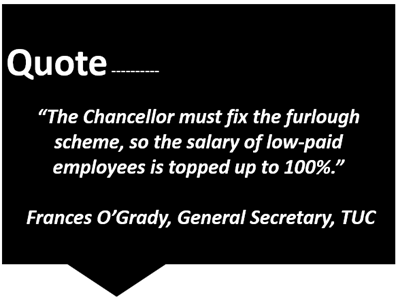
The Trade Union Congress (TUC) had welcomed the extension but had requested the government to consider raising the support for millions of low-paid workers to cover their entire salary. Since their salary equalled the minimum wages, it would be difficult for them to survive at anything below that.
Impact on unemployment
With the onset of the deadly coronavirus pandemic across Britain beginning March 2020, the worst hit categories of workers were the young and the low-paid ones, according to government estimates.
The extension of furlough scheme has come as a big respite for people who feared losing their jobs once the scheme expired, in an already grim economic scenario impacted by the unprecedented coronavirus pandemic.
There is no doubt about the fact that the scheme would be saving millions of people from getting redundant which would have been the case otherwise as ailing businesses would not have been able to support them single-handedly.
Resolution Foundation said despite this extended job support, many people still faced the threat of unemployment and needed financial certainty. For instance, there were close to 0.5 million self-employed people who were currently out of work, pointed out the Foundation.
O’Grady from the TUC said that sick pay and universal credit also needed a boost to avoid any financial hardships.
Stephen Phipson, chief executive, Make UK said that it was now clear that the coronavirus led crisis would be lasting for months to come and would damage many sectors and dampen the overall consumer demand further. Government should therefore start working towards a long-term sustainability plan for the businesses rather than offering only short-term piecemeal support schemes, he emphasised.
