
 AUS
AUS
 NZ
NZ
 UK
UK
 CA
CA
 USA
USA
 IND
IND







Summary
- Sale of second-hand vehicles continues to show growth post the economic reopening in Australia.
- Prices for the used vehicles in Australia rose by around 31 per cent in July 2020 compared to April 2020 slump.
- Market rally for the second-hand cars is bolstered by growing pandemic-related safety concerns regarding public transport, hindrance in new vehicles production and supply chain disruptions.
- Economic challenges and rising unemployment have typically led to a decrease in the sales of new vehicles.
The COVID-19 induced paradigm shift is evident writ large on the automobile industry, with a significant transition observed in the consumption patterns. The vehicle manufacturers and dealers have been impacted by changing needs of the consumers and ongoing infection scenario.
In the current scenario, the global economic turmoil and reduced travel consumption could be directly correlated with the automobile sector performance.
However, contradictory to the shared assumptions, the ‘Used Vehicle Market’ has shown a significant growth trajectory post the economic reopening. Individuals in a bid to avoid catching infection seem to have shirked away from public transport.
ALSO READ: Changing Paradigm and New Normal in Travel Sector
Growth in Second-Hand Car Market
Defying the decline witnessed across the travel sector, oil market and even new vehicles market, the sale of second-hand cars in Australia has rallied substantially. According to the recent figures from Moody’s Analytics, robust demand has been witnessed for the wholesale used vehicles in July 2020.
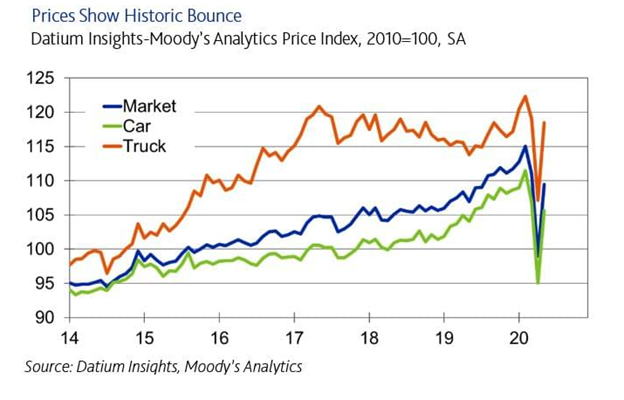
July prices for second-hand vehicles in Australia rose by around 31 per cent compared to the April 2020 slump. The price contraction of 14% over March and April had wiped out historical price gains in the Australian second-hand car market. However, the market bounced in May and has continued to show a growth curve.
The ‘Datium Insights- Moody’s Analytics Used Vehicle Price Index’ was 19.2 per cent more in July 2020 compared to July 2019.
The prices of trucks rose by over 27 per cent, while the car prices surged by more than 17 per cent on PCP basis. Furthermore, Vehicle retention value (price/MSRP) edged up by over 20 per cent in July 2020 compared to the same period last year.
Similarly, in the US market, the used-vehicle prices, after falling by 17.6 per cent in April 2020, jumped by 26 per cent from April to June 2020.
Interesting Read: What's Latest in the Australian Automotive Industry?
Charting out the Factors Responsible for Second-Hand Car Market Growth
The upswing in the used-auto market is driven by several factors that are altogether adding up to the increased sales.
Safety Concerns
Reducing the infection probability is one of the primary reasons for people ditching public transport. With the restrictions easing, the commuters are focused on avoiding the mass transit where social distancing can be at risk.
The high risk of community transmission associated with coronavirus has raised the bar for protective measures. Furthermore, avoidance of air travel has increased the need for personal vehicles for travelling a longer distance.
ALSO READ: Economy And ASX 200 Stocks: Is Stay-At-Home the Best Bet As A Sector?
Impact on Production of New Vehicles
The automakers shut the assembly lines as a prevention against the pandemic. Although with relaxations, motor vehicle production has resumed, they have not been able to achieve the pre-pandemic level. Furthermore, the pandemic situation still prevailing is creating staffing issues, thereby impeding auto-production to pick up the steam.
Significantly, the lack of hourly union workers due to coronavirus has forced General Motors to pitch in its salaried employees in order to keep the production running at Missouri truck plant. Similar action is undertaken at Marysville (Ohio)-based Honda plant where office workers are used for the production area.
Supply Challenges of Vehicles
Notably, supply chain challenges have significantly obstructed the flow of economic activities. The car manufacturing in Australia ceased in 2017, thereby making the Australian car industry typically dependent on the imports. Thus, disruption in the supply chain inhibiting the availability of cars has created a substitution effect, leading to the robust growth of the second-hand car market.
What is the Scenario in New Vehicles Market?
New vehicles market in Australia significantly felt the overriding turbulence gripping the Australian economy. The sale figures despite the reopening are not able to pick up to the pre-Covid level. Significantly, the prevailing unemployment scenario is another critical factor that seems to deter potential buyers of new vehicles.
The economic reopening has accelerated the need for transportation, catalysing vehicle demand which during the lockdown came to a standstill. However, the volatile situation still seems to remain dominant, generating inertia among potential vehicle buyers.
Australian Bureau of Statistics (ABS) reported a fall in the Consumer Price Index (CPI) by 1.9 per cent during the second quarter of 2020. Meanwhile, the annual inflation stood at -0.3 per cent during the June 2020 Quarter. The above measures indicative of the consumer expenditure and price changes highlight resistance in the purchase decisions of the consumers.
Federal Chamber of Automotive Industries (FCAI) reported total sales around 72.5k vehicle units in July 2020, which were down by 12.8 per cent compared to July 2019.
The declines in different categories of vehicles in July 2020 over the same month in 2019 include:
- Passenger Vehicles- Sales was 18149 units, which dropped by 28.5 per cent
- Sports Utility Vehicles- 35360 vehicles units were sold, declining by 1334 vehicles or 3.5 per cent
- Light Commercial Vehicles- Sales fell by 1812 vehicle or 10.8 per cent
- Heavy Commercial Vehicles-There was 9.3 per cent drop (296 vehicles) in the sales
Bottomline
Covid-19 has been the tipping point for many businesses, including the second-hand car market, which currently seems to be relishing the prospects generated by COVID-19 induced crisis. With the pandemic scenario still lurking, the consumer behavioural changes are expected to continue at least till the time the vaccine develops, or the situation normalises. The Government’s fiscal packages have ensured income inflow for the people, allowing them to make a sensible investment in the second-hand cars. Additionally, further directions to both the used and new cars in Australia will depend upon how the pandemic, as well as economic situation, pans out in the country.
