
 AUS
AUS
 NZ
NZ
 UK
UK
 CA
CA
 USA
USA
 IND
IND





Summary
- According to the Natural Resources Canada (NRCan), the country currently gets around 16 per cent of its major energy supply from renewable sources.
- Canada could use hydrogen to fulfil about 27 per cent of its energy needs a net zero GHG emissions future, says the report Transition Accelerator report.
- Alberta’s Industrial Heartland Hydrogen Task Force report points that the province has significant access to low-cost natural gas which will support the production of blue hydrogen.
Renewable power is the next big thing in the agenda for many major economies around the world, including Canada. According to the Natural Resources Canada (NRCan), the country currently gets around 16 per cent of its major energy supply from renewable sources such as solar, ocean, hydropower, wind, biomass, etc. But Canada is now eyeing the hydrogen energy sector as well.
Canada and 72 other countries around the world have signed up for a Climate Ambition Alliance, which requires participating nations to achieve net zero greenhouse gas (GHG) emissions by 2050.
As the fourth largest producer of oil and natural gas in the world, Canada currently has significant dependence on fossil fuels such as gasoline, diesel, natural gas, etc. Hence, the country is seeking green alternatives to these carbon-based fuels in order to achieve the net-zero target.
So Is Hydrogen A Green Alternative?
According to a November 2020 report by Transition Accelerator, Canada produces about 8,200 tons of hydrogen (H2) in a day from natural gas. This ‘gray’ hydrogen is used in the making of fertilizer nitrogen and in the petrochemical sector. It also results in about 9 kg CO2e/kg H2 of GHG emissions.
A way to produce low-carbon hydrogen is via electrolysis, which is basically the process of extracting H2 from water molecules using electricity.
Hydrogen extracted via electrolysis is said to be 99.999 per cent pure. It can also be stored for months as a clean source of energy and it also has significant GHG benefits.
Would Producing Hydrogen Benefit Canada?
Canada, while being one of the world’s cheapest places to produce hydrogen, could use the fuel fulfil about 27 per cent of its energy needs a net zero GHG emissions future, says the report Transition Accelerator report.
It also points that Canada would see an economical benefit from hydrogen production as well as it has an annual market potential of up to $100 billion.
One way to implement a hydrogen economy, the report suggests, would be via hydrogen nodes, or local hydrogen economies, which would have the capacity to produce low-cost, low-carbon hydrogen.
Could Alberta Be Canada's First Hydrogen Energy Hub?
Alberta’s hydrocarbon-based economy, which equips it with natural resources, infrastructure, talent pool, etc., makes it a good option for Canada’s first hydrogen node, says a report by Alberta’s Industrial Heartland Hydrogen Task Force.
The report points that the province, a fossil fuel powerhouse, has significant access to low-cost natural gas which will support the production of blue hydrogen. It also has a substantial experience in the production of hydrogen and carbon capture, along with an existing system of storage, pipeline networks and supporting industries.
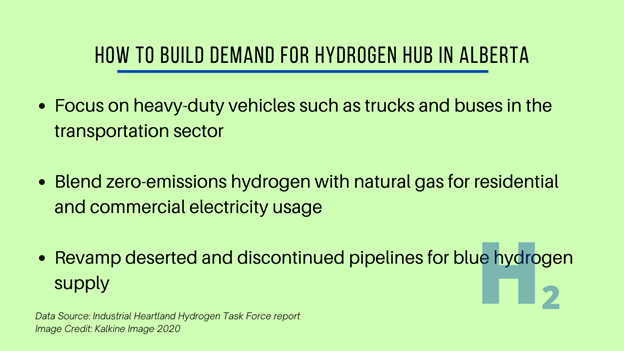
But along with the ideal means for production, an economy also requires sufficient consumers to function. With that in mind, the Industrial Heartland Hydrogen Task Force report points out ways by which Alberta’s Greater Edmonton Region could be transformed into an ideal location for Canada’s hydrogen hub.
- Hydrogen has not panned out well as an alternative fuel for low-duty vehicles in the past. So, to make Greater Edmonton Region a hydrogen economy, the focus could be trained on heavy-duty vehicles such as trucks and buses which require ample fuel, the report says.
- Another way to implement a hydrogen economy there would be by blending zero-emissions H2 fuel with natural gases in powering residential and commercial buildings. Back in July, ATCO company’s Canadian Utilities began injecting about five per cent hydrogen into the natural gas distribution network in Fort Saskatchewan.
Would Alberta’s Greater Edmonton Region Be Able To Meet Hydrogen Demands?
The Greater Edmonton Region’s vast network of deserted and discontinued pipelines could be used for large-scale blue hydrogen supply, the report pointed.
The pipelines can then be interlinked with fueling stations which fall in the route of heavy-duty vehicles, as well with commercial and residential buildings.
Where Does Canada Stand With Its Zero GHG Emissions Goals As Of Now?
While the government has projected several goals and initiatives for clean technology and initiatives, numbers tell a different tale.
A 2019 report by the Canadian Center for Policy Alternatives (CCPA) said that despite implementation of new policies to speed up the reduction of greenhouse gas (GHG) emissions, Canada will most likely miss its 2020 and 2030 targets.
The report said that the country’s GHG emissions rose one per cent in 2017 to 716 Mt total, and since 2005, it recorded a measly two per cent fall in its GHG emissions.
Alberta’s Greater Edmonton Region is said to have already taken the Industrial Heartland Hydrogen Task’s report into consideration. The Canadian government is also reportedly looking into the whole hydrogen economy concept at this point and is expected to release its plans on the production of low-cost, low-carbon hydrogen in the near future.
