
 AUS
AUS
 NZ
NZ
 UK
UK
 CA
CA
 USA
USA
 IND
IND






Highlights
- Bitcoin’s whitepaper calls the cryptocurrency ‘electronic cash’, and there is not a single mention of terms like investment and trading
- Over the past years, Bitcoin, alongside altcoins like Dogecoin, has gained recognition as a speculative asset that can be traded over cryptocurrency exchanges
- Last year, Tesla announced that the car manufacturer would accept Bitcoin from its customers as a mode of payment. However, this decision was soon withdrawn
Bitcoin is popular, and it can be assumed that many investors might have weighed the option of parking some money in it. Many might have decided not to, but there are also some staunch backers, also referred to as ‘hodlers’. But all this makes Bitcoin and later cryptocurrencies like Ether speculative assets. Was this the reason why Bitcoin’s creator/s introduced this blockchain-based ‘currency’ in 2009?
There is a reason why cryptocurrencies have ‘currency’ in their name. The first half, crypto, refers to cryptography or the technique to store information and data. Creators like Satoshi Nakamoto of Bitcoin wanted cryptography-backed virtual currencies to be used as money. Even big-ticket backers like Elon Musk have also subscribed to this idea, and Tesla has experimented with using Bitcoin and Dogecoin as a form of payment. But can an investor who holds Bitcoin be sure of its acceptance as money anywhere in the world? Let us explore.
Bitcoin as money or speculative asset or both
In a whitepaper, widely believed to be penned by Nakamoto, Bitcoin is proposed as a ‘peer-to-peer version of electronic cash’. It talks about ‘online payments’ and also how Bitcoin can eliminate the need for a financial institution that usually acts as an intermediary between a payer and a payee. In the document, there is also a mention of how peers would support the Bitcoin transaction network and how incentives would accrue to them in return. The paper is titled heavily on the idea of the use of Bitcoin as money, and notably, words like investment or asset do not appear in it.
However, with the passage of time, many seem to have disregarded the original idea and intent of Satoshi Nakamoto. Today, instead of being a widely adopted means of payment or money, Bitcoin has ended up more like a speculative asset which is traded for capital gains. It is sometimes compared with listed stocks, at times with gold, but at the same time, the intense price volatility of Bitcoin makes it a very risky asset for its backers.
That said, a few countries have started experimenting with using Bitcoin as legal tender. El Salvador, a small economy in Central America, and the Central African Republic, one of the world’s poorest nations, are using Bitcoin as legal tender. This theoretically means that merchants in these two nations would readily accept Bitcoin from any payer. However, the situation on the ground can be different. This is because many merchants are wary of the unpredictability of Bitcoin, which makes it less attractive as a store of value like the US dollar or the Australian dollar.
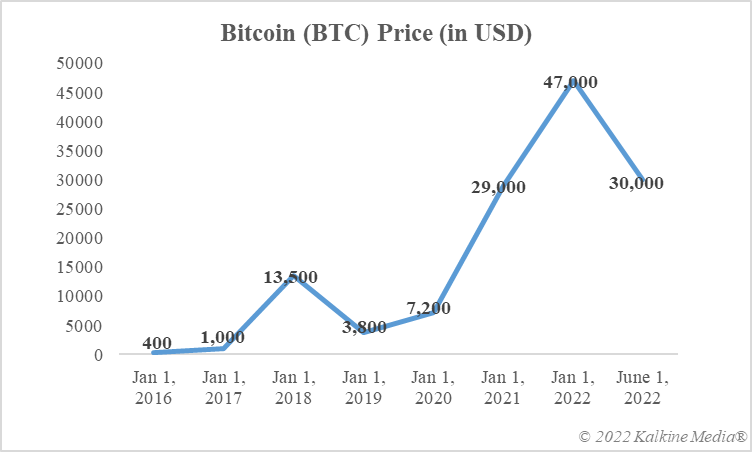
Data provided by CoinMarketCap.com
Where can Bitcoin be used as money?
Bitcoin’s use as money depends more on a payee than a payer. The payee is usually a merchant selling goods or a service. Notably, when airBaltic approved the booking of tickets using Bitcoin in 2014, it became the first airline in the world to do so. Recently, there were news reports that Emirates, the UAE’s most prominent airline, might soon add Bitcoin as a form of payment for customers. Major airlines, be it in the United States or Australia, are yet to experiment with the use of Bitcoin as a mode of payment.
Tesla, the electric car company run by billionaire Elon Musk, first announced the acceptance of Bitcoin as a mode of payment but soon dropped the idea. Later, Tesla declared that it would accept Dogecoin, a meme cryptocurrency, for the purchase of its merchandise. In Australia, retail brand OTR, which runs fuel and convenience stores, has recently started accepting Bitcoin. Across the world, the scene is almost the same -- Bitcoin is accepted as money only by a handful of businesses. In some countries, like China and Turkey, payment in Bitcoin or any other cryptocurrency is totally outlawed.
Any business that accepts Bitcoin today may tomorrow decide to backtrack, just like how Tesla changed its stance last year. In other cases, a business can even widen the scope. For example, airBaltic now accepts some other cryptocurrencies, including Ether and Dogecoin, for ticket booking. Separately, there are Bitcoin ATMs in countries like the US and Australia. But these act more as a means to buy the cryptocurrency using fiat currencies like the USD or the AUD and hold Bitcoin as a speculative asset.
Bottom line
Money that is issued and controlled by any central bank, like the Fed or the Reserve Bank of Australia, is the most readily accepted form of payment in today’s financial world. This money is also called fiat currency, and it is considered a trusted store of value. Bitcoin, on the other hand, can sharply gain or lose value over a short span. This is why most countries and businesses are not keen on using it in payments. A few businesses here and there have independently experimented with Bitcoin. For now, Bitcoin has very limited use as money and a very long road ahead to become what Satoshi Nakamoto envisioned -- electronic cash.
Risk Disclosure: Trading in cryptocurrencies involves high risks including the risk of losing some, or all, of your investment amount, and may not be suitable for all investors. Prices of cryptocurrencies are extremely volatile and may be affected by external factors such as financial, regulatory, or political events. The laws that apply to crypto products (and how a particular crypto product is regulated) may change. Before deciding to trade in financial instrument or cryptocurrencies you should be fully informed of the risks and costs associated with trading in the financial markets, carefully consider your investment objectives, level of experience, and risk appetite, and seek professional advice where needed. Kalkine Media cannot and does not represent or guarantee that any of the information/data available here is accurate, reliable, current, complete or appropriate for your needs. Kalkine Media will not accept liability for any loss or damage as a result of your trading or your reliance on the information shared on this website.
