
 AUS
AUS
 NZ
NZ
 UK
UK
 CA
CA
 USA
USA
 IND
IND








Highlights
- Always remember, government aids mostly have an expiry date and is usually limited
- It is always rewarding to save money to overcome financial complications arising out of disasters
- It might be a tough choice between fixed return instruments, market-related and volatile assets
The best preparation for a natural disaster is assuming that you will be all alone to lift yourself out of the financial burden that ensues.
The ongoing pandemic has left many jobless, many are behind their mortgage and rent payments, and high inflation has made food, clothing and energy costlier. What can be done to ensure a smooth ride? In most advanced economies of today, governments come to the rescue of the affected, for example, we have cash support for families in the wake of the pandemic in the US, Canada and many other countries.
Best saving strategy while preparing for any natural disaster
Such aid is always limited and cannot always meet the debt obligations that will still have to be serviced despite a blow dealt to cash inflow. This calls for prudent financial planning in a mix of products so that the basket is both versatile as well as reliable.
Also read: How are low interest rates helping Canada & US?
Best saving instruments
Modern financial planners often ignore traditional saving instruments like the certificate of deposit, which come with guaranteed returns over a fixed period of time, albeit may look unattractive when compared to relatively riskier options like stocks or the new-age volatile assets like cryptocurrencies.
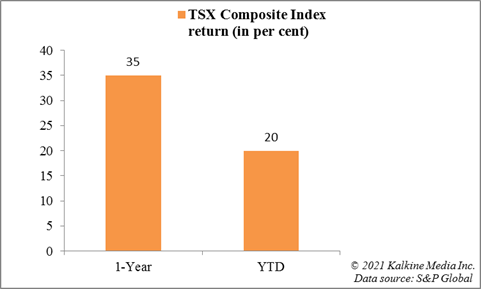
The stock market has rewarded most backers over the last one and a half years. The S&P/TSX Composite Index, which is the benchmark of the Canadian stock market, has returned over 20 per cent on a year-to-date (YTD) basis. The one-year return of the index is over 35 per cent as of now. It is likely that the index will end the year 2021 with the same momentum.
Also read: 9 TSX stocks to buy before Christmas
Cryptocurrencies, on the other hand, have given mixed results. The main crypto investment strategy is timing. If someone had invested in Bitcoin (BTC) on January 1, 2021, it could have returned over 100 per cent in less than four months. However, after mid-April 2021, Bitcoin lost value and at one point was priced at below US$30,000 in July 2021. The cryptocurrency is again on the rise now, trading at nearly US$63,000 as of now.
Also read: Can Bitcoin end 2021 with a price tag of $100,000?
Best strategy to invest money
It may be rewarding to keep a balanced portfolio with most of the money allocated between traditional saving options and listed stocks with sound fundamentals. A small fraction may also be used to bet on any emerging, volatile asset class like cryptocurrencies.
Bottom line
Assuming that the government aid will be enough during times of natural disaster is the biggest mistake people make. It's always one's own savings that can save at the time of difficulty. One must choose wisely in a market full of both traditional and volatile instruments. Most money can be parked in stable assets, and a little may be used to bet on emerging assets like Bitcoin or altcoins.
