
 AUS
AUS
 NZ
NZ
 UK
UK
 CA
CA
 USA
USA
 IND
IND








The Australian small business insurance market is shifting. Analysis of more than 1,900 broker-client conversations during 2025 reveals changing attitudes toward coverage, rising demand for higher limits, and a growing awareness of gaps that could leave businesses exposed.
Here are five trends shaping how Australian SMEs approach business insurance heading into 2026.
- Bundled Business Packs Are Becoming the Default
SME owners are increasingly requesting "all-in-one" insurance packages rather than managing multiple standalone policies. Over 115 broker conversations in 2025 included requests along the lines of "can I just get everything in one policy?"
Business packs - which typically combine public liability, professional indemnity, business property, and sometimes cyber or management liability - offer a single renewal date, fewer coverage gaps, and often better value than purchasing each cover separately.
The appeal is straightforward. Running a small business means juggling a hundred things at once. Tracking four separate policies with different renewal dates and different insurers adds unnecessary complexity. For professional services firms and healthcare providers who require multiple coverage types to operate, bundled solutions are becoming the path of least resistance.
- Coverage Limits Are Climbing
The limits Australian businesses are requesting have shifted noticeably upward. Data from 2025 broker conversations shows:
- $20 million limits: 155 mentions
- $10 million limits: 97 mentions
- $5 million limits: 120 mentions
The driver behind this isn't necessarily a greater appetite for risk. Contract compliance is pushing businesses toward higher coverage. Head contractors requiring subcontractors to carry $20 million in public liability. Corporate clients demanding $10 million in professional indemnity before signing an agreement. Government procurement processes setting minimum insurance thresholds.
For SMEs tendering for larger projects or pursuing corporate clients, higher coverage limits are increasingly a cost of doing business rather than an optional extra.
- Cyber Insurance Is MovingFromOptional to Required
Cyber insurance conversations among SMEs shifted significantly in 2025. Where previous years saw exploratory questions - "should I think about this?" or "is it worth it for a small business?" - the tone changed.
The phrase brokers reported hearing repeatedly: "My client requires it."
Contract compliance is pushing cyber insurance from a nice-to-have to a mandatory line item for many SMEs. Businesses tendering for work with larger companies or government bodies are finding cyber insurance on the procurement checklist alongside public liability and professional indemnity.
IT consultants, professional services firms handling client data, healthcare providers with patient information, and anyone working with larger corporate clients are most affected. The shift isn't fear-driven. It's commercially driven.
- Tradiesand Construction Lead Insurance Demand
The construction and trades sector generated the highest volume of insurance enquiries in 2025, followed by beauty and wellness, retail, and hospitality.
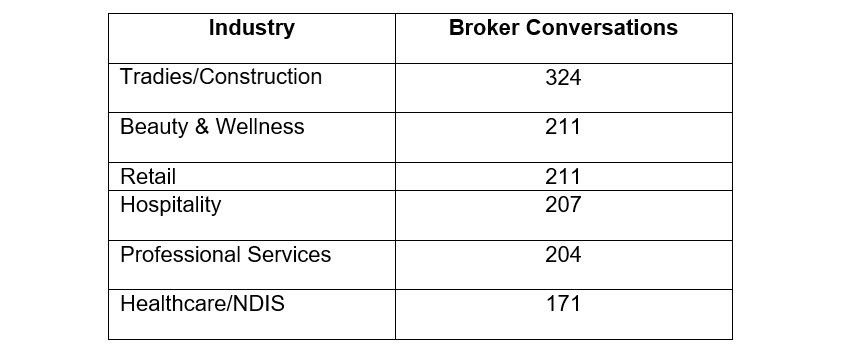
Within construction, height-related work generated notable attention. Over 115 conversations involved questions about insurance considerations for working at heights - a risk category many tradies weren't aware of until a client or site manager asked for proof of coverage.
The beauty and wellness category reflects a wave of sole traders and mobile operators - beauticians, nail technicians, massage therapists - sorting out their first proper business insurance policies as they formalise their operations.
- Underinsurance Anxiety Is Growing
Perhaps the most significant trend: business owners are increasingly worried they don't have enough cover. Over 183 broker conversations in 2025 touched on underinsurance anxiety, with questions like "do I have enough?" or "what if my sum insured is too low?"
The concern has merit. Replacement costs have climbed, business interruption scenarios have become more complex, and liability claims aren't getting smaller. A policy that was set up three years ago may not reflect a business's current revenue, headcount, equipment value, or liability exposure.
For SMEs uncertain about whether their coverage still fits, working with a business insurance broker who can review existing policies against current risk profiles is one way to identify gaps before they become problems.
The Bigger Picture
Australian SMEs are more engaged with their insurance than they were even two years ago. The conversations are more informed, the questions are more specific, and the expectations around coverage are higher.
Whether driven by contractual obligations, rising asset values, or simply a better understanding of what's at stake, the trend is clear: small business owners are treating insurance less as an afterthought and more as a core part of operating responsibly.
This is general information only and does not constitute financial or insurance advice. Business owners should consider their own circumstances and seek independent advice before making insurance decisions.
