
 AUS
AUS
 NZ
NZ
 UK
UK
 CA
CA
 USA
USA
 IND
IND


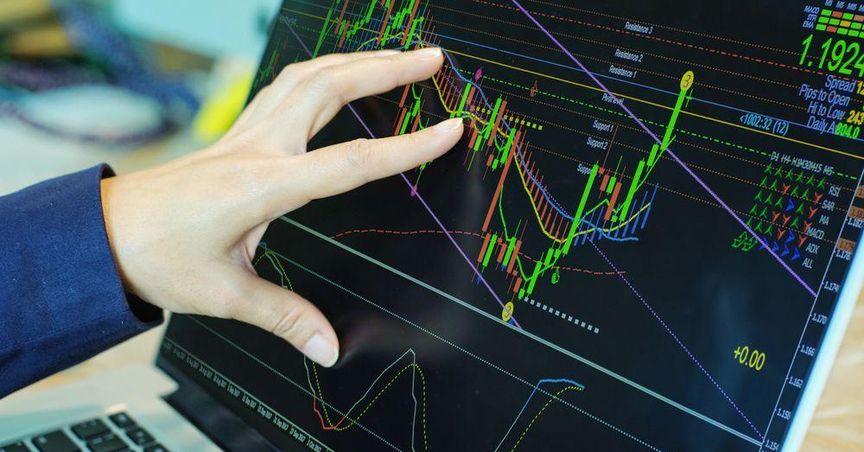




Commission-free apps have made day trading look cheap. The real numbers tell a different story, and understanding them before the first trade is the closest thing the field has to an unfair advantage.
Every year a new group of UK retail investors decides to try day trading, and every year most of them make the same discovery too late. The activity is not expensive because of any single fee. It is expensive because of half a dozen small costs that each look trivial in isolation and compound viciously with volume. Zero commission is real, but it was never the whole bill.
This piece walks through the actual cost stack a UK day trader carries in 2026, with realistic numbers. None of it is investment advice, and the standard caution applies with full force here. FCA-mandated disclosures show that a large majority of retail CFD accounts lose money, and day trading is the most demanding form of retail market participation. But for those determined to try, the arithmetic below is the homework that should come first.
The visible costs are the small ones
Start with what the marketing shows you. Commission on UK shares now ranges from zero to a few pounds per trade. This is the number platforms compete on publicly, and for an active trader it has genuinely collapsed over the past decade. If commissions were the whole story, day trading would be cheaper than a coffee habit. They are not the whole story.
The invisible costs are the large ones
The spread, the gap between the buying and selling price, is the first silent charge. On a liquid FTSE 100 stock it might be a few basis points. On mid caps, small caps and volatile instruments it widens sharply, and a day trader crosses it on every single round trip. Trade twenty times a week on instruments with an average 0.2 percent spread and the cost is roughly 0.4 percent of turnover weekly before anything else is counted.
Then comes financing. Day traders using leveraged products pay overnight funding on any position held past the close, typically a benchmark rate plus 2.5 to 3.5 percent annualised.
Currency conversion is next. UK traders active in US markets often pay 0.5 to 1.5 percent on FX conversion, either per trade or on deposits, and US shares dominate most day trading strategies. Finally there is market data. Real-time level 2 data, essential for many intraday styles, runs from free on some platforms to well over 100 pounds a month on others.
A realistic monthly cost stack
The table below models a moderately active UK day trader: 60 round trips a month, 5,000 pound average position, mixed UK and US instruments, on a typical mainstream platform.
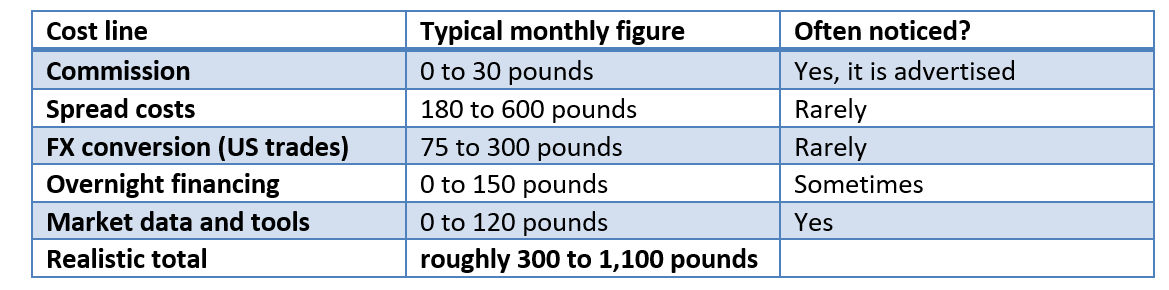
Read that bottom line again. A trader running this profile needs to generate several hundred pounds of gross profit every month just to reach zero. That is the breakeven treadmill, and it runs before tax, before losses, and before the value of the trader's own time.
Why platform choice moves the number so much
The striking thing about the table is the range on every line. The same trading pattern can cost three times as much on one venue as another, which is why experienced UK traders treat venue selection as a first-order decision rather than an afterthought. Independent comparisons of UK day trading platforms exist precisely to make these differences visible, weighing spreads, FX charges, data costs and execution quality side by side rather than taking any single provider's headline rate at face value.
The right answer also depends on style. A trader doing five large trades a week has a completely different cost profile from one doing five small trades a day. Matching the fee structure to the actual pattern, rather than the imagined one, is worth more than most strategy tweaks.
The tax dimension
UK traders have a structural choice that affects the net result significantly. Profits made through spread betting are currently free of capital gains tax, while the same strategy through a share dealing or CFD account is taxable above the annual allowance. The catch is that spread betting pricing typically embeds wider spreads, so the tax advantage is partly repurchased through execution costs. Which side of that trade wins depends entirely on trading frequency and average gain per trade, and it deserves an hour with a spreadsheet before committing capital.
Record keeping matters either way. HMRC expects disposals to be reported where relevant, and active traders generate hundreds of taxable events a year. The traders who last treat their records like a small business does, because as far as the tax system is concerned, that is what they are running.
The honest bottom line
Day trading is not a scam and it is not a lottery. It is a low-margin, high-skill business with a cost base most participants never bother to calculate. The minority who succeed tend to be the ones who did the unglamorous arithmetic first, controlled every cost line they could, and chose their infrastructure deliberately. Resources like The Investors Centre publish independent research and comparisons for exactly this reason: the difference between a viable trading operation and an expensive hobby is usually decided before the first order is ever placed.
The market will always sell excitement. The traders still standing in five years will be the ones who bought the boring spreadsheet instead.
The content has been authored in collaboration with our guest contributor, Tom Drury.
