
 AUS
AUS
 NZ
NZ
 UK
UK
 CA
CA
 USA
USA
 IND
IND








Summary
- The pandemic has forced businesses to accelerate digital adoption, causing a tech-tonic shift in Canadian stocks.
- Early events of 2020 have resulted in a spike in tech stock valuations.
- InfoTech now accounts for nearly 10 per cent of the key Canadian equity market.
- Tech stocks such as Shopify (TSX:SHOP), Docebo (TSX:DCBO), Lightspeed POS (TSX:LSPD) and many more are searing up the stock markets.
- With the onslaught of COVID-19 and homebody economy, digital will continue to be the key driver of metrics at workplace
Canada’s economy has primarily been fueled by its abundant natural resources – a fact highlighted by materials index’s bull run on the Toronto Stock Exchange (TSX) during the pandemic. But the country is changing, and a new post-COVID-19 order is emerging which has thrust information and communications technology (ICT) and other intangibles such as artificial intelligence, data, and internet of things (IoT) to the forefront. Canada’s tech sector had entered a boom-period nearly five years ago with Shopify. Over time, other tech giants like Facebook, Google and Amazon launched offices in the region. Toronto, Vancouver and Montreal established themselves as tech and startup hubs.
In days following the coronavirus-related lockdown in March 2020, Canada’s digital economy witnessed a growth spurt as businesses shifted to online operations and relied on connectivity. Industry verticals that failed to digitally transform and shift to allied models are seeing rapid falls in business revenues and stock prices.
The need to accelerate digital adoption is reflecting on the country’s key indices as tech stocks overshadow almost every other vertical, with the exception of materials sector.
Canada’s ICT sector accounts for nearly 4.8 per cent or C$94.1 billion of the GDP, and has outperformed the overall economy’s output, employment and innovation growth of 1.5 percent in 2019, reports Innovation, Science and Economic Development (ISED), Canada.
The sector generated C$210 billion in revenues and constitutes of 43,200 companies, of which over 39,000 are a part of software and computer services industries.
Read: Embracing Disruption Through Digitalization- Banking Trends of 2020
Snapshot of Canadian ICT Sector 2019: Sub-Sector Trends
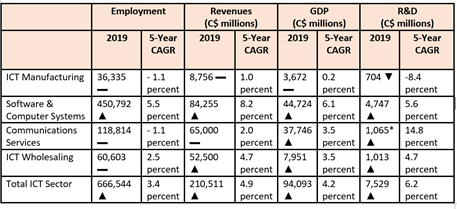
(Source: Innovation, Science and Economic Development Canada)
The total IoT market in Canada is likely to grow to C$ 21.8 billion in 2023 from C$ 13.5 billion in 2019, according to a pre-COVID forecast by the International Data Corporation (IDC). The country’s ICT services industry predominantly operate in the domestic market, while the ICT manufacturing sector relies on exports. About 99 percent of ICT products such as computers, communication devices and other hardware manufactured in Canada were exported in 2019.
Canada has several free trade agreements – such as the Trans-Pacific Partnership (TPP), the Canada-United States-Mexico Agreement (CUSMA) and the Comprehensive Economic and Trade Agreement (CETA) – which have the potential to expand the current ICT sector and its digital entrepreneurs across the globe.
Canada’s Digital Economy: Sub-Sectors
Canada’s digital economy is a broad umbrella term and not just about the ICT and IoT companies. It also refers to markets based on digital technologies, automation, and SMAC (Social, Mobile, Analytics and Cloud.

(Source: ICTC)
Some of the defined sectors in the country’s digital economy are:
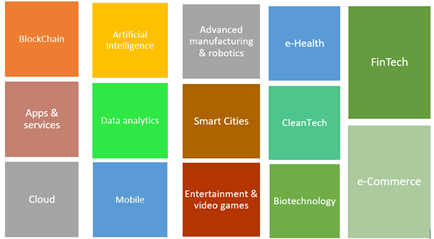
Canada’s e-commerce market is projected to grow from US $ 3.53 trillion in 2019 to over US $ 6.54 trillion in 2023, thanks to an increasing digital population, according to a report Statista. In 2019, 28.1 million Canadians generated nearly C$ 1.85 billion revenue in e-commerce retail trade. By 2024, this revenue generation is expected to surpass US $ 33 billion.
E-Commerce Stats
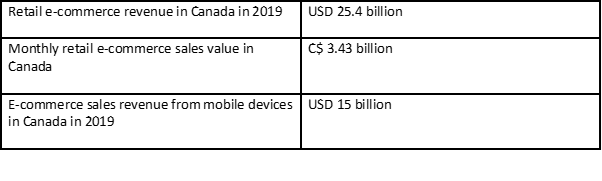
(Source: Statista)
READ: Investors are eyeing these two e-commerce stocks
Tech-tonic Shift In Canadian Stocks
With the onslaught of COVID-19, digital has emerged as a key driver of metrics in workplace. While the pandemic has led to the closure of workplaces and maintaining social distance, businesses are now adopting technological solution, moving their services online. This wide-scale digitization and automation will lead to massive job transformation across industries.
As a result, all forecast and projections for the Canadian digital economy points at one direction: growth of tech stocks.
Shares can be viewed as a yardstick to measure the intangible capital and investment in the ICT, IoT and other sectors of the digital economy. It also reflects the human mindset of staying ‘ahead of the curve’ through investments.
About five years ago, the information technology sector accounted for just 2.4 per cent of the S&P/TSX Composite Index (TSX). The figure is now up to 10.84 per cent (July 2020) of the Canadian equity market, close behind industrials and energy.
Another indicator of the shifting market dynamic can be viewed in the Year-to-date (YTD) performance of S&P/TSX Capped Information Technology Index, which has a total of 16 members.
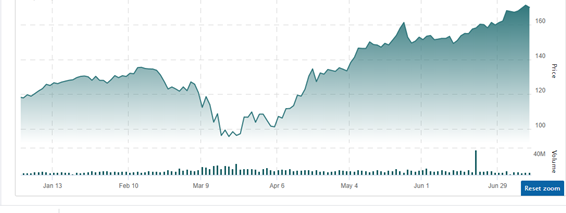
(Source: TSX)
The infotech index has posted a 38.46 per cent growth since the beginning of the year and has a current adjusted market capitalization of C$ 247 billion.
So far, Shopify Inc. (TSX: SHOP) has been hogging the headlines, thanks to its humongous market growth in the face of pandemic. At a current market cap of C$ 137.5 billion, this e-commerce giant accounts for over 50 percent of the infotech index and 5.5 percent of the TSX market capitalization. The valuation of its shares has more than doubled in 2020. Lightspeed POS (TSX:LSPD) and Docebo (TSX: DCBO) too has surged.
Apart from these three, valuations of other Canadian tech firms have gone up too this year. Let us look at the performance of some of the stocks:
Real Matters Inc. (TSX:REAL)
This Canadian network management owns an application software platform for mortgage lending and insurance industries on cloud-based environment. It has a current market cap of C$ 2.1 billion and P/E Ratio of 47. Real Matters scrips have advanced by an astonishing 108 per cent this year.
In the second quarter of 2020, Real Matters announced 73 per cent YoY growth in revenues to US $ 109.6 million and increase in adjusted EBITDA to US$ 14.6 million.
Evertz Technologies Limited (TSX:ET)
This Canadian firm offers technology solutions, software, equipment, and audio-video infrastructure solutions for multiplatform media segments and next-gen Internet Protocol ecosystems. It has a current market cap of C$ 908 million. In its recently announced Q2 results, Evertz announced a quarterly dividend of C$ 0.09 per share. The scrips’ current P/E ratio is 13.60.
Kinaxis Inc. (TSX:KXS)
The Ottawa-based firm provides software solutions to supply chain management and sales and operations. The company has posted 90+ per cent return on shares since the beginning of the year. It has a current market capitalization of C$ 5 billion and P/E ratio of 147. In the first quarter of the year, Kinaxis announced a revenue growth of 15 per cent to US$ 52.8 million and an adjusted EBITDA margin of 29 per cent. The company recently acquired AI solutions firm Rubikloud for US$ 60 million in an all-cash transaction.
Read: Nuvei’s Eyes Largest Canadian Technology IPO of 2020
Post-COVID Outlook
With COVID-19 and work-from-home scenarios, the outlook of the investment industry has shifted. A new crop of investors is betting on the market as stock prices nosedive.
According to an Investor Economics study, over 500,000 new discount online brokerage accounts were opened between January to March 2020 in Canada.
And many of these first-time investors are betting on IT stocks. Developments in the last six months have reinforced the fact that information and communication technology will continue to define our future and the path of the market.
