
 AUS
AUS
 NZ
NZ
 UK
UK
 CA
CA
 USA
USA
 IND
IND







There was a time when people did not trust even banks for monetary assistance and strongly believed in saving for the future or emergencies. Fast-forwarding to the present time; there has been a shift in the international customer preferences to accept the Buy Now Pay Later (BNPL) services largely due to the attitude of the people to want everything now.
Over the years, these BNPL services have gained sizable popularity in the Australian and New Zealand markets among the customers, as well as the merchant partners of the companies providing these services. One of such companies is Afterpay.
An International technology-driven payments company, Afterpay Touch Group Limited (ASX: APT), has a mission to be âthe worldâs most-loved way to payâ, with its current business verticals, namely Afterpay and Pay Now (Touch) services.
Through its âbuy now, receive now, pay laterâ business model, Afterpay is said to steer the retail innovation by serving leading retailers in Australia and globally. The cornerstone of the service is that it eliminates the requirement to enter a traditional loan or pay any fees or interest by the customers.
Let us take a closer look at the business performance of Afterpay.
APTâs Sturdy Business
APT has a strong business in New Zealand, and Australia (with presence in multiple sectors in Australia, including telecommunications, health and convenience retail sectors), and the business has shown robust growth in the past year in these countries. Afterpay currently has over 4.3 million active customers and ~30,600 active retail merchants on-boarded.
On 13 November 2019, APT released a CEO and CRO presentation, wherein it mentioned that it had more than 6 million active consumers, by the close of October 2019. It was further stated that APT and MasterCard had signed a strategic partnership in the market of Australia to support scale APTâs business and provide services to merchants in a more efficient manner. On the Groupâs YTD performance front,
For the year ended 30 June 2019, the total income for Afterpay amounted to $264.1 million, which represented an increase by 86% as compared to the previous yearâs (ended 30 June 2018) total income of $142.3 million.
APT believes that such whooping growth is principally fuelled by continued strong growth in the Australian and New Zealand Afterpay businesses.
The New Zealand business of APT also produced continued strong earnings, which was offset by the significant investment required to support the Groupâs global expansion, that influenced the Pro forma EBITDA (excluding significant items) to reach an amount of $35.5 million for FY19 (slightly above the $35.2 million in FY18).
APTâs Independent Interim Chair, Elana Rubin, said:
âWe continued to consolidate our market-leading market position in Australia and New Zealand, which included the expansion of our instore proposition and entry into new verticals. Over $1 billion worth of Afterpay transactions have now been processed instore in Australia and New Zealandâ
During FY19, Afterpayâs underlying sales doubled in Australia and New Zealand, with a 140% increase reflecting continued growth across all channels (in-store and online) in Australia and New Zealand.
The development of the Groupâs instore proposition has been a key feature of the striking growth in underlying sales in Australia and New Zealand, with instore cumulative underlying sales amounting to $1 billion making a contribution of 18% to Australia and New Zealandâs combined underlying sales in FY19.
Opportunities in BNPL
New industry verticals and cross-border trade are expected to produce budding opportunities for Afterpay in New Zealand and Australia. Currently, Afterpay has significant opportunities to address on the international level.
According to APTâs reports, the immediate markets with the presence of Afterpay represent an enormous opportunity of $6 trillion, constituted by an online contribution of $780 billion.
In the bigger picture, a trend worth noting in the New Zealandâs customer preferences is the growing choice to space out the cost of spending with BNPL options.
However, a major number of companies operating in the BNPL services have restrictions ranging from $1k and $1.5k for individual buying. However, Payright, an Australian payment plan provider, delivers its customers with a $20,000 limit, which can be repaid over a period of 36 months.
Australian payment plan provider, Payright develops for merchants to speed up return-on-effort and to increase the affordability of the consumers by deferring the cost of purchases over a period of time, without ever having to pay interest.
Recently, a major media source reported that Payright confirmed its plans for expanding its business from Australia to a global level by entering into New Zealand by the end of the year 2019.
BNPL services are already popular among New Zealand customers, making it a brighter opportunity for the service providers.
Payright has also built a strong business in Australia and has been able to raise $30 million of funds earlier in the ongoing year 2019. Payright looks forward to establishing a robust business by capitalising on the opportunity of the budding and nascent outlook of the BNPL services in New Zealand.
A major difference that we might be able to witness in the business activities of Afterpay and Payright is the customer segment targeted by them as there is a difference in their offered buying limits.
Numbers Canât Be Ignored
According to the New Zealand Government, the spending in the retail industries decreased by 0.6 % and spending in the core retail industries reduced by 0.6 % for the month of October 2019 as compared to the month of September 2019.
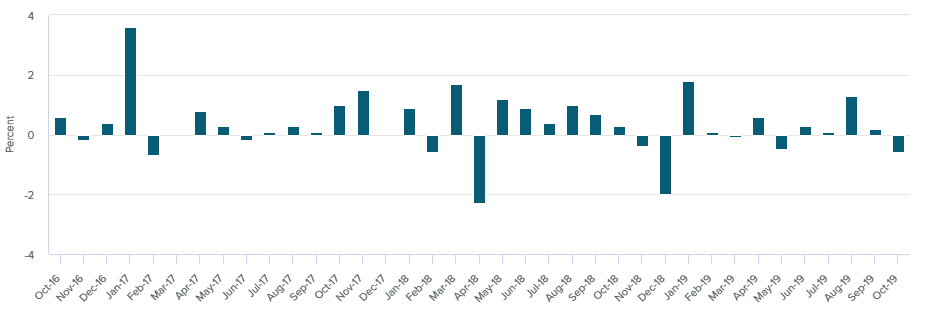
Figure 1 Change in retail card spending from October 2016- October 2019, Source: Stats.govt.nz
Based on industry, the movements were as follows:
- Fuel, up $4.3 million (0.7 %)
- Hospitality, up $0.9 million (0.1 %)
- Motor Vehicles (excluding fuel), down $1.9 million (1.0 %)
- Apparel, down $2.5 million (0.8 %)
- Consumables, down $11 million (0.5 %)
- Durables, down $11 million (0.8 %)
Moreover, the cardholders made 162 million transactions across all industries in October 2019 with an average value of $49 per transaction, while the total amount spent using electronic cards amounted to $8.0 billion.
Outlook for APT
Afterpayâs business has a network of millions of consumers, which includes numerous small, medium and large businesses. APTâs accumulated wealth of small-to-medium business (SMB) merchants presents a momentous opportunity for the company to expand its reach in Australia and New Zealand while contributing towards the global stronger margins.
APT strongly focuses on the implementation of a strategic approach to connect and work with SMB merchants. The investments are anticipated to be channelised towards the technology and processes further fuelling the onboarding of SMB merchants and maximise the SMB opportunities.
Afterpay has been able to procure a high-value and regularly returning customer base, with low outstanding balances and industry-leading loss rates through its highly customer-centric service based on trust, loyalty and responsible spending habits through its business model.
What differentiates Afterpay from traditional credit card businesses is the free service provided by Afterpay to the customers who pay on time.
In addition to this, the merchants who provide Afterpay as a service form the major source of Afterpayâs revenue. The lesser part of the revenue is earned by Afterpay through the way of payment.
Bottomline
The entry of Payright into New Zealand is bound to increase the competition for the already operating Afterpay. However, Afterpay has an advantage of the existing customer base in New Zealand, but the competition is expected to intensify.
Moreover, it is not an implied outcome of increased competition to limit the growth of a company. Increased competition can also mean increased marketing and increased consumer awareness which has an influence on consumer choices and may lead to increased demand for the services.
23.06% return on APT Stock
APT stock was trading at $29.070, down by 0.411% as on 13 November 2019 (at AEST 1:33 PM). The stock has a market capitalisation of $7.38 billion and has provided 23.06% return during the past three months as on 12 November 2019.
Disclaimer
This website is a service of Kalkine Media Pty. Ltd. A.C.N. 629 651 672. The website has been prepared for informational purposes only and is not intended to be used as a complete source of information on any particular company. Kalkine Media does not in any way endorse or recommend individuals, products or services that may be discussed on this site. Our publications are NOT a solicitation or recommendation to buy, sell or hold. We are neither licensed nor qualified to provide investment advice.
