
 AUS
AUS
 NZ
NZ
 UK
UK
 CA
CA
 USA
USA
 IND
IND







Summary
- The number of payroll jobs increased by 0.3% nationally over the first half of June till 19-June 2021.
- In May, the number of housing allowed fell 7.1% y-o-y.
- The retail turnover increased by 0.4% m-o-m in May, quicker than expected.
According to statistics released by the Australian Bureau of Statistics, building approvals in Australia fell more than expected in May. However, according to another report from the ABS, retail sales in May climbed faster than expected, and payroll jobs also increased over the first half of June.
Let's have a detailed look at these indicators before diving into the effects of these indicators on the economy.
Payroll jobs increased 0.3% over the first half of June.
The number of payroll jobs increased by 0.3% nationally over the first half of June till 19-June 2021 as the govt eased the restrictions in the recent lockdown. This followed a 0.8% fall in May first half, according to ABS data released on Tuesday.
Bjorn Jarvis, head of Labour Statistics at the ABS, said:
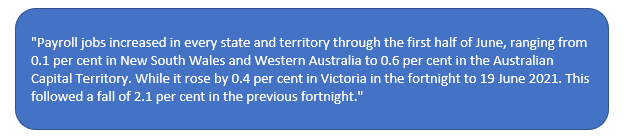
Source: ABS Media Release, 6 July 2021, Payroll jobs rose 0.3% over the first half of June
He further added that in Victoria, accommodation and food services showed early indications of recovery after the lockdown, climbing 6.4% over the fortnight, but arts and entertainment services dipped 3.2%. Both industries had experienced significant drops in the preceding weeks, down 15.3% and 10.4%, respectively.
Talking about national data, payroll jobs in the accommodation and food services industry rose by 1.4 per cent in the fortnight and fell by 1.0 per cent in Arts and recreation services.
Also Read: Payroll jobs fall in Victoria, Western Australia; Frydenberg bats for high GDP numbers

Source: © Cammeraydave | Megapixl.com
Home approvals declined more than expected.
In May, the number of housing allowed fell 7.1% year-over-year, following a 5.7% drop in April. In contrast, economists had predicted a 5% decline.
The decline in the overall number of homes sanctioned in May was mainly due to a 10.3% drop in private sector houses. The value of building permits issued in May was down 5.8% from the previous month.
Source: © Andreyyalansky19 | Megapixl.com
The value of total building increased 4.5%, in seasonally adjusted terms. The value of non-residential buildings rose 28.5 per cent, driven by a significant rise in public sector projects approved in May, following a 38.5 per cent fall in April.
Also Read: Dwelling approvals fall, but private houses reach new high: ABS
Retail sales grew 0.4% in May.
Another report from the statistical office revealed that retail turnover increased by 0.4% month-over-month in May, quicker than the 0.1% gain previously expected. In April, sales increased by 1.1%.
By industry, the most significant difference between the preliminary (-1.5%) and final release was seen in the clothes, footwear, and personal accessory retailing industries (0.0 per cent).
Food retailing at 1.1% continued to outperform the rest of the industry, despite declines of 1.1% in household goods retailing and 0.7% in department stores.
What do these economic indicators mean for the Australian economy?
The ongoing coronavirus outbreak in part of Australia will cause the uncertainty in the near future as well. On Tuesday, in a statement, Philip Lowe, Governor, said:

Source: RBA Media Release, 6 July 2021, Statement by Philip Lowe, Governor: Monetary Policy Decision
The governor and the government are employing a monetary-fiscal combination to push the economy toward full employment. The governor aims for wage growth above 3%, which has not been seen since 2013. Increased wage growth would assist in reactivating long dormant inflation.
Australia's economic recovery is greater than projected and is expected to continue. Investment prospects have increased, and household and business balance sheets are in good shape. The high price for commodities exports also help to boost national income, said Lowe.
According to him, the housing markets have remained strong, with prices growing in all the major cities, and with high demand from owner-occupiers, especially first-time buyers, housing loan growth has increased up. As a result, investors have also raised their borrowing. Given the current climate of rising property prices and low-interest rates, the bank will be keeping a close eye on changes in housing borrowing.
The government will continue to maintain highly accommodative monetary conditions to facilitate Australia's return to full employment and inflation in line with the objective. The govt does not plan to raise the cash rate until actual inflation falls within the target range of 2-3%. These criteria will not be reached before 2024, according to the bank's central projection for the economy, and the labour market must be sufficiently tight to create wage growth.
