
 AUS
AUS
 NZ
NZ
 UK
UK
 CA
CA
 USA
USA
 IND
IND








Summary
- Medical billing and coding help healthcare facilities manage insurance claims, invoices, and payments.
- In medical coding, the billable information is extracted from clinical documentation, and medical billing uses those codes to generate insurance claims.
- By outsourcing medical billing, healthcare service providers, including hospitals, can save training and benefit costs.
A medical coding and billing system acts as a connection between healthcare service providers and insurance companies. Medical billing and coding help healthcare facilities manage insurance claims, invoices, and payments. While billing and coding are distinct processes, they are critical to obtaining payment for healthcare-related services.
The medical billing and coding cycle can take place in a few days or could take months. The duration depends on the intricacy of the services delivered, how organisations collect the financial responsibility of the patients, and how claim denials are managed.
Medical billing and coding are mainly responsible for ensuring that medical office revenue cycles run smoothly.
RELATED ARTICLE: What is value-based pricing in healthcare?

Source: © Everythingpossible | Megapixl.com
What is medical coding?
Medical coding is the process of extracting billable information from the clinical documentation and medical record of patients. The codes are utilised in medical billing to generate insurance claims and bills. Thus, forming claims is where medical billing and coding interconnect to support the revenue cycle of healthcare.
Medical coding starts when a patient visits a physician, a hospital, or other healthcare centre and ends when the provider receives full payment for all services provided to the patient. On the patient encounter, the providers specify the visit or service in patients' medical records, explaining why they furnished specific services, processes, or items.
ALSO READ: Climate pledges to the UN: India, China miss deadline, smaller nations submit ambitious plans
What is medical billing?
The process of medical billing includes submission and taking follow up on claims with the health insurance players for obtaining payment for the services provided by the healthcare service providers. The process translates a healthcare service into a billing claim. The person accountable for medical billing is responsible for following the claim in a healthcare facility that makes sure the practice gets reimbursement for the provided services.
People who develop the medical bills often communicate with physicians and other healthcare professionals (HCPs) for the explanation of diagnosis or to get some additional information, if required.
MUST WATCH: Electronic Medical Records (EMR): What are they, and why do we need them?
Medical billing process explained
The medical billing process includes several steps, and all of these play a significant role in ensuring that a physician practice obtains the revenue it is owed.
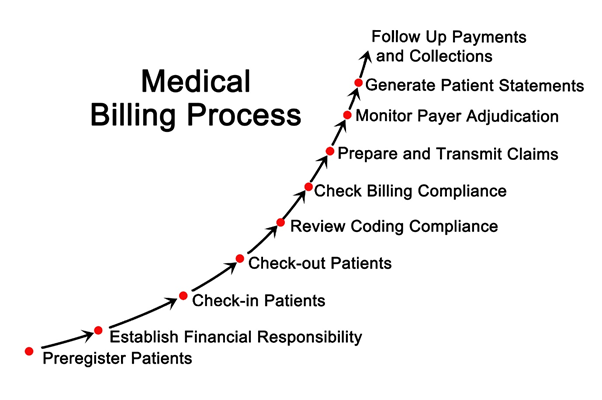
Source: © Vaeenma | Megapixl.com
In the past, medical billing procedures were done manually by using paper-based methods or documents drafted by a typewriter. However, multiple technological advancements in the healthcare industry have transformed the process into an electronic one.
Benefits of medical billing and coding
Outsourcing medical billing services undoubtedly helps in the revenue cycle management. Here are some benefits one can enjoy with medical billing and coding-
Increased patient care- Hospitals can free up their staff’s energy and ensure greater returns by redirecting the resources from managing complicated billing questions to serving the patients.
RELATED ARTICLE: How are medical chatbots transforming patient care?
Cost-saving- With the outsourcing of the medical billing process, healthcare service providers, including hospitals, can save on training and benefit costs. With this, hospitals can also skip additional costs, including office supply, furniture, and hardware purchase.
Cash flow acceleration- Irrespective of the situation of staff, medical billing outsourcing services allow customers to maintain a steady cash flow as well as faster collection. Moreover, hospitals can attain greater economies by allowing a specialised company to carry out the medical billing process quickly.
Better patient satisfaction- The medical billing services ensure that each code gets the correct reimbursement, denials are followed, and errors are identified swiftly. On the other hand, healthcare service providers can offer excellent services to their patients.

Medical coding bill (Source: © Andreypopov | Megapixl.com)
DO READ: Electronic Medical Records (EMR): What are they, and why do we need them?
Challenges with medical billing and coding
By focusing on combating the common challenges, healthcare service providers can increase their reimbursement and optimise the revenue cycle.
Some of the key challenges in medical billing include-
- Claim denial- Claim denial arises when a claim is processed and then rejected by a payer. The denials mainly fall under five groups, including administrative, clinical, preventable hard and soft. Most of the denied claims are preventable, and over half of them are re-submittable after making corrections.
- Accuracy- Some healthcare service providers perform their denial management process manually, increasing the chances of human errors and reducing transparency. Even the smallest inaccurate information related to the patient can lead to a claim being rejected.
- Automation paucity- Processing claims manually is usually a time-taking process and can increase the turnaround for claims. Healthcare providers who do not have the automation in their medical billing system can miss the potential of advancing claims reporting.
- Technology unavailability- Without using technology for effective prioritisation, management as well as channel claims, the healthcare practitioners cannot streamline claim denial management. Even if the staff members in practice are well informed about the process, it would be difficult to manage them efficiently if they do not have the technology to administer claims.
INTERESTING READ: What is nanotechnology and where can it be applied?
