
 AUS
AUS
 NZ
NZ
 UK
UK
 CA
CA
 USA
USA
 IND
IND








Summary
- The significant shift in people working and socialising online during the COVID-19 pandemic has led to an increase in scammers seeking personal information.
- More than $22 million has been lost to scammers, and Scamwatch received 24,000 reports of stolen personal information.
- Since the emergence of COVID-19, Scamwatch has received 3,900 scam reports mentioning the coronavirus, exceeding $3.1 million in reported losses.
- Individuals need to be extra careful while dealing with people asking for their personal information, no matter who they say they are.
Current uncertain times have instigated a massive rise in the number of online scams aiming individuals as well as entities. These scams have seen a significant increase during the pandemic from offering online shopping and payment service to entering people’s homes to check for the virus in their water tanks.
During this year, there has been a 55% rise in reports concerning the loss of personal information as compared to the pcp in 2019, as per Scamwatch. These include over 24,000 reports with losses worth more than $22 million.
Increased Online Activity Causes Increased Scams
Identity theft in Australia has seen a dramatic rise during COVID-19 with increased online work as well as socialising through online platforms due to lockdowns and social distancing measures. Unfortunately, these uncertain times have proven to be severely fatal for many who have been tricked into scams by failing to secure their personal information.
An individual’s personal information is highly sensitive information that can allow the scammer to gain access to one’s bank accounts or superannuation. Moreover, a scammer can even avail loans in someone’s name by gaining access to their personal information and threaten/bully them for money through impersonating them on social media.
The graph below highlights the 15,490 scams reported for June 2020, where a total of $12,712,415 was lost. This grew to 18,579 reports of scams in July 2020 where a total amount of $12,263,998 was lost in scams.
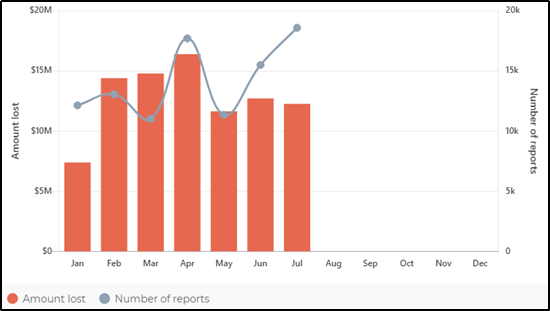
Amount lost and number of reports (Source: Scamwatch Website)
GOOD READ: Can Cybersecurity Industry Be a Part of New Defensive Strategy of an Investment Portfolio?
Dating and Romance Top the List of Scams
Upon funnelling down further, the data from Scamwatch indicates that dating and romance related scams remained at the top of the chart and amounted to $3,909,743 lost. These were followed by investment scams which totalled to $3,616,199. Next in line are online scams which cost $757,802.
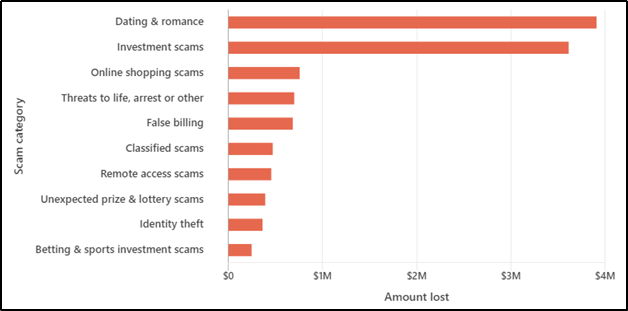
Top 10 Scams by The Amount Lost (Source: Scamwatch Website)
Interestingly, people aged between 25-34 years reported losing personal information more than any other age group as scammers look like targeting the personal information of individuals more than ever. Moreover, this has resulted in growing financial losses across all the scams. There has been a sharp rise in scammers seeking personal information of individuals, mostly over the phone, through mobile applications as well as emails and even personally.
Delia Rickard, ACCC Deputy Chair, said that scammers should try to steal extremely valuable personal information like bank and superannuation details or passwords for their financial gain. Also, the rise in the usage of technology has led to more opportunities for scammers to become more active.
Other than bank and superannuation details, scammers can also attempt and steal a range of other documents like passports, credit cards, driver licences, utility bills, Medicare cards or tax statements, or even the numbers linked with them, for impersonation.
INTERESTING READ: Opportunities and Challenges for Cybersecurity
44% Rise in Phishing Scams
Notably, the most common form of scam, phishing scams, have risen by 44% as compared to the same time previous year. It is commonly reported under phishing scams that scammers tend to gain bank account details and other information about a person by pretending to be from government departments and businesses, like the ATO, myGov, Telstra or the NBN, so that their information can be used to impersonate them.
Moreover, Scamwatch reported that it received more than 3,900 scam reports mentioning the coronavirus exceeding $3.1 million in reported losses since the emergence of COVID-19. The common scams include phishing for personal information, online shopping, and superannuation scam.
In a fresh attempt to con individuals, scammers are phishing for people’s personal information by pretending to be government agencies providing information on COVID-19 by way of emails and text messages.
These emails and text messages also contain malicious links and attachments that can easily steal your personal as well as financial information. Moreover, scammers even pretend to offer help with applications for financial assistance or payments for staying home.
Few tips can help to stay vigilant and protect your personal information:
- Do not feel pressurised to share any kind of personal information to someone who tries to ask for the same through any means of contact, no matter how realistic they may pretend to be or what they say.
- Abstain from clicking on any links in emails and messages that are unexpected, disregarding the fact that it may be from a legitimate source.
- Try to set a strong password for all your accounts as well as internet network, and never share the same with anyone.
- Keep an anti-virus software installed on your device and make sure it is up to date.
- Put a limit to the amount of your personal information that you share online, comprising social media platforms.
Other than these, a person can perform his/her research to verify if someone is who they claim to be individually. Moreover, people can also look for tools that help in checking and protecting online security.
A Stich in Time Saves Nine
In essence, an individual’s personal information is an extremely valuable possession. If one loses his/her personal information in the wrong hands, it can cost a lot more than just money. It could take years to recover one’s identity once their personal information is lost. Therefore, an individual needs to be extra careful while attending calls or dealing personally with people who ask for your personal information.
NOTE: $ denotes Australian Dollar unless stated otherwise.
