
 AUS
AUS
 NZ
NZ
 UK
UK
 CA
CA
 USA
USA
 IND
IND







Summary
- Airbnb released prospects to go public on the Nasdaq Stock Exchange under the ticker ABNB.
- Airbnb, in its prospectus, indicated a rise of 29% in Gross Booking Value (GBV) and 32% in revenue in 2019 compared to 2018.
- COVID-19 significantly impacted the material performance of the Company, with GBV during the nine months ended 30 September 2020 down by 39% to US$18 billion over the year.
- Airbnb raised US$2.0 billion in the form of term loans in April 2020 while also undertaking several cost-cutting measures to sail through COVID-19 crisis.
Airbnb is once again stealing the thunder as it is ready to make its debut on the US public markets. The San Francisco-based rental online marketplace is gearing up for the year’s one of the most anticipated Initial Public Offerings (IPO).
The COVID-19 pandemic has induced massive transformations, blurring the lines between travel and living as the Company files for an IPO at the US Securities and Exchange Commission. The Company has applied its Class A common stock on Nasdaq under the symbol ABNB. It aims to raise around US$3 billion through its IPO and have a valuation of US$30 billion.
Airbnb, which began thirteen years ago with its two founders looking to cover the rental cost of their apartment, has now more than 4 million hosts providing accommodation services. Meanwhile, the decentralised peer-to-peer economy of the Company facilitating the sharing of services has gained massive popularity both among the hosts and the renters.
With hosting as the foundation of the Airbnb experience, the Company has not only enabled home-sharing at a global level but has also created a new travel category.
ALSO READ: Airbnb Starts Prep For IPO, May List in 2020
Lens on Airbnb’s latest Financial Performance
The Company, since its inception, has witnessed massive growth in its popularity. Airbnb in its prospectus indicated that it recorded a Gross Booking Value (GBV) of US$38 billion in 2019, marking a growth of 29% over 2018, which recorded GBV of US$29.4 billion.
Meanwhile, the revenue for the Company also edged higher by 32% from US$3.7 billion in 2018 to US$4.8 billion in 2019. However, Airbnb has a net loss of around 670 million in 2019, which was substantially higher compared to a net loss of US$16.9 million in the previous year.
In addition, Airbnb had an Adjusted EBITDA of US$(253.3) million during 2019 against Adjusted EBITDA of US$170.6 million in 2018.
COVID-19 has significantly impacted the material performance of the Company. During the nine months ended 30 September 2020, its GBV was down by 39% to US$18 billion over the year. Meanwhile, the revenue dwindled by 32% to US$2.5 billion in the same period. Net cash used in operating activities also saw a drop of US$909.7 million year-over-year.
ALSO READ: As the US markets Zooms, IPO bell rings - Airbnb to hit the floor
COVID-19 Impact on the Business
Airbnb took a hit a major hit due to COVID-19 pandemic’s disruptive repercussions on the travel sector as the firm witnessed a decline in its bookings. Significantly, the border closures impacted the number of international tourists and the apprehensions concerning the infection also affected the influx of guests.
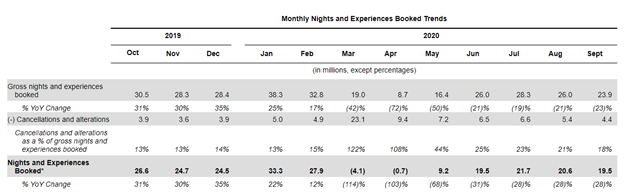
The Company faced material contraction in the gross nights and experience booked, with April recording a drastic fall of 72% on a YOY basis.
Source: Airbnb Prospectus filed on November 16, 2020
Meanwhile, the apprehensions regarding the safe travelling and the imposition of the curb of public movement transcended in the significant increase in the cancellations and alterations. The cancellations were significantly higher during March when the Governments across the globe took sudden lockdown measures to prevent COVID-19 infection. Although the recovery trend has been picking up momentum with the material rise in the booking, Gross Booking Value has remained down on a year-over-year basis.
Airbnb expects continued volatility in the business as the COVID-19 infection remains rampant in many parts of the globe. The implementation of recent lockdowns and prohibitions could impact the Company’s business and financial results.
ALSO READ: European countries are re-imposing lockdowns amid the second wave of Coronavirus
Resilience from Pandemic effects
The individuality of each Airbnb’s hosts offers a novelty to the Company’s business. The Company has a presence in more than 220 countries, with 86% of hosts situated outside the US. The gradual economic reopening, the Company’s business model, has demonstrated resilience as many travellers have set out to explore their backyards through domestic travel.
The Company raised US$2.0 billion in the form of term loans in April 2020 to offer a cushion to its business from the pandemic-related disruptions and ensure liquidity. Meanwhile, the Company undertook several measures to reduce operating expenses, including layoffs of 25% of its employees. The domestic travel or short-distance travel within 50 miles along with long-term stays of at least 28 nights have remained as a silver area for the business of the Company.
DID YOU WATCH: Trends Shaping the Australian Travel Industry
Airbnb in its prospect indicated substantial prospects as a fair section of globetrotters putting their travel goals into effect. As per Airbnb’s estimation, it has a serviceable addressable market of US$1.5 trillion, with a predominant proportion contributed through short-term stays.
Airbnb’s unique business model together with its global network of host communities connected by a custom-built platform and managed via design-driven approach, continues to offer a competitive advantage to the Company. Meanwhile, with its introduction in the public market amidst the pandemic scenario, the company is grabbing significant spotlight.
