
 AUS
AUS
 NZ
NZ
 UK
UK
 CA
CA
 USA
USA
 IND
IND








Summary
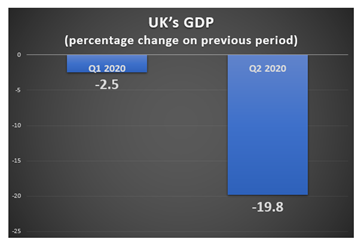
- Revised ONS data depicts that the national GDP contracted by 19.8 per cent during Q2 2020
- It was the worst contraction seen amongst the major economies of the world
- IMF has warned that unless rich nations hand-hold the poorer ones to sail through the crisis, inequalities would rise
- FTSE 100 dropped with the fears of Covid-19 resurgence and Brexit uncertainties
Revised data has been released from the Office for the National Statistics (ONS) which revealed that the economic output in the UK dropped by 19.8 per cent as against the initial estimates of 20.4 per cent for the second quarter of the year 2020. This is by far the sharpest recorded quarterly GDP (gross domestic product) fall in the British history.
Overall, the revised estimates suggested that the British national income plummeted by 21.8 per cent during the first half of 2020. The fall has been spread across the sectors of construction, production, and services and has been more severe in industries vulnerable to government restrictions such as airlines, hospitality, and physical retail shops.
Once the lockdown period was over, the economy had started to get back to the recovery track. However, the renewed coronavirus restrictions would once again put a break on the economic growth in the UK, and the national economy is projected to be smaller by roughly 5.5 per cent than its pre-Covid size, according to Ruth Gregory, senior UK economist, Capital Economics.
Britain’s falling output was also the fastest decline in GDP among G7 nations for the second quarter of 2020. For instance, the French economy grew by minus 18.9 per cent for Q2 2020 while the Italian economy became smaller by 17.7 per cent for the same period. Economic growth also pulled back in all other G7 members including Canada (13 per cent), Germany (11.3 per cent), Japan (9.9 per cent), and USA (9.1 per cent) for the same quarter.
On the sidelines, the IMF has forecasted that overall, the world economy stands to lose around $12 trillion due to the pandemic led crisis. It has also cautioned on maintaining a healthy economic balance between the haves and have-nots of the world, going forward.
(Source: Office for National Statistics, UK)
IMF’s warning
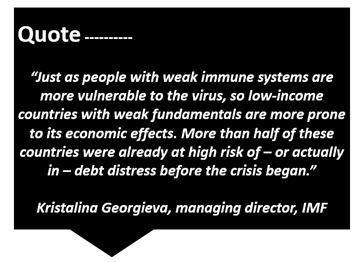
The International Monetary Fund (IMF) has warned that the coronavirus might lead to a lost generation in case corrective steps are not undertaken to control the damage which has already taken place. The global body cautioned that the crisis could leave the world with a higher gap between the rich and poor nations.
Financial assistance to the poorest nations needed to be stepped up to prevent any long-term social and economic damages, said Kristalina Georgieva, managing director, IMF.
Seventy nations were most vulnerable to the threats posed by the coronavirus pandemic, she lamented. These countries experienced lower exports, minimal capital inflows, and lesser tourist arrivals post March 2020, when the pandemic struck the world.
Georgieva has called for a four-pronged approach to minimise the impact on low-income nations:
- Nations should focus on health and take special care of the needs of the elderly and the most vulnerable parts of their populations.
- Annual budgets should prioritise education and lowering corruption as their top agenda items.
- The transition to becoming low-carbon and digital economies should be speeded up.
- Rich nations should raise their support to the needy ones in the forms of aids, loans, and reliefs.
In the absence of these measures, there are chances of a social disruption, which is not desirable. More than 100 countries have sought monetary help from the IMF till now to sail through the rough impact of the Covid-19 pandemic.
The global fund predicted the poor economies to grow at a nil rate for the FY 21, as compared to a relatively decent 5 per cent growth recorded during FY 20.
FTSE 100 dropped
FTSE 100 tumbled with the rising uncertainty with respect to the coronavirus pandemic and risks associated with a possibility of a no-deal Brexit. Meanwhile the new data confirming a record contraction in the British GDP for the second quarter also seemed to lower the investor sentiments.
The blue-chip FTSE 100 index opened at a value of GBX 5890.34 points on 30 September 2020 as compared to its previous day’s close value of GBX 5897. 50, which was a drop of 0.12 per cent. The fall was mainly led by oil & gas and healthcare stocks.
The FTSE 100 index has seen a wide variation throughout the year. Its 52-week range was recorded as GBX 4,993.89/7,674.56 on a YTD (year to date basis) with a negative return of 23.16 per cent.
Leading market analysts pointed out that issues of Brexit and Covid-19 need to be attended in a fast-paced and definite manner by the UK government to bring stability to the stock market else volatility could rise as the investors look to rebalance their portfolios. Investors seem worried over the further stress on the national economic growth due to the onset of the second wave of the deadly virus across Britain.
To sum up, the British economy is undoubtedly going through an unforeseen rough patch. The economic output shrunk by almost one-fifth during the second quarter of 2020, depicting the sizeable impact the pandemic had on the national income. With the re-opening of the economy during the third quarter of the year, there was a renewed optimism with respect to the country’s growth. However, the resurgence of infections has raised new fears and the negative impact would be visible in the growth numbers of the last quarter of 2020, predict the economic experts.
