
 AUS
AUS
 NZ
NZ
 UK
UK
 CA
CA
 USA
USA
 IND
IND


.jpg)





Summary
- Property market flouted pandemic predictions as 8 regions of NZ, and 17 cities declared record median sale prices for August as per REINZ data
- About 7,652 residential properties were sold in the month, up 24.8% on pcp, the largest number of homes sold in August for 5 years while the median number of days to sell property fell from 39 to 34 in the month, lowest for August in 4 years
- Economists expect a slowdown in the housing activity as several headwinds continue to affect the housing market of NZ
- San Francisco Bay area has been choked with the sky turning apocalyptic orange amid wildfire smoke for weeks
- Metro areas of California dominate the list of US cities with the worst air pollution while NZ is amongst the cleanest countries to live in
House prices in New Zealand have hit a record high amid COVID-19 as sales improved after lockdown and people looked at renovating their homes due to increased amount of time spent there.
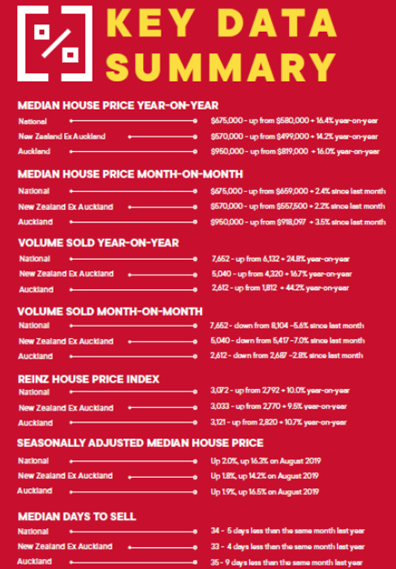
As per the latest sales figures from Real Estate Institute of New Zealand; REINZ House Price Index for NZ rose 10% YOY in August to a new high of 3,072. A total of 8 regions of NZ and 17 cities posted record median sale prices in August with the property market challenging COVID-19 driven predictions and going against the norms.
Median house prices in NZ rose 16.4% to NZ$675,000 in August 2020, up from NZ$580,000 in August last year and up from NZ$659,000 in July 2020 while median house prices for New Zealand with the exception of Auckland soared 14.2% to a new record median price of $570,000.
ALSO READ: Housing Sales And Prices Rising, But Can They Be Sustained?
Nationally the median number of days to sell property fell by 5 days in August 2020, from 39 to 34 compared to August 2019, shortest for August in 4 years. Further, auctions were still the most popular method of selling and helped to achieve 16.1% of the sales across NZ, the highest percentage of auctions for August in 4 years. About 1,232 properties sold under auctions, up by 10.6% on pcp when 650 properties were sold.
Source: REINZ, dated: 11 September
Bindi Norwell, Chief Executive at REINZ, stated that the recovery in the housing market after the lockdown has been astonishing and has outstripped many predictions. The mix of low-interest rates, lack of listings, increased desire for more space/ larger backyard, and elimination of LVRs are motivating buyers (purchasing for the first time) desire to get onto the market. Newcomer purchases add up to a substantial part to the uptick in the prices witnessed in the last few months. However, she cautioned that more listings must come to the market before Christmas failing which more pressure will be built on house prices and their affordability.
GOOD READ: How to get easier House loan with Loan-to-value ratio(LVR ) in New Zealand?
She also added as witnessed in the past, the sales volumes start to rise in warm weather, but it remains uncertain how the sales will fare going ahead. The full impact of COVID-19 remains to be studied primarily in relation to unemployment and the economy.
Highest number of properties were sold in August 2020 in last 5 years
As per the date from REINZ, let us go through the highlights of the properties sold and the regions that saw the highest variations in annual sales volumes in August are as follows:
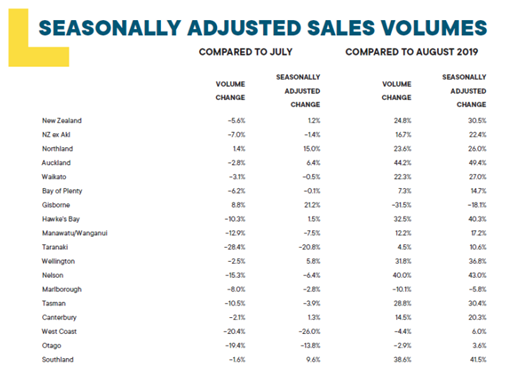
- The number of residential properties sold across NZ rose by 24.8% to 7,652 from 6,132 when compared to August 2019
- The number of residential properties sold for NZ excluding Auckland increased by 16.7% on pcp to 5,040
- The largest rise in annual sales volumes in regions outside Auckland was seen in Nelson (+40%) followed by Southland (+38.6%), Hawke’s Bay (+32.5%) and Wellington (+31.8%)
- Gisborne, Marlborough, West Coast and Otago witnessed an annual fall in sales volume.
Source: REINZ, dated: 11 September
Ms Norwell noted that level 3 lockdown least affected Auckland in August as it witnessed the highest number of properties sold for 5 years. This also highlights that changing with times and adopting the latest technology such as digital tools could be a vital factor in keeping the property market moving.
ALSO READ: What next in Property Space: House prices tumbled 0.4 per cent in August
ASB Economist, Mike Jones stated that August was an odd month given the unexpected shift to Alert level 3. Another 1 or 2 months will reveal the real picture of the housing activity. ASB expects a housing market slowdown ahead with mortgage repayment holidays, wage subsidies and interest rates acting as crosswinds. He also notified that the bank had upgraded the previous forecast of a 6% fall in house prices to just a 3% drop by March 2021.
San Francisco’s sky turns orange while NZ- the northern star
Residents in San Francisco woke up to a strange and apocalyptic orange sky on 9 September with social media getting swamped with images of the sky that looked hazy orange and ash-filled due to smoke from major wildfires across Northern California.
However, the winds subsided a day after, i.e. 10 September, while the air quality at the ground level worsened when a marine layer and high winds in the mid to upper stretches of the atmosphere kept the smoke from settling in lower elevations. The worst pollution occurred in San Francisco and Oakland as well as in a few Sonoma County towns, especially, Sebastopol as per the Bay Area Air Quality Management District statistics.
The fires began in the Bay area and surrounding regions on 16 August after a storm of 11,000 lightning strikes. Pollution in the Bay area is partially due to local fires that blew up and were blown back in Santa Cruz mountains and the North Bay. However, it also comprises particulate pollution carried South on 9 September from fires as distant as the Washington state.
The past fires have revealed that they result in a rise in ailments, one of them being asthma, and hence, people are being asked by authorities to stay inside their homes and run air filters. Many California cities fall under the list of most polluted cities in the US.
However, for NZ, the case is just the opposite. The country has been known for good air quality due to fierce winds arching in from the sea, low urban population, and scarcity of heavy industries.
ALSO READ: Shopping trends in a Post-Pandemic Environment: Any takers on NZX
All shopping, travel and dining out came to a halt due to COVID-19 induced lockdown, which positively reduced pollution levels as well. Nitrogen oxide levels fell by as much as 90% in Auckland at the end of March. The lockdown in the country has further improved the air quality. Coronavirus has shown how the environment gets affected by our daily lifestyle.
