
 AUS
AUS
 NZ
NZ
 UK
UK
 CA
CA
 USA
USA
 IND
IND








Summary
- NZ economy is anticipated to plunge sharply in the June quarter due to fresh coronavirus lockdown in Auckland hampering recovery expectations of the country
- ASB Quarterly economic forecast for September has predicted that NZ economy will shrink by 5% YOY by the end of 2020 and about 8% has been shaved off from the NZ weekly GDP due to imposition of August lockdown
- RBNZ has cautioned of the risks of low inflation or deflation and showed a preference towards negative interest rates
- NZ 2-year bond yield was at 0.03% on 9 September after falling into the negative territory due to investor expectations of easing of policy ahead by RBNZ to lift the economy
- Markets are pricing in the probability of negative cash rate in NZ, despite which the demand for government bonds remained robust in an auction on 10 September
New Zealand has been leading the world in battling coronavirus. The country has been applauded globally for its effective control on coronavirus by imposing strict and early 7-week lockdown in April and May. However, the country witnessed a second wave cluster in August in Auckland after which the city was put in two-and-a-half week lockdown that ended on 30 August.
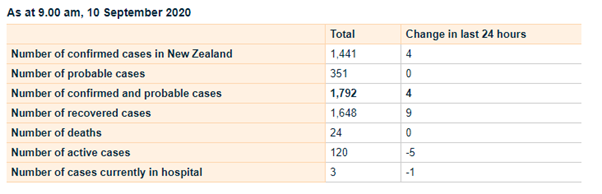
New Zealand, a small nation of 5 million, has reported 1792 coronavirus cases and 24 deaths till date. The country still has 120 active cases.
Source: Ministry of Health, NZ
NZ economy better than anticipated amid COVID-19 challenges
NZ economy experienced its greatest contraction in 29 years during the first 3 months of 2020 with GDP shrinking 1.6% in January to March quarter. However, the GDP figures are expected to be much worse for the June quarter and are due to be released on 17 September.
The latest ASB Quarterly Economic forecast report released in September has predicted that the NZ economy will plunge 5% YOY by the end of 2020.
The 5% fall would be an improvement of 1% in the earlier 6% decline forecasted in the May report. The report has also predicted the unemployment rate at 7.5% while house prices to drop by 3%, which have also shown improvement from earlier predictions.
ALSO READ: NZ Economic Charter: Three Silver Linings in the COVID-19 Cloud
Nick Tuffley, Chief Economist of ASB, has stated that a relatively faster shift of Auckland from a strict lockdown in March to Alert level 1 helped in limiting the damage caused to the economy in the near-term. He stated that August lockdown is projected to trim 8% of the weekly GDP of NZ and more than NZ$1 billion in lost economic activity.
RBNZ considering negative policy rate
The central bank of New Zealand is actively pondering implementation of negative interest rates to tackle the economic fallout of COVID-19. Reserve Bank of New Zealand (RBNZ) kept its official cash rate at 0.25% in the August meeting and expanded the Large Scale Asset Purchase (LSAP) programme of NZ government bonds to up to NZ$100 billion. The committee considers lower or negative rates, a Funding for Lending Programme, purchases of foreign assets and interest rate swaps as policy optionality that could be looked at in the future.
ALSO READ: RBNZ's Balance Sheet To Expand Further In Response to COVID-19 | NZ Market Update
Governor of RBNZ, Adrian Orr in a speech to the Victoria University of Wellington School of Government, stated that the bank has been in talks to bring in negative interest rates to support COVID-19 hit NZ economy. The bank plans to implement monetary policy in a way that thrives in achieving dual goals of monetary and financial stability. It has been in discussions of a package that includes a combination of lower interest rates, direct lending to banks, and ongoing quantitative easing.
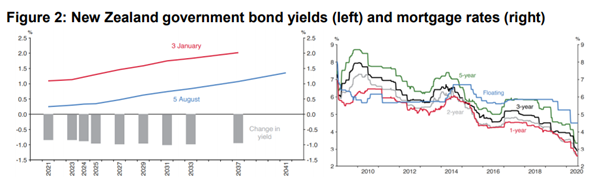
He also asserted that cash rate cuts have had substantially higher pass-through to mortgage rates than usual. Government bond yields have been at least fifty basis points lower and maybe more than hundred basis points lower than they would have been without the LSAP programme.
Source: RBNZ’s Victoria University speech, dated: 2 September
He also cautioned of the risks of low inflation or deflation that may arise due to supply cuts by health-driven social restrictions, interrupting production and separating businesses from their domestic and global supply chains and customers. Households have been unable to consume, partly due to lockdowns, but also due to increased caution. And businesses have been similarly constrained and concerned about their future. If the above scenario sustains , it can result in low inflation and high unemployment rate.
RBNZ aims to push wholesale rates to negative, bringing retail rates down to 0 and subsequently encouraging more demand for debt.
NZ bond yields sank into negative territory
On 10 September, NZ wholesale rates went below 0 as investors expected that the central bank would need to ease the policy rate, betting on negative rates to get the economy back on track.
The yields on 2-year NZ bonds slid into negative territory for the first time on 9 September and later rising to 0.03%. The rate on 5-year bond also stood at a mere 0.05% showing that the street is betting on the rates to stay low for a longer duration. Negative or near 0 yields reflect that the markets are taking into account the fact that the official cash rate will go negative in NZ.
GOOD READ: RBA: Negative Interest Rates Extraordinary Unlikely, Less Severe Economic Downturn Expected Ahead
Conventionally, negative bond yield is an uncommon situation where issuers of debt are paid to borrow; however, things have changed on this front in the post GFC era. It is a situation when an investor gets less money than the original buy price of the bond at the time of maturity.
Despite the low yields and a probable negative rates ahead, NZ government bonds were in huge demand at an auction on 10 September with NZ$50 million offer getting bids valued at NZ$90 million. The 2-year April 2022 bonds stood at 0.16%-0.18% while the 2029 bonds got bids near 0.81%-0.83%.
ALSO READ: Bond Yields Plummet Globally Amid Lower Interest Rates & US-China Trade Conflict
NZ dollar stood at 0.666 on 10 September, falling 0.22% from the previous day. Foreign exchange strategists at JP Morgan have predicted that New Zealand dollar is expected to fall in the weeks ahead due to predictions of an interest rate cut by RBNZ to 0% or below in as early as November.
All Currencies are in NZ$ unless stated otherwise.
