
 AUS
AUS
 NZ
NZ
 UK
UK
 CA
CA
 USA
USA
 IND
IND







Summary
- The Boris Johnson government wants to make the alteration to ensure that businesses in Northern Ireland do not have to fill export summary declarations for goods entering Great Britain
- The proposed changes are required before the expiry of the EU regulations which are applicable to the country till 31 December 2020.
- These alterations would impact Great Britain's political and economic treaties with Northern Ireland which were entered into when the UK as part of EU.
The Pulling out of the United Kingdom from the European Union is creating unforeseen complications for both for the UK as well as the EU. The latest controversy to hit both these economic blocs is a statement made by cabinet minister Brandon Lewis that the UK would be breaking the international Brexit treaty with EU relating to Northern Ireland. The statement which came as a surprise to several of British parliamentarians and also rang alarm bells in the Northern Ireland parliament along with Brussels, home to the EU parliament. The trigger for this controversial decision seems to be the rising possibility of the failure of the Brexit talks before the 31 December 2020 deadline, necessitation realignment of relationships with EU and Northern Ireland.
Brexit and how will it apply differently to Northern Ireland?
When the United Kingdom decided to leave the European Union, Northern Ireland decided to be part of the UK while the republic of Ireland decided to stay with the EU. At that time, both the economic blocs had divergent opinions on how custom checks will be imposed on goods movement between Northern Ireland and Great Britain. While the British government insisted that there should be no checks or restrictions of any kind on the movement on goods, the EU side insisted that new administrative processes would have to be imposed. However, during the pull-out on 31 January 2020, both sides had agreed to continue negotiating for a deal till 31 December 2020, during which this issue was expected to be amicably settled.
The outbreak of the coronavirus pandemic and the subsequent lockdown resulted in this negotiation process getting delayed severely. When the negotiations did resume, there were sharp differences between the negotiators of both sides. Till late into August 2020, the deadlock in talks could not be resolved leading many to believe that an agreement may not materialise by the 31 December 2020, the due date leading to a no-deal Brexit.
This would mean that new custom tariffs and admirative procedures would have to be imposed in goods transacted between both sides, including those between Northern Ireland and the rest of the United Kingdom. This could effectively mean that Northern Ireland's economy is separating itself from the British economy, thereby contracting the size of the economy by a proportionate amount which is something that is not acceptable to the United Kingdom.
The Brexit deal and its importance to the United Kingdom
The successful negotiation of the Brexit deal is of extreme importance to businesses on both sides. During the forty-seven years that both the economic blocs were together, deep trading relations had developed between businesses on both sides. These business relations which were based on the reduced tariff structure on goods and people moved within the bloc and helped them to be large and competitive in relation to their international counterparts. When both sides parted ways, and new tariffs are to be imposed, and these trading relations are now at the risk of falling apart. Businesses on both sides would lose their competitive advantage leading to a fall in the share in international trade.
The Brexit negotiations thus were designed to address this particular issue and keep the tariff structure between the two sides and similar as possible to the structure when they had not parted ways. Thus, administrators on both sides are under immense pressure to complete the negotiation process and arrive at an amicable deal before the deadline.
The breaching of the International law, and its implications
After several rounds of negotiations both UK and EU are not able to agree on few major issues; one is the role of the European court of justice, second, on the fishing rights and the third and the most important one is of state aid rules to businesses on both sides.
The current controversial statement made by the British cabinet minister relates to these issues. The breach of the international law that is being talked about seeks to separate Northern Ireland from the stand taken by the EU on these key issues so that trade between rest of UK and Northern Ireland does not suffer.
However, this move will not put the countries relations at risk with Northern Ireland but will also bring about significant reputational damage to the country. The Northern Ireland parliament has also been very critical of the stand taken by the British government and have decided to take it as an issue that undermines its economic freedom.
The stand taken by senior Tory party leaders and other British parliamentarians would put significant pressure on the British government to come up with a solution which is agreeable to all. Though a successful negotiation of the Brexit deal will be an ideal case scenario, if it does not materialise; alternative ways have to be found to protect the interest of all parties.
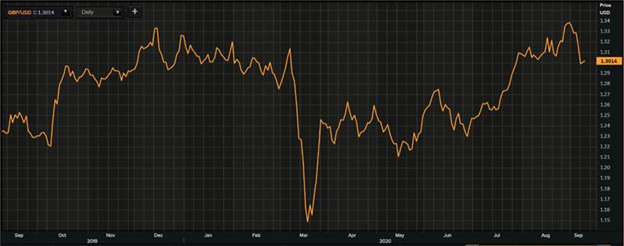
British Pound/ USD since the beginning of the year when deal negotiation started after the pull-out
(Source – Thomson Reuters)
The British pound sterling has been reacting to all the developments of the Brexit since the beginning of the year; the British currency has been underperforming against the US Dollar. On 2 January 2020, the currency was available at the exchange rate of 1.3254 USD per Pound, and towards the mid of March, it took a sharp turn downwards to reach a low of 1.164 on 18 March 2020. Since then, however, it has made a recovery, and as of 9 September 2020 at the close of trade, the currency was quoted at 1.3014 against USD.
