
 AUS
AUS
 NZ
NZ
 UK
UK
 CA
CA
 USA
USA
 IND
IND







Source: DCStockPhotography, Shutterstock
Summary
- Global economy is estimated to grow 6 percent in 2021 after contracting 3.3 percent in 2020.
- Additional fiscal support in a few large economies particularly the U.S. boosted the outlook.
- Global economy contracted 3 percent in 2020 while the U.S. economy contracted 3.5 percent.
The International Monetary Fund on April 6 upgraded its growth outlook for the U.S. economy to 6.4 percent in 2021 while projecting the global economy to expand at 6 percent.
In 2022, the U.S. economy and global economy are forecasted to grow 3.5 percent and 4.4 percent, respectively.
Earlier, the fund expected the U.S. real GDP growth in 2021 to be 5.1 percent, while in 2022 the growth was estimated to drop to 2.5 percent. The global economy was projected to expand at 5.5 percent in 2021.
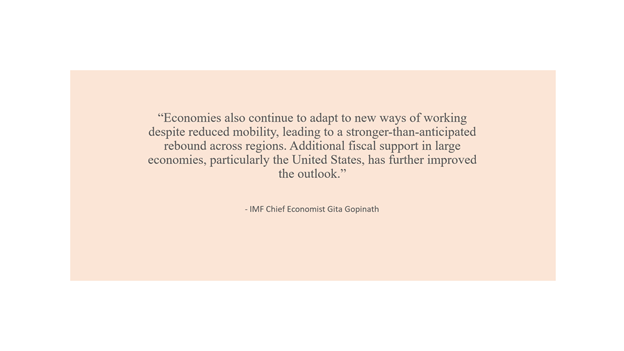
The IMF attributed the updated guidance to additional fiscal support in large economies, particularly in the U.S., and the anticipated vaccine-led recovery in the second half of the year.
@Kalkine Image 2021
The U.S. is the only large economy projected to surpass the GDP level forecast for 2022 in the absence of this pandemic, said IMF chief economist Gita Gopinath. The US$1.9 trillion stimulus package is expected to further boost the economy.
The global economy is estimated to have contracted 3.3 percent in 2020, while the U.S. economy contracted 3.5 percent.
The Euro area which includes Germany, France, Italy and Spain is expected to grow 4.4 percent in 2021, while the Chinese economy is projected to expand 8.4 percent this year.
The medium-term losses from the pandemic are expected to be lower than after the global financial crisis. Global output in 2024 is estimated to be down 3 percent from the pre-pandemic expectation.
Source: Pixabay
Meanwhile, the IMF forecasts the average annual loss in per capita GDP over 2020–24 in low-income countries relative to pre-pandemic forecasts to be 5.7 percent. The loss is projected at 4.7 percent and 2.3 percent for emerging markets and advanced economies, respectively.
The fund also projects that an additional 95 million people have entered the ranks of the extreme poor in 2020 compared with its pre-pandemic projections.
The IMF has also warned that several factors such as a more prolonged pandemic, new COVID mutation that evades vaccines can lead to a sharp downgrade. Unexpected rise in the U.S. interest rates can also pose financial risks.
