
 AUS
AUS
 NZ
NZ
 UK
UK
 CA
CA
 USA
USA
 IND
IND








Summary
- JobKeeper and JobSeeker payments were introduced to give support to businesses suffering financial losses due to COVID-19.
- From 28 September 2020 to 3 January 2021, wage subsidy will be slashed from $1500 per fortnight to $1200 for full-time workers and $750 per fortnight for part-time workers.
- Further cuts in wage subsidy from 4 January 2021 to 28 March 2021 with JobKeeper payments being limited to $1000 per fortnight for full time workers and $650 per fortnight for part-time workers.
- The eligibility criteria for JobKeeper has been relaxed with a less stringent turnover test, implying businesses will have to show a substantial revenue fall in the September quarter rather than for multiple quarters since the pandemic.
Government's JobKeeper and JobSeeker support schemes have rescued more than 2.2 million workers when millions of Australians have been pushed into unemployment or are witnessing shortened work hours. These payouts also assisted in reducing measures of housing stress and poverty.
When introduced, the JobKeeper stimulus provided $750 per employee per week and JobSeeker payments provided about $1100 a fortnight including $550 coronavirus supplement and $612 pre-tax JobSeeker payment for singles and $510 pre-tax payment for couples.
ALSO READ: JobKeeper Scheme to cost an extra $15 billion amid Victoria crisis
In June 2020, the Australian government completed a 3-month review of the JobKeeper scheme. The study revealed that while the present scheme met its original goals of promoting businesses and job sustainability, the Australian labour market remains fragile and requires more macroeconomic support.
DO READ: All you need to know about JobKeeper Payment scheme
A lower new JobKeeper rate
Keeping in mind the findings of the review, on 21 July, the Federal Government announced an extension of JobKeeper scheme until 28 March 2021 intending to help organisations that have been significantly affected by the coronavirus pandemic.
On 1 September, the Federal government passed the extension to the $100 billion JobKeeper scheme, officially giving affirmation to a lower rate of JobKeeper from September end.
Source: Treasury
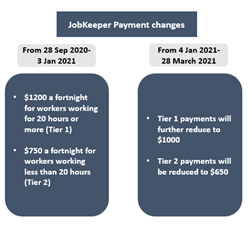
From 28 September 2020 to 3 January 2021, JobKeeper payment is set to reduce from $1500 a fortnight to $1200 per fortnight for full-time workers. Further, the JobKeeper payment will be reduced to $750 per fortnight for part-time workers, i.e. employees working for less than 20 hours a week.
From 4 January 2021 to 28 March 2021, JobKeeper payments will decrease further to $1000 per fortnight for full-time workers and $650 per fortnight for part-time workers.
Labour leader Anthony Albanese had highlighted that many workers, (mainly part-time and casual staff) were gaining from the existing scheme and were earning more income than they otherwise usually would.
There were also complaints that many workers did not turn up to their shifts as they could stay at home on government payments.
DO READ: JobKeeper Lifting Returns for Investors: A Look at 6 ASX listed Stocks that benefitted
Eligibility changes for employee and employers
From 28 September 2020, businesses will be required to show that GST turnover has fallen in September quarter of 2020 for getting the first extension and the December quarter of 2020 for the second extension compared to the previous corresponding period to receive the fortnightly payments.
Businesses would also need to show that in this quarter, they have fulfilled the required decrease in turnover requirements to be eligible for JobKeeper from 28 September 2020 to 3 January 2021. Further re-assessment of eligibility will be taken from 4 January to 28 March 2021.
Businesses need to provide a monthly declaration along with meeting the drop in the turnover test. It is mandatory for employers to pay the applicable fortnightly JobKeeper amount to the eligible employees.
MUST READ: The new JobKeeper might cause bankruptcies for businesses
Businesses, who have already registered for JobKeeper for fortnights before 28 September, need not to re-enrol for the JobKeeper extension and qualifying companies will be able to enrol in JobKeeper before the support expires.
The eligibility criteria for JobKeeper has been relaxed with less stringent turnover test, implying businesses will have to show a substantial revenue fall in the September quarter rather than for multiple quarters since the pandemic.
GOOD READ: Withdrawal of Wage Subsidy Packages early can bog down Australian economy
More access will also be provided to employees liable for reimbursement from 28 September, with the date they need to be employed modified by the government from 1 March to 1 July. The move would offer newer employees access to the programme.
ALSO READ: Morrison government revamped rules lets one take a dip into JobKeeper and JobSeeker dole outs
JobKeeper cuts to hit the Australian economy
OECD has stated in its September interim economic outlook that the Australian economy is set to plunge by 4.1% in 2020. OECD estimated that the economy would grow by 2.5% in 2021, down 1.6% from its June forecast due to border closure, new restrictions and localised lockdowns.
INTERESTING READ: RBA charts out Economic Recovery Forecasts apparently with 'No Vaccine Roll-out' assumption
Labour's Treasury spokesperson Jim Chalmers stated that it does not make sense for the government to slash JobKeeper without any jobs plan when the economy is facing deepest recession and elevating jobs crisis.
He also added that the recession would be more profound with long unemployment queues because the Australian government is leaving too many people behind by cutting income support. He noted that OECD has also joined RBA and many economist's calls for more support with the Australian economy likely to be dimmer for a longer duration.
ALSO READ: Is Australia ready for the JobSeeker cord being pulled?
