
 AUS
AUS
 NZ
NZ
 UK
UK
 CA
CA
 USA
USA
 IND
IND








Summary
- On 1 September, Australian Senate passed the extension to JobKeeper Payment announced in August for payments to continue over the next 6 months but at a lower rate.
- Part-time workers will be the most affected and earn less on the new $750 a fortnight JobKeeper Payment than the new unemployment payment of $815 a fortnight under the revamped scheme.
- The double-dipping strategy to claim both JobKeeper and a part-rate of JobSeeker is being encouraged for workers forced to join the dole queues due to COVID-19 shutdown.
- The new rules would not prove as a disincentive to find work, as Treasury has made a point that businesses still on JobKeeper would be making payments in addition to JobKeeper to staff working for extra hours.
- Morrison government also increased the amount one can earn on JobSeeker to $300 a fortnight with a taper rate lowering welfare payments if the person earns more.
JobKeeper and JobSeeker subsidies by the Australian government came to the rescue of more than 2.2 million people from falling into poverty as millions had come under the unemployment net or were facing reduced work hours.
On 1 September, the Australian government passed an extension to JobKeeper subsidy. The Federal government declared an extension to JobKeeper for another 6 months but with reduced payments in August.
Under the new scheme, workers who work less than 20 hours a week will get $750 a fortnight while those working for more hours will receive $1200 (earlier $1500), beginning 28 September. The arrangement will last till 3 January, post which another phase of the program will be started with the larger payment sliding to $1000 a fortnight while the smaller payment to $650 from 4 January until 28 March.
The coronavirus supplement given to JobSeeker recipients will be cut by $300 from the end of September with the workers getting $800 a fortnight until the end of the year, as per the new changes.
GOOD READ: The new JobKeeper might cause bankruptcies for businesses
The new JobKeeper scheme will make more businesses and workers eligible for the it. Businesses that have experienced a drop of 30% in their turnover compared to the same quarter in 2019 and employees who held job in a company up to 1 July will be eligible for the new scheme.
Treasurer Josh Frydenberg stated that nearly 530k Victorians would need the subsidy in the September quarter while declaring the modifications in the schemes in August.
About 1 million Victorians are dependent on JobKeeper as a state continue to witness a double-digit rise in the daily cases. Victoria had 1,483 active cases with a total of 19,728 cases, and 701 lives lost, as on 10 September (at AEST 3:45 PM).
As per Treasury, about 30,000 people have been forced to seek unemployment welfare payments since June end in the state with a total of 400,000 relying on JobSeeker Payment.
ALSO READ: Victoria’s second wave of COVID-19 is pulling down jobs and consumer spending
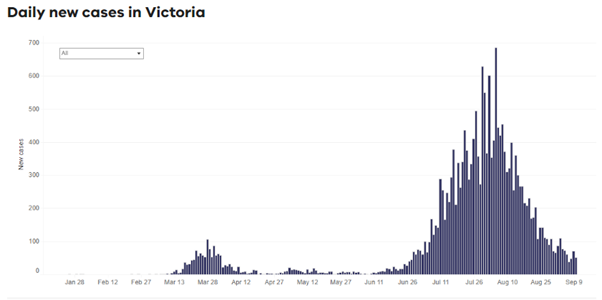
Source: Department of Health and Human Services, Victoria, dated: 10 September
JobKeeper hack that allows double-dipping
The part-time workers, i.e. the workers working for less than 20 hours a week on the new $750 a fortnight JobKeeper will be paid less than the new rate of JobSeeker Payment of $815 per fortnight as per the revamped scheme.
However, employees who had to stand in dole queues because of coronavirus lockdowns would be able to obtain JobKeeper and JobSeeker in few cases earning up to $1300 a fortnight if they work part-time under the scheme. This is even more than the $1200 JobKeeper for full-time workers though the base rate in wages would be topped up by the employer.
ALSO READ: JobKeeper Scheme to cost an extra $15 billion amid Victoria crisis
About 1 million people in Victoria who are counting on JobKeeper subsidy for their survival amid COVID-19 are being forced to also apply for the dole to top up their payments by up to $500 in a fortnight as the Federal government plans to slash the wage subsidy.
Morrison government is increasingly encouraging the double-dipping strategy to claim both JobKeeper and JobSeeker to assist workers who are struggling from the economic fallout of coronavirus and can lose hundreds of dollars when wage subsidy gets cut from 27 September. Workers are being persuaded to claim both JobKeeper and JobSeeker at a part-rate under the new rules.
ALSO READ: JobKeeper Lifting Returns for Investors: A Look at 6 ASX listed Stocks that benefitted
New scheme to act as a disincentive to find work?
One can earn either $750 a fortnight under JobKeeper or $815 a fortnight on the dole from October if he/she is a part-time worker. This raised concerns that some workers will not find working worth it now.
DO READ: A Push to GDP Estimates and Stocks centred around JobKeeper dependency
Prime Minister Scott Morrison rejected such claims and asserted that the revamped scheme would not act as a disincentive while looking for a job. He further added on the assumption that no one is doing any work must not be made. Treasury is clear that businesses that still need JobKeeper will give payments in addition to JobKeeper to the staff that is working for more hours and hence keeping industrial relations in place.
ALSO READ: All you need to know about JobKeeper Payment scheme
He added that the subsidy payments have provided big support to businesses and workers during the most challenging time of coronavirus, but the industrial relations flexibility given to employers has also helped them to keep people in jobs.
The new changes have been far more generous than the original JobKeeper payment that stood at just $550 a fortnight before COVID-19 hit Australia. JobKeeper Payment is paid directly to employers and not employees but claiming both the schemes (JobKeeper and JobSeeker) was not an actual choice until now.
The Federal government has also increased the amount an individual can earn to $300 a fortnight that is available to those on JobSeeker, with a taper rate lowering the welfare payments if one earns more. Workers can earn $300 without it affecting any of his/her JobSeeker payments.
However, beginning 4 August, the government is planning to reinstate shared responsibility in 2 stages, where people looking for job would be expected to re-connect to employment services and carry out 4 employment searches in a month. Hence, if there is a job on offer and there is a job to be taken, then it is the joint responsibility for the people on JobSeeker to take those jobs.
PM Morrison stated that assets test for eligibility for such payments and liquid assets waiting period will be re-established, and eased restrictions would be kept for sole traders for JobSeeker eligibility.
