
 AUS
AUS
 NZ
NZ
 UK
UK
 CA
CA
 USA
USA
 IND
IND






Summary
- RBA maintained the cash rate at 0.25% during its policy meeting conducted on 1 September, as the Australian economy has been coping with the economic fallout caused by coronavirus.
- RBA had launched an unlimited government bond-buying program, cheap funding facility for banks to lift the economy from coronavirus crisis, while maintaining accommodative settings as long as needed for the economy.
- Many activity indicators have started to pick up since May, but a rise in unemployment expectations, demand shortfall and Victoria’s second wave of coronavirus outbreak still pose significant uncertainty to the economic recovery of the country.
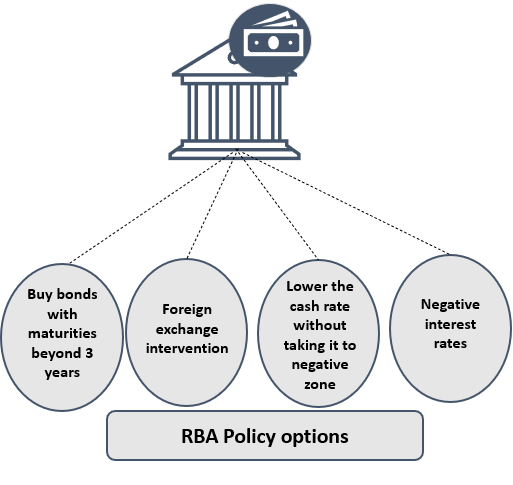
- Bond buying, foreign exchange intervention, lowering cash rate without taking it in a negative zone and negative rates were assessed as policy options by the Deputy Governor, RBA on 22 September during Australian Industry Group Virtual Conference.
The Australian economy is facing its first recession in 30 years with its economy shrinking by record 7% in the June quarter compared to a drop of 0.3% in the previous (March 2020) quarter as it continues to suffer from the economic fallout of the deadly virus.
However, the result could have been much harsher without massive financial support and loan payment deferrals for mortgages and business loans.
Also, the prolonged lockdown imposed to curb the resurgence of the virus in Victoria has severely hampered the economic growth of September quarter.
DO WATCH: Payroll Jobs Fall Further In Victoria | ASX Market Update
The length up to which the lockdown is imposed and the eventual withdrawal of fiscal support by the government would pose significant uncertainty on the economic recovery of the country.
DO READ: Victoria’s second wave of COVID-19 is pulling down jobs and consumer spending
The central bank has been taking several measures like lowering interest rates and expanding liquidity to support the Australian economy amid these challenging times.
Let's have a look at RBA's toolkit for the Australian economy.
RBA Keeps policy rate unchanged at 0.25%
Earlier, RBA slashed the cash rate to a record low of 0.25% in an emergency meeting in mid-March and left it intact at 0.25% in its regular monthly policy meeting, held on 1 September as the nation remains reeling under the pressure of coronavirus.
In the latest meet, the Board reaffirmed the following elements of the policy package, as notified before:
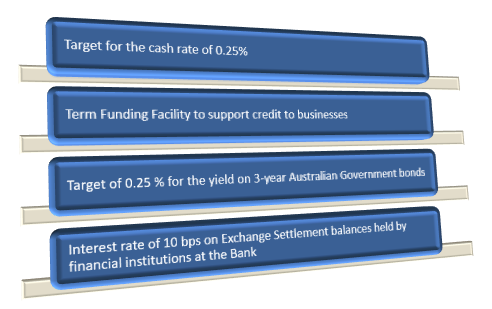
Source: RBA’s Monetary Policy MOM, dated 1 September 2020
Banks and other authorised deposit-taking institutions (ADIs) would now have the ability to gain access to more funding, corresponding to 2% of their outstanding credit at a fixed rate of 25 bps for 3 years.
Philip Lowe, RBA Governor, stated in the policy meeting that the economy was being supported by co-ordinated policy responses, including government spending and the same would be required for an extended period.
DO READ: RBA retains cash rate at 0.25% yet again; Majority of ASX indices ended in red
RBA asserted that it would stay committed to supporting jobs, businesses and incomes in Australia while maintaining an accommodative approach as long as needed by the economy. The Board reaffirmed that the cash rate would not be increased until the bank achieves its goals of full employment and inflation (within 2-3% target).
GOOD READ: RBA's Projection: What if the Cash Rate stays at 0.25 per cent for 3 years?
The Financial Effect of COVID-19
Deputy Governor of RBA, Guy Debelle addressed the Australian Industry Group on 22 September, discussing the existing state of the Australian economy, the monetary policy actions taken to support the economy and the policy options available whenever the economy needs it.
There is a huge discrepancy observed in coronavirus effects across countries when it comes to measuring the impact of coronavirus pandemic that led to a significant drop in output in Australia and around the world.
ALSO READ: Impact of Coronavirus on Australian Economy and Way Forward
The different factors behind varied consequences include the type and management of the virus outbreak in the country, behavioural response of people to the virus, and the share of the service sector in the economy, which has been shaken by the pandemic induced shutdowns.
Mr Debelle noted that several factors played a role towards Australia's output decline in the June quarter and are as follows:
- Household income increased, whereas GDP and employment suffered massive falls due to JobKeeper and JobSeeker income support provided by the government.
- Loan payment deferrals and JobKeeper payments supported business incomes, but business investment fell 4% in the June quarter due to a significant rise in uncertainty.
- Hours worked decreased by 10% during initial May, but rose by about 6% nationally afterwards, which is now being interrupted by Victoria lockdown.
- The unemployment rate surpassed expectations, falling to 6.8% in August from 7.5% in July.
Different monetary policy actions have been taken up by RBA that have resulted in a substantial rise in the size of its balance sheet from $170 billion in February to $300 billion currently.
ALSO READ: Unemployment rate slips to 6.8% in August, Beacon of Hope on Economic Charter?
The higher unemployment rate is expected ahead implying subdued wage growth, but many activity as well as recovery indicators, have started to show some recovery since May. The demand shortfall and the virus-induced lockdown in Victoria are expected to act as significant brakes on economic recovery.
RBA evaluating various policy options for economic recovery
Mr Debelle stated that the central bank had 4 policy options if the economy needed any further boost.
Source: RBA’s speech, dated: 22 September 2020
RBA was considering one of the options as buying of bonds with maturities, of more than 3 years to help reduce longer-dated government bond rates.
Foreign exchange intervention was another policy option that could be considered, but its effectiveness was not clear, given that the Australian dollar was supported with the basics.
DO READ: How increased spending support & cash rate at 0.25% would help the Australian economy?
AUD has been up by more than 3% in 2020 due to robust prices for its export iron ore, slumping US dollar and a better COVID-19 response in the country. RBA further added that a reduced exchange rate could be advantageous for the economy of Australia.
INTERESTING READ: Bond Yields Plummet Globally Amid Lower Interest Rates & US-China Trade Conflict
The third option included lowering the current structure of interest rates in the economy without entering into the negative zone, in terms of the target for government bond yields and the borrowing rate that RBA offers to banks from the current 0.25%.
HAVE YOU READ: Are negative interest rates being considered for a long haul - ASX 200 Shares to watch?
The last option comprised of negative rates, which RBA had discussed during many meetings previously. Further, Mr Debelle stated that the empirical evidence on the negative rate was mixed.
