
 AUS
AUS
 NZ
NZ
 UK
UK
 CA
CA
 USA
USA
 IND
IND







Highlights
- Bitcoin was invented to harness the potential of blockchain technology in the payments system and money transfers
- With time, the cryptocurrency began to be treated as a speculative investment asset, the value of which can change abruptly
- Only a handful of nations, including El Salvador, have made Bitcoin legal tender, while bigger nations like the US are wary of cryptocurrencies
Bitcoin has yet to be toppled from the top position in the cryptocurrency world by any altcoin. It is widely regarded as the first-ever blockchain-based cryptocurrency. From 2009 to now, Bitcoin, which was supposed to be ‘electronic cash’, has not been widely accepted as a form of money.
When the idea of Bitcoin was floated, its creator/s Satoshi Nakamoto pitched it as ‘electronic cash’, and not as any speculative asset. At that time, Bitcoin was neither considered an alternative to precious metals like gold nor to listed stocks. The cryptocurrency was considered an alternative to the current dominant form of money -- fiat currency. Notably, while the value of currencies like the US dollar or the AU dollar usually rises or falls by very small margins, the value of Bitcoin can change drastically over a short period.
Today, let us understand why and how the price of Bitcoin or that of any other cryptocurrency changes.
Speculative asset, not money
The way Bitcoin is functioning right now is in contrast to how Nakamoto envisioned it. Instead of being accepted widely in the payments system, the cryptocurrency has become a globally popular and controversial speculative asset. A listed stock is an example of a speculative asset. The price variation in such assets is a product of market sentiments, particularly buy-and-sell trade activities.
Its supporters hail Bitcoin as a medium of exchange that can reduce time and costs involved in payment transfers. The US dollar is considered a very critical participant in trade and commerce, thanks to the fiat currency’s near-universal acceptance.
Demand and supply
Bitcoin trades on specialised cryptocurrency exchanges, like listed shares do on stock exchanges. The value of Bitcoin is a product of how many people are willing to buy and sell it. The more the number of buyers competing and outbidding others, the more can be the price. When the demand falls, the value automatically falls. By this measure, the functioning of Bitcoin does not resemble the functioning of fiat currencies, but that of speculative assets.
On the other hand, most other speculative assets like gold and shares are usually less volatile than cryptocurrencies, including Bitcoin. This is why many also view Bitcoin as overly risky and prone to very deep losses. The reason is many experts believe that Bitcoin lacks utility as a medium of exchange and that it cannot also be compared to the listed stocks that represent a particular company engaged in some commercial activity.
Ultra-volatility of Bitcoin
Listed shares can sometimes be volatile, but cryptocurrencies can be overly volatile. The price of Bitcoin grew sharply in 2020 and 2021, but a sharp dip followed this in 2022. Speculative asset market sentiment has lately been weak due to rising interest rates, with stocks like Microsoft enduring losses. However, the loss in the value of Bitcoin is relatively very big. Events such as a company declaring the acceptance of Bitcoin in payments, can result in a limited rise in the cryptocurrency’s value. On the other hand, a negative comment by someone like Elon Musk can also trigger a broad sell-off of Bitcoin.
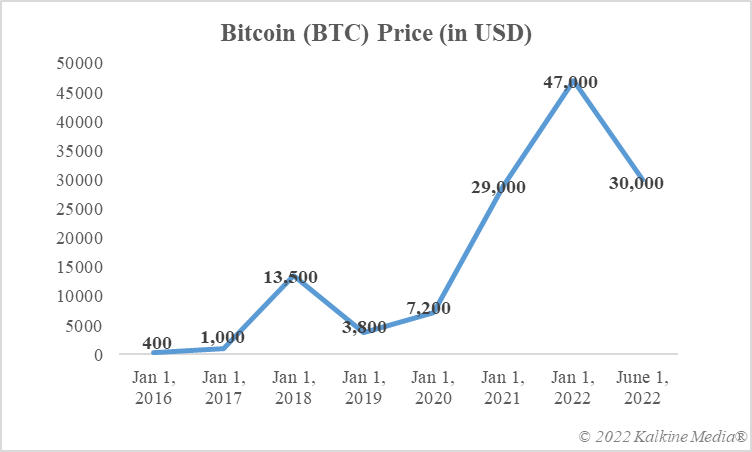
Data provided by CoinMarketCap.com
Bottom line
The answer to why the price of Bitcoin changes is that it is functioning as a speculative asset at the moment. How it changes depends on the mood of the market, with demand and supply forces deciding the price at any given time. Bitcoin has yet to be considered a stable medium of exchange by the broader financial world. Even the legalisation in El Salvador declaring Bitcoin as legal tender has invited criticism from various quarters, including the International Monetary Fund.
Risk Disclosure: Trading in cryptocurrencies involves high risks including the risk of losing some, or all, of your investment amount, and may not be suitable for all investors. Prices of cryptocurrencies are extremely volatile and may be affected by external factors such as financial, regulatory, or political events. The laws that apply to crypto products (and how a particular crypto product is regulated) may change. Before deciding to trade in financial instrument or cryptocurrencies you should be fully informed of the risks and costs associated with trading in the financial markets, carefully consider your investment objectives, level of experience, and risk appetite, and seek professional advice where needed. Kalkine Media cannot and does not represent or guarantee that any of the information/data available here is accurate, reliable, current, complete, or appropriate for your needs. Kalkine Media will not accept liability for any loss or damage as a result of your trading or your reliance on the information shared on this website.
