
 AUS
AUS
 NZ
NZ
 UK
UK
 CA
CA
 USA
USA
 IND
IND


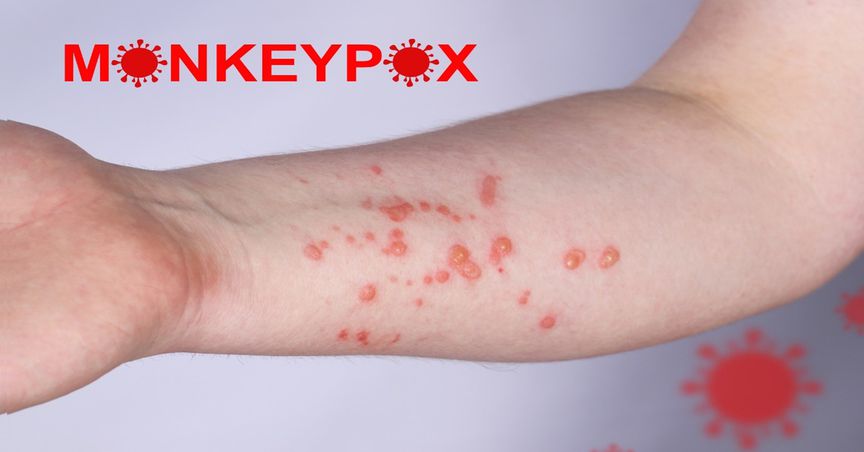





Highlights
- CDC has reported over 1,000 Monkeypox cases from 29 nations
- The United Kingdom has the highest number of total confirmed cases
- The first case of Monkeypox in human beings was recorded in the Democratic Republic of the Congo (DRC) in 1970
Cases of Monkeypox have been reported in several regions around the globe. Data from the Centers for Disease Control and Prevention (CDC) highlighted 1,019 confirmed Monkeypox cases from 29 countries, as of 6 June 2022.
The United Kingdom has the highest number of total confirmed cases (302), followed by Spain (198) and Portugal (153). The United States has 30 cases, while Australia has six confirmed cases.
Emergence in non-endemic countries
A rare but potentially serious viral illness, Monkeypox can be transmitted from person to person through direct contact with body fluid or monkeypox lesions. Other modes of transmission include respiratory droplets from prolonged face-to-face contact and contaminated materials such as bedding or clothing.
Typically, Monkeypox has headaches, muscle aches, fever or flu-like symptoms followed by a rash and lesions.
Many people with reported cases do not have a travel history to central or West African countries where Monkeypox is prevalent. The emergence of Monkeypox in numerous non-endemic nations at the same time shows that there may have been undiscovered transmission for an unknown period of time, followed by recent amplifier occurrences.
History of Monkeypox
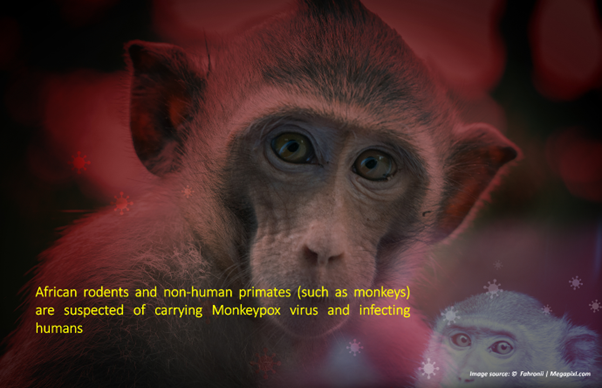
Monkeypox was first detected in 1958 when two outbreaks of a pox-like disease occurred in research colonies of monkeys. The first instance of Monkeypox in human beings was recorded in 1970 in the Democratic Republic of the Congo (DRC). Since then, the disease has been documented in humans in several countries of Africa, with the infections most common in the Democratic Republic of Congo.
Monkeypox's natural reservoir is yet to be discovered. African rodents and non-human primates (such as monkeys) are suspected of carrying the virus and infecting humans.
CDC recommended safety measures
CDC has issued a notice regarding the safety measures for Monkeypox. In general, travellers should avoid:
- Close contact with sick people and those with skin/genital lesions
- Contact with dead or living wild animals such as rodents and non-human primates
- Eating or preparing meat or meat products derived from wild animals from Africa
- Contact with infected things used by sick people
Further, a mask should be worn for protection
