
 AUS
AUS
 NZ
NZ
 UK
UK
 CA
CA
 USA
USA
 IND
IND







On 21 August 2019, clinical-stage drug development company Noxopharm Limited (ASX: NOX) pre-clinical evidence confirmed that its lead drug candidate Veyonda® has the potential to produce off-target responses known as an abscopal effect.
The company conducted a series of key proof-of-principle experiments in mice, investigating the interaction between radiotherapy and Veyonda® under its Direct and Abscopal Response to Radiotherapy (DARRT) trial treatment regimen.
In these pre-clinical studies, Noxopharm discovered that Veyonda® has the potential to create an abscopal response where radiation directed at a tumour in one part of the body leads to an anti-cancer response both in the irradiated tumour as well as in tumours elsewhere in the body, thereby putting forward a potentially transformative method of cancer therapy within the minimally intrusive, so far well-tolerated treatment regimen of DARRT.
This confirmation comes approximately one week before the expected release of key interim DARRT-1 clinical data from Noxopharm regarding the 12 patients in the second arm of the study, outlining the 3 months post-DARRT treatment impact on pain levels, PSA response rate and tumour response.
The bi-flank mouse model has been developed by the company along with Australian academic institutions, wherein tumours are grown on both sides of a mouse with only side receiving the radiation. The breakthrough observation of the model suggested that the combination of Veyonda® and radiotherapy to one side delivered an anti-cancer effect on both sides, consistent with what is known as an abscopal effect. CEO Dr Greg van Wyk said in the August 21st release that “…. Our work to date corroborates our belief that Veyonda® is enabling radiotherapy to kill more cancer cells”.
Noxopharm recently completed three years on the Australian Securities Exchange (ASX) since its listing in August 2016.
On the third listing anniversary of the company, Executive Chairman and Founder Dr Graham Kelly appeared in an FNN media interview to talk about the progress of Veyonda® and the plans for a proposed intention to seek a secondary securities exchange listing in the United States.
Dr Kelly commented: ‘…..It’s been an extraordinary three years.’
Talking about the performance of the company’s lead drug candidate Veyonda®, Dr Kelly stated that Noxopharm has now seen enough positive responses to now be convinced that the company has got a drug candidate that is going to be transformative.
The statement outlines the senior management’s confidence in the drug on the basis of encouraging interim clinical outcomes where an encouraging percentage of patients, who were in the last stages of their prostate cancer treatment journey, have responded well to the treatment, with many being successful in reaching progression-free over 6 months post-treatment in the study.
Regarding the funding facility, recently secured from the two New York-based institutional investors, Dr Kelly said, ‘….Drug development is a very hungry beast that needs to be fed constantly.’
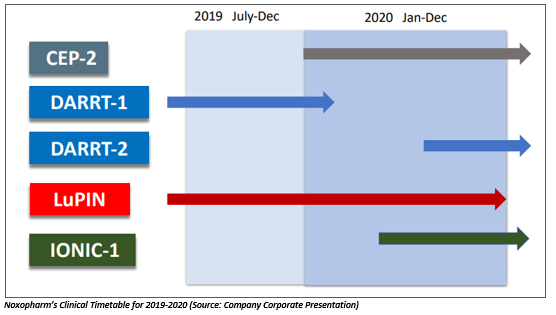
Dr Kelly also provided some important insights on the company’s capital utilisation plan. He said that Noxopharm intends to use the capital primarily for the next stage of clinical trials where two large studies are scheduled to be started next year.
Phase 2 of Direct and Abscopal Response to Radiotherapy (DARRT-2) is likely to include the use of Veyonda® in combination with external beam radiation in late stage prostate cancer, involving an even larger number of patients and hospitals.
Dr Kelly said that another major study would include CEP-2, involving the use of Veyonda® with chemotherapy in patients with a rare form of cancer called Sarcoma. This study is designed to include dose escalation and dose expansion arms, with standard three cycles of doxorubicin. There are very few treatment options for sarcoma patients.
The overall objective of the company’s CEP Program (Chemotherapy Enhancement Program) is to demonstrate that Veyonda® plus a standard chemotherapy can improve efficacy and/or achieve the same efficacy with a reduced, safer and well-tolerated chemotherapy dose.
These two major studies, DARRT-2 and CEP-2, are planned to be followed by a third smaller study possibly using Veyonda® in combination with an immuno-oncology drug, said Dr Kelly.
The company has planned to discuss a range of potential trial designs with world-renowned nuclear medicine physicians and oncologists in the U.S. and Australia at upcoming advisory boards, scheduled to be held in Q3 2019.
In a recently released August corporate presentation, Noxopharm once again touched upon the latest way of fighting cancer that is ‘killing cancer with our own immune cells’. But the biotech informed that in case of solid cancers, the challenge in using the body’s immune system to fight the cancer is that the cancer cells either have eliminated all immune cells from the tumour or switched off their cancer-fighting ability. These kinds of tumours are called COLD tumours.
To make the current immuno-oncology (i-o) drugs potentially work better in more people and more cancers, first the COLD tumours are required to convert into a HOT tumour. As per Noxopharm’s July Newsletter, this potential conversion, believed to be associated with amplifying the so-called STING mechanism, potentially could have the ability to boost the efficacy of current i-o (checkpoint-inhibiting drugs) (Versatility Newsletter July 2019)
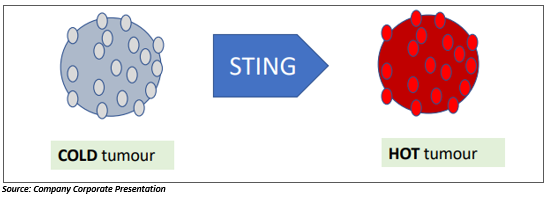
As per the company, this potentially positions Veyonda®, which is a suppository dosage form of the active compound idronoxil (IDX), as a dual-acting cytotoxic and immuno-oncology molecule.
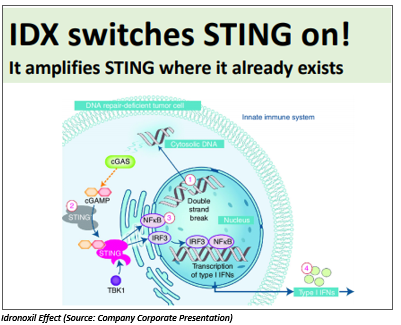
As per the Company, the competitive advantages of idronoxil include:
- IDX does not trigger STING; rather it amplifies STING where it already exists.
- IDX relies on the presence of ‘self-DNA’ to amplify STING, not on foreign DNA, thereby limiting its effect to cancer cells.
- IDX is not a bacterial or viral cyclic nucleotide and therefore should not induce a potentially fatal ‘cytokine storm’ syndrome associated with debilitating treatment side-effects. Veyonda® has proven to be well-tolerated in clinical trials to-date.
- IDX up-regulates both the adaptive and innate immune system: Natural Killer (NK) cells, monocytes, CD4+ (Helper T cells), CD8+ (cytotoxic T cells).
- IDX is not restricted to being injected into a single tumour. It can be given systemically via Veyonda®, giving it the chance to reach all tumours.
Discussing the significant Board changes, Dr Kelly explained that the business requirements of the company have made him shift to the role of Executive Chairman, where he is focusing more on the proposed intended dual listing of Noxopharm on a US Securities Exchange. He further mentioned that the new CEO, Dr Greg van Wyk, has been a senior medical director in a large pharmaceutical company and has the experience to bring Noxopharm from where it is now to its commercial end point.
Noxopharm projects a notable flow of news pieces and trial updates, given the structuring of clinical trials program. Dr Kelly stated ‘Typically, when you engage in clinical studies, you enter long periods of cones of silence. But we (Noxopharm) deliberately plan out our trials so that there are interim reporting points, and that's primarily the news flow that we will be getting over the next 12 months.’
NOX stock is currently trading at $0.420 on 26 August 2019 (12:44 PM AEST).
Also Read: A Lens On Noxopharm’s June 2019 Quarterly Results
Disclaimer
This website is a service of Kalkine Media Pty. Ltd. A.C.N. 629 651 672. The website has been prepared for informational purposes only and is not intended to be used as a complete source of information on any particular company. The above article is sponsored but NOT a solicitation or recommendation to buy, sell or hold the stock of the company (or companies) under discussion. We are neither licensed nor qualified to provide investment advice through this platform.
