
 AUS
AUS
 NZ
NZ
 UK
UK
 CA
CA
 USA
USA
 IND
IND







Highlights
- XRT ore sorting, conducted by TOMRA, successfully separated mineralised material into product and waste streams at the Linka Tungsten Project.
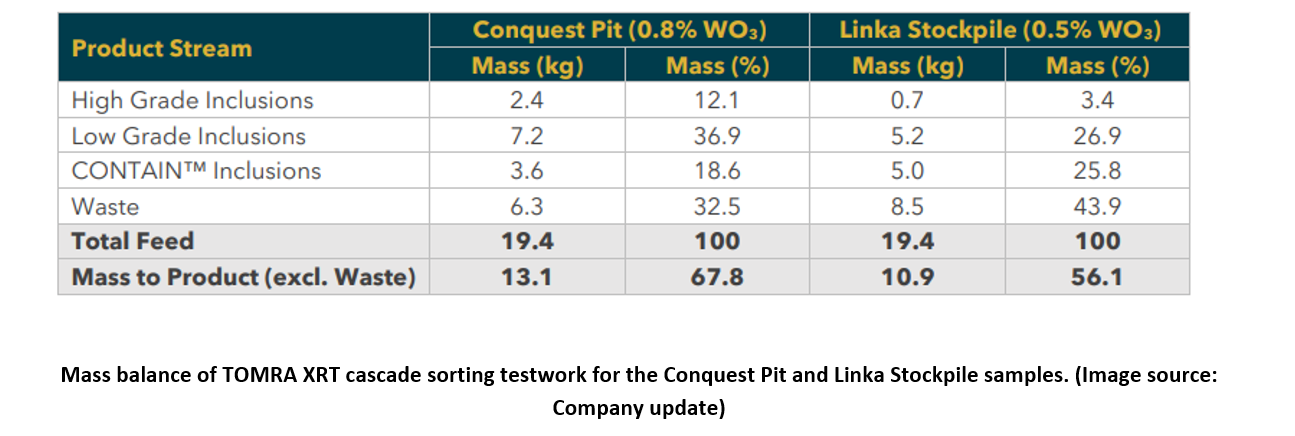
- Approximately 8% of the Conquest Pit feed and 56.1% of Linka Stockpile feed reported to product streams during sorting trials.
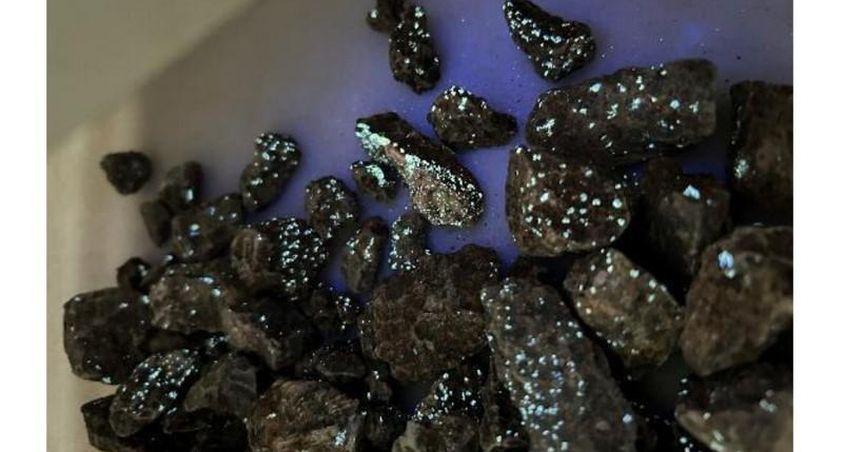
- Visible scheelite was confirmed in the high-grade product fraction from the Conquest Pit sample.
- The testwork deployed TOMRA’s new CONTAIN™ deep-learning software within a three-stage cascade sorting process.
- Product fraction assays are expected in July 2026.
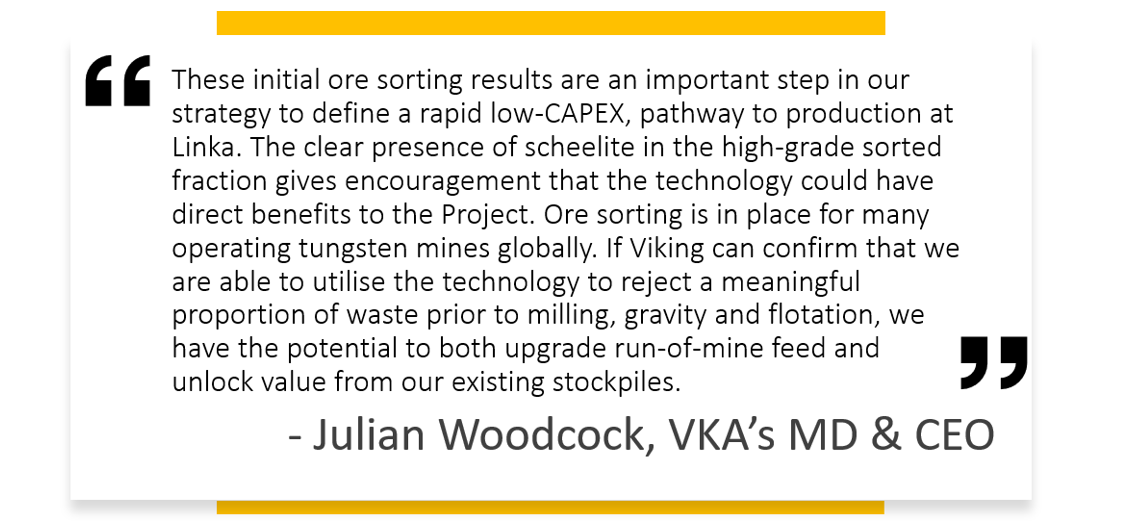
- Ore sorting could support higher plant feed grades and stockpile upgrading as part of Viking's proposed 300,000-tonne-per-annum Linka processing strategy.
Viking Mines Limited (ASX:VKA) (OTCID:VKALF) has reported positive initial results from X-ray Transmission (XRT) ore sorting testwork conducted by TOMRA on mineralised material from its Linka Tungsten Project in Nevada, USA. The testwork on two samples separated mineralised feed into discrete product and waste streams. Assay results from the product fractions are expected in the second half of July 2026.
Advanced Ore Sorting Technology Put to the Test
The ore sorting program was carried out at TOMRA’s Test Center in Wedel, Germany, using approximately 19.4 kg samples each from the Conquest Pit and Linka Stockpile. The material was crushed and screened to a size range of 10 mm to 40 mm to evaluate its suitability for sensor-based pre-concentration.
The testing employed XRT technology, which distinguishes material based on atomic density. The technology is particularly suited to detecting scheelite, a tungsten-bearing mineral, because tungsten's high atomic density enables it to absorb X-rays more effectively than surrounding waste rock and appears as dense, distinct inclusions in XRT images.
Deep-Learning Software Enhances Detection
The testwork incorporated TOMRA’s newly launched CONTAIN™ software, a deep-learning module designed to identify mineralised inclusions within host rock particles. The software was deployed alongside TOMRA’s established OBTAIN™ detection technology.
Both samples were processed through a three-stage cascade sorting system. The first stage targeted high-grade inclusions, the second focused on lower-grade inclusions, while the third stage used the CONTAIN™ module to recover additional inclusion-bearing particles. The process generated four output streams comprising High Grade Inclusions, Low Grade Inclusions, CONTAIN™ Inclusions, and Waste.
Product Streams Generated from Both Samples
Results from the Conquest Pit sample reported 67.8% of the feed mass, with the remaining material classified as waste. Examination under ultraviolet light confirmed the presence of visible scheelite within the high-grade product fraction. For the Linka Stockpile sample, approximately 56.1% of the feed mass reported to product streams.
The sorted fractions have been returned to the company's metallurgical laboratory in Canada for independent analysis. Product fraction assay results are expected during the second half of July 2026 and will determine the grade and recovery performance achieved by the sorting process.
Potential Applications for the Linka Project
According to Viking, ore sorting may offer two potential pathways for enhancing the Linka Tungsten Project -
- pre-concentration of run-of-mine feed to lift plant feed grade and
- upgrading of existing grade stockpiles.
These initiatives form part of Viking's broader metallurgical program and will be incorporated into the conceptual processing flowsheet being developed by Mineral Technologies for a proposed 300,000-tonne-per-annum processing model.
Next Phase of Evaluation
Following the receipt of assay results, Viking plans to evaluate ore sorting effectiveness and quantify recovery and grade performance.
Additional work is expected to include assessing ore sorting applications for stockpile material, conducting gravity and flotation testwork on sorted products through Base Met Labs, reviewing the project's conceptual processing flowsheet, and obtaining equipment quotations from TOMRA.
VKA shares were trading at AUD 0.010 per share, up 5%, at the time of writing on 18 June 2026.
