
 AUS
AUS
 NZ
NZ
 UK
UK
 CA
CA
 USA
USA
 IND
IND








An emerging leader in cancer immuno-oncology, Imugene Limited (ASX: IMU) is a clinical stage biotechnology company seeking to develop a range of novel immunotherapies to enhance the efficacy of cancer treatments.
Imugene has released its Quarterly Activities and Quarterly Cash Flow Report for the June 2019 quarter on 26 July 2019. The company achieved several milestones in the quarter that included presenting four presentations at the AACR conference on its B-cell vaccine programs, adding new members - Dr Jens Eckstein and Dr Lesley Russell to the Board as Non-Executive Directors, presenting updated and positive data of its HER-Vaxx cancer vaccine at the prestigious ASCO annual meeting and ESMO World Congress on Gastrointestinal Cancer, and announcing new positive clinical data from the Phase Ib study of the companyâs HER-Vaxx cancer vaccine.
The company currently has a strong financial position (with a cash balance of $~19 million as at 30 June 2019) and is well funded to support its clinical program. Imugene spent ~$1.3 million on research and development during the period and is expected to further spend $7.5 million in the next quarter.
Today, the company also announced that its Chief Technology Officer, Dr Nick Ede, will present a business update at the 15th Bioshares Biotech Summit (26th â 27th July 2019) held in Queenstown New Zealand. Bioshares Biotech Summit is organised annually by Bioshares, and attracts pharmaceutical licensing executives, biotech CEOs, retail investors and fund managers from around the world.
Key Insights from Bioshares Presentation
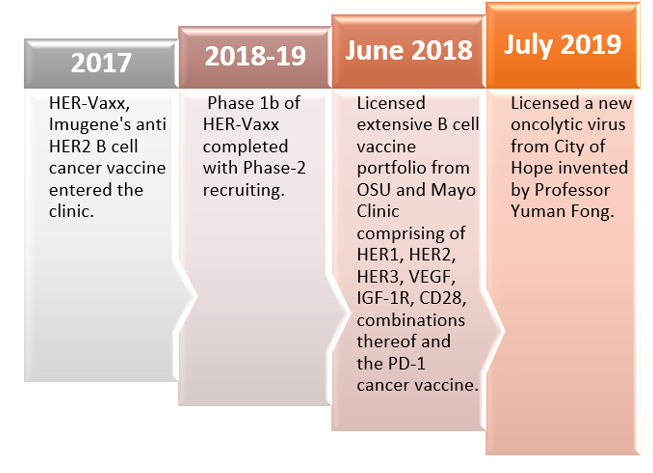
Imugene is focused on targeting B-cell peptide vaccines that enable a patientâs immune system to recognise and destroy cancer cells. The companyâs B-cell vaccine based technology was originated from the Medical University of Vienna.
Imugeneâs Product Pipeline
The company has a developing pipeline of products that includes several immunotherapy B-cell vaccine candidates that seek to harness the bodyâs immune system to generate polyclonal antibodies, potentially achieving a similar or greater effect than existing commercialised monoclonal antibody therapies. Recently, Imugene also announced its intention to expand its product portfolio through the acquisition of the exclusive licence to the oncolytic virus CF33. The addition of CF33 to the product portfolio has the potential to add substantial value to the company if clinical trials deliver positive results.
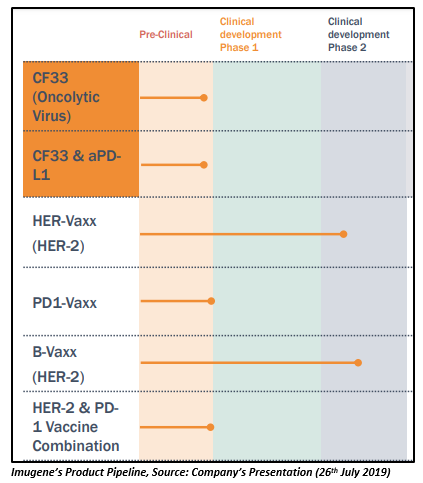
Let us know more about Imugeneâs products in some detail below:
CF33 (Oncolytic Virus)
The big pharma companies are paying serious attention to the oncolytic viruses that are an emerging form of immunotherapy. In 2018, companies like Boehringer Ingelheim, Merck & Co and Janssen Biotech had made three acquisitions totalling over $1 billion. This includes acquisition of Viralytics by Merck & Co for AUD 502 million, Vira Therapeutics by Boehringer Ingelheim for AUD 340 million and BeneVir Biopharm by Janssen Biotech for AUD 200 million.
Imugene will expand its oncology program by acquiring Vaxinia Pty Ltd and obtaining a license from the City of Hope comprehensive cancer centre for an oncolytic virotherapy, CF33.
The oncolytic virus, CF33, is a large enveloped virus that contains a double stranded DNA genome and belongs to the Poxvirus family. Developed by Professor Fong at the City of Hope Cancer Centre in Los Angeles, it has shown strong anti-tumor responses in preclinical studies and is poised to enter Phase 1 clinical trials in 2020.
Key Outcomes of Pre-Clinical Studies
CF33 has shown inhibition of tumor growth in nearly all NCI60 models in Triple Negative Breast Cancer (TNBC), Lung, Pancreatic etc. The pre-clinical data of the CF33 virus has demonstrated that it can shrink multiple types of cancer at a low dose.
In TNBC, CF33 has proven safe in mice that were treated with both intratumoral virus and IV. The key outcome of the study was that the virus worked at a dose of 2-5 orders of magnitude that was lower than the doses used for competing oncolytic viruses.
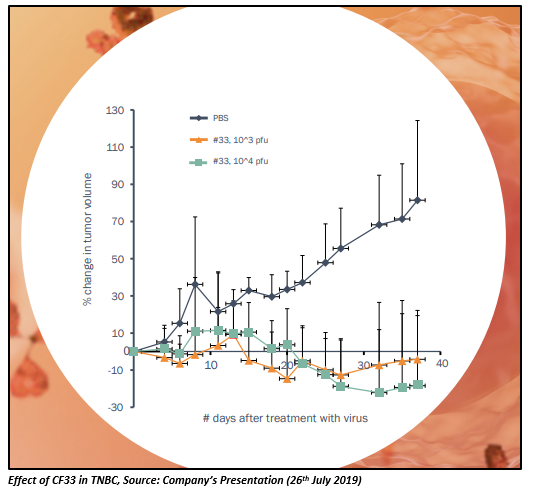
The presentation highlighted that several studies have been completed to-date with CF33 as well as some of the derivatives. The oncolytic virus has been proven very safe in immunocompetent mice and in nude mice with no viral shedding in blood or urine found. In the data published in Journal Translational Research, there were no signs of illness found in animals; rather they ate well and gained weight.
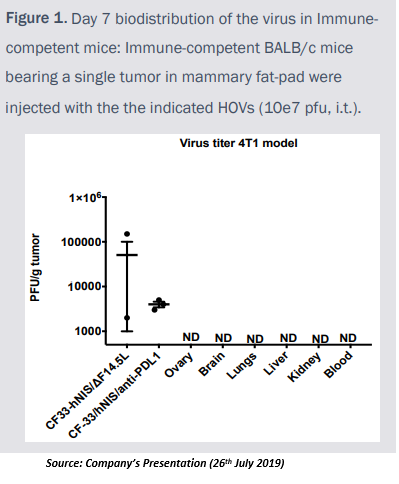
More than 500 mice have been treated in total with derivatives from the back bone and over 50 mice have been treated without any signs of toxicity with doses up to 10E7 IV and IT. No virus was detected by PCR in BALB-C mice at day 7 in any other organ, while it was detected in the tumor.
Signs of increased tumor growth inhibition were seen with CF33 + anti PD-L1. The pre-clinical studies showed that the cancer growth inhibition was better with the combination in comparison to Amgen or Genelux oncolytic virus. The presentation mentioned that CF33 and anti PD-L1 potentially solves the industry problem of additive toxicity of combined checkpoint inhibitors if the safety of CF33 is maintained in combination.
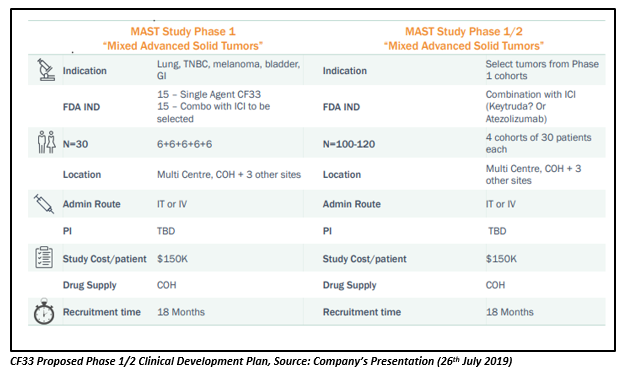
Imugene has proposed the following development plan for CF33âs Phase1/2 clinical development phase:
HER-Vaxx or IMU-131 (anti-HER-2)
HER-Vaxx is the Imugeneâs most progressed immunotherapy treatment from a clinical perspective which focuses on cancers that have an over expression of HER-2. It is a B-cell vaccine that seeks to stimulate patientsâ B cells to generate antibodies that target cancer cells with HER-2 on their surface. It is composed of 3 epitopes from the extracellular domain of HER2/neu conjugated to CRM197.
Imugene completed the Phase Ib clinical trial of HER-Vaxx in 2018 that focused on patients with gastric cancer. After meeting all the endpoints from Phase Ib study, Imugene commenced a Phase II clinical trial in March this year, which is likely to be completed in mid-2020.
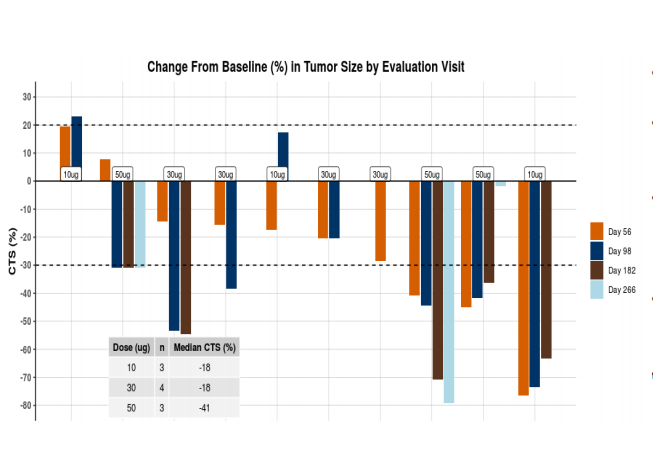
The Phase Ib study of HER-Vaxx involved 14 patients that were dosed with three different dosage levels of 10, 30 and 50 micrograms. Out of these fourteen patients, one patient showed a complete response, five patients showed a partial response with a reduction in the tumor by more than 30 per cent, four showed a stable response with less than 20% change in the size of the tumor and one showed progressive disease. The preliminary response data showed that 50 µg of IMU-131 was associated with tumor size reduction, which is now being used in a phase 2 study.
The results were promising with an increased antibody response across all dose levels and no safety issues. The trial demonstrated that the treatment was well tolerated with no significant reactions and no dose-limiting toxicities.
Source: Companyâs Presentation (26th July 2019)
The Phase II study of HER-Vaxx will target the patients with HER2-positive metastatic gastric cancer, measuring the response of up to 70 patients. The patients will be randomised into two groups - HER-Vaxx in combination with standard of care chemotherapy and Standard chemotherapy alone.
Imugene has also presented its HER-Vaxx data at key conferences in 2019, including American Association for Cancer Research, ESMO World Congress on Gastrointestinal Cancer, American Society of Clinical Oncology and Gastrointestinal Cancers Symposium in 2019 with a proactive approach to business development and brand awareness.
B-Vaxx (anti-HER-2)
B-Vaxx is a well-advanced B-cell vaccine that targets HER2-positive cancers. The vaccine has delivered positive Phase 1 results and is currently undergoing Phase 2 development. It is fully funded by the Ohio State University grant.
PD1-Vaxx (anti-PD-1)
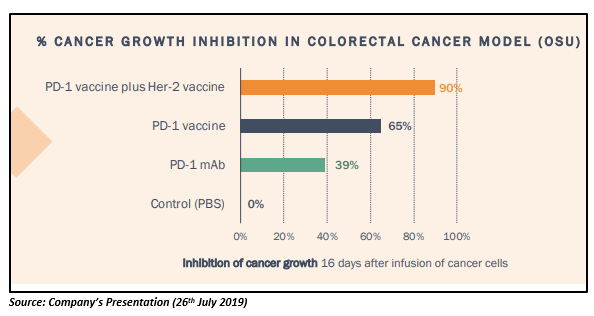
Another B-cell vaccine, PD1-Vaxx seeks to stimulate the body to generate polyclonal antibodies that obstruct PD-1 signalling. The vaccine has also shown encouraging response in preclinical studies with a strong inhibition of tumor growth in mouse models of colorectal cancer. When co-administered with B-Vaxx, the vaccine showed signs of increased tumor growth inhibition.
HER-2 & PD1 Vaccine Combination
The combination of HER-2 & PD1 Vaccine has shown 90 per cent cancer growth inhibition in colorectal cancer model in pre-clinical studies. PD1-Vaxx, when combined with the B-Vaxx agent, potentially solves the industry problem of additive toxicity of combined checkpoint inhibitors if the safety of vaccines maintained in combination.
A report published by Bioshares on Imugene and its oncolytic virotherapy CF33 license mentioned that Imugene will continue the development of its existing programs that include HER-Vaxx, PD1-Vaxx, B-Vaxx and a HER2/PD1 combination vaccine. As per the report, Imugeneâs recently proposed acquisition of Vaxinia and license of CF33 has the potential to create significant shareholder value, transform the company and potentially eclipse the value of its existing programs.
Stock Performance
Imugeneâs stock soared by 8.33% (as at 11:05 AM AEST, 29 July 2019), trading close to its 52-week high value at AUD 0.026. IMU has delivered a return of 33.33 per cent on a YTD basis.
Disclaimer
This website is a service of Kalkine Media Pty. Ltd. A.C.N. 629 651 672. The website has been prepared for informational purposes only and is not intended to be used as a complete source of information on any particular company. The above article is sponsored but NOT a solicitation or recommendation to buy, sell or hold the stock of the company (or companies) under discussion. We are neither licensed nor qualified to provide investment advice through this platform.
