
 AUS
AUS
 NZ
NZ
 UK
UK
 CA
CA
 USA
USA
 IND
IND







In a move that was surprising for all, German retail sector giant, Kaufland announced on 22 January 2020 that it will move out of the Australian market in order to concentrate more on its European operations.
With a substantial investment made in the country in terms of both time and capital, the shocking update by Kaufland has made the regulators and industry experts believe there could be more to it than meets the eye. The competition regulator, Australian Competition and Consumer Commission (ACCC) has announced that it will probe the allegations surrounding the exit.
Overview of Kaufland
Kaufland, a subsidiary of the Schwarz Group, is an international grocery chain headquartered in Germany. The company has operations in eight countries including Germany, Romania, Bulgaria, Czech Republic, Slovakia, Republic of Moldova, Croatia and Bulgaria.
Kaufland employs ~130,000 people and has around 1,300 branches.
Plans to foray into the Australian retail market
Schwarz Group, the parent company of Kaufland, requested for Kaufland trademark in Australia in November 2016, and market experts speculated its plan to enter the Australian retail market. The company set up its Australian website in March 2017 and acquired its first site for ~$25 million in October 2017.
The intentions of the company were palpable when it started and continued recruiting throughout 2018 and even began building a Victoria-based distribution centre for $450 million in 2019. Kaufland made further investments through other site acquisitions. Back then, it had plans to open ~20 stores in the country. In total, the company had invested ~$500 million in Australia before its decision to pull out. In fact, just a week before the announcement, the company’s directors approved a $100 million capital infusion from its parent company.
Potential reasons for exit
In its statement dated 22 January 2020, Kaufland said that it would be exiting the Australian market and cited increased focus in the food retail industry in Europe as the reason behind the decision. Retail industry experts, however, believe there were other reasons as well that led to the unexpected decision. Some of the key reasons are highlighted below:
- Timing of the planned entry: Industry experts believe that the company’s strategy to enter the Australian market was ill-timed given the challenges that the retail industry is facing at a global level. These challenges include the threat from the ever-growing online retail industry and growing pressure to keep the prices in control;
- Australian market: The retail industry has been struggling due to the drought in the country and more recently, due to the bushfires. The current scenario has led to an increase in prices driven by limited supply;
- Barriers to entry: Industry leaders Coles Group (ASX:COL) and Woolworths Group (ASX:WOW), through their existing long-term contracts with producers and suppliers of dairy products and meat, make it extremely difficult for a new player to capture significant share in the retail space;
- Geography-specific challenges: Australia is the sixth-largest country in the world while it stands at the 55th position in terms of population. Finding ideal locations for its stores and the distribution channels in this large country with a small population is a tedious task;
- Changes in the market scenario in the last couple of years: Market conditions have worsened over the previous 2-3 years period, and the strategies that the company had at the start of 2016 might not be relevant in the current scenario. Some consultants are of the opinion that Kaufland would have had to wait much longer to generate returns they were probably expecting in 3-4 years after entering the Australian market;
- Performance in Europe: Some analysts noted that the company’s European operations were performing below expectations that could have been the reason it wanted to focus solely on Europe.
Impact of the exit
The Australian retail sector is dominated by Coles and Woolworths, with Aldi and Metcash (ASX:MTS) being the other major players. The latter two have been posing a significant challenge to the market leaders, especially in South Australia, and the competition could have intensified further with the arrival of Kaufland. The German retailer’s decision is likely to have both positive and a negative impact on the various stakeholders in the retail industry.
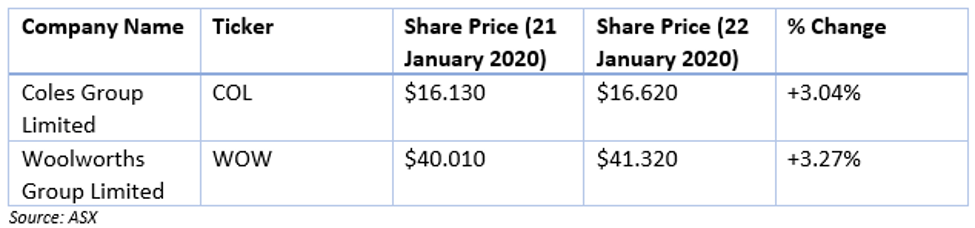
Favourable move for existing players: As is the case in any industry, the withdrawal of a potentially strong player in the market favours the existing players. This is because with more competition, there is a higher chance of losing your customers to other players who either offer better products or better concessions. Kaufland, being a significant player, would have been able to set a strong base in the country, thus capturing customers from other players. The positive impact was evident with shares of both Coles and Woolworths going up by over 3% on 22 January 2020, the day when the announcement was made.
Negative impact on customers: With Kaufland’s decision, any chances of a fall in current food prices due to an increase in competition have died. The customers, thus, will be at a loss, especially because the food inflation has been on the rise. As a matter of fact, the company’s exit from the Australian market has put further pressure on food inflation.
Could there be more to it than we know so far?
Though analysts and experts have assessed the market scenario and have come up with potential reasons for Kaufland to reverse its decision, there have been allegations that Australian distributors and manufacturers were hesitant in supplying fruits and vegetables as they feared it would affect their business relationship with the leading retail players. It was also claimed that the larger retail industry players compelled the suppliers not to engage in the business activities with Kaufland.
The ACCC chairman, Mr Rod Sims has promised that the regulators would investigate the matter and asked for assistance from parties who are aware of any such agreement between the suppliers and retailers. Mr Sims believes that such partnerships will potentially give rise to the formation of cartels that could disrupt the dynamics of the industry.
Whether or not there is any truth in the allegations, we will only find out once the ACCC concludes its investigation.
